

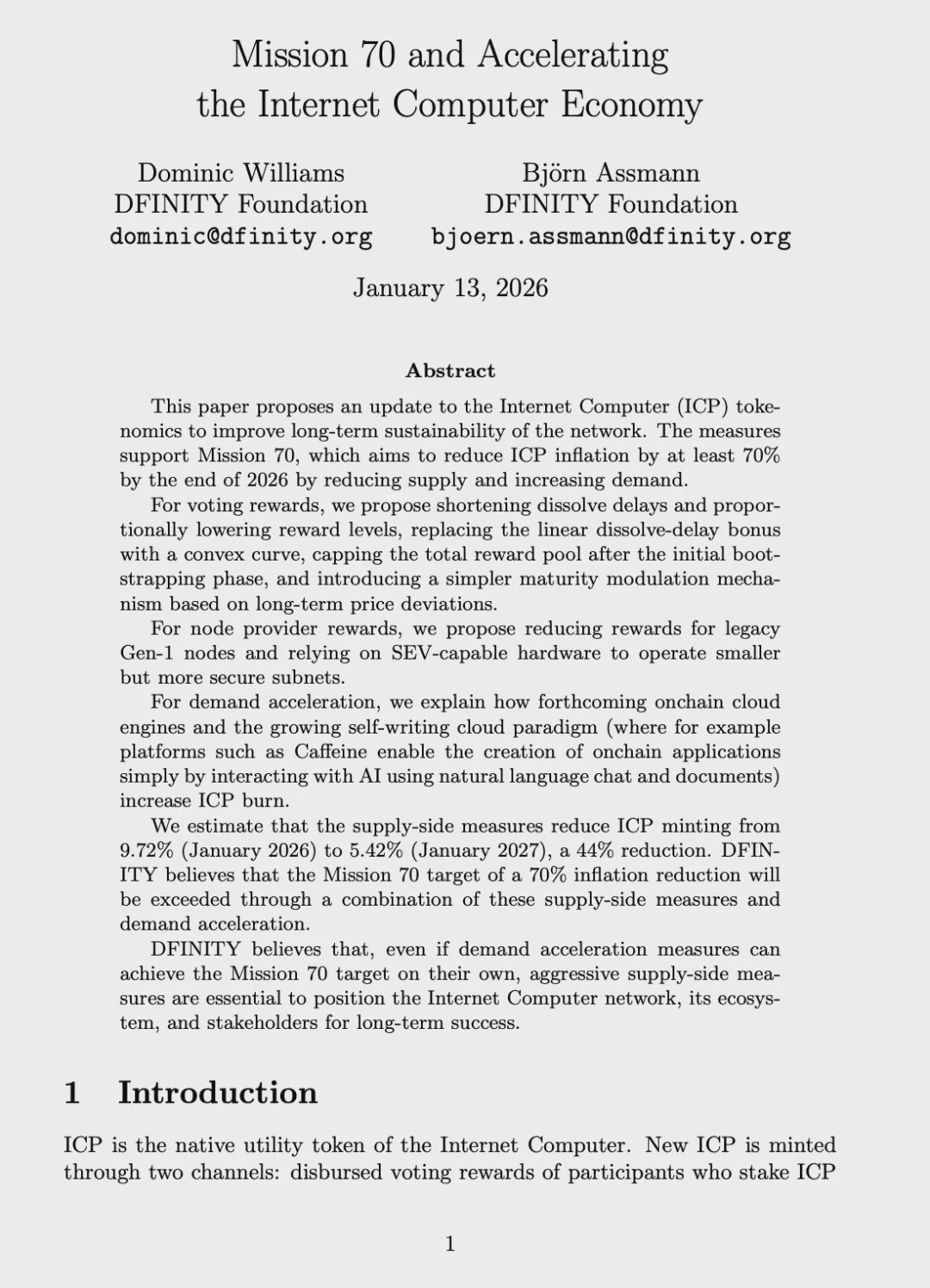
On January 14, the DFINITY Foundation officially released a new tokenomics white paper called 'Mission 70', proposing an extremely aggressive deflationary plan: to reduce the inflation rate of ICP by 70% by the end of 2026.
After the announcement, the ICP price performed strongly, with an intraday increase exceeding 30%, leading the market. This is not just simple emotional speculation, but a repricing of the fundamentals of Internet Computer.
For DFINITY, which harbors the ambition of 'reconstructing the internet', this is not only an adjustment of the economic model but may become a turning point for ecological development. It is attempting a high-difficulty 'economic surgery' to make a daring leap from 'money-burning infrastructure' to 'self-sustaining value engine'.
Shifting from subsidy expansion to a deflationary era, aiming to reduce the inflation rate by over 70%
This brand new white paper was personally crafted by founder Dominic Williams; it does not resemble an ordinary project update but more like a 'fiscal tightening bill' aimed at all token holders.
The core objective of this plan is to reduce the new issuance of ICP tokens, namely the nominal inflation rate, by 70% or more through dual levers of 'supply reduction' and 'demand increase' within 2026, pushing ICP towards deflation.
ICP's current annualized inflation rate is approximately 9.72%, mainly from two major 'bleeding points' on the supply side: governance voting rewards (5.88%) and node provider incentives (3.84%). This is like a machine that continuously prints money, diluting the asset value of early participants.
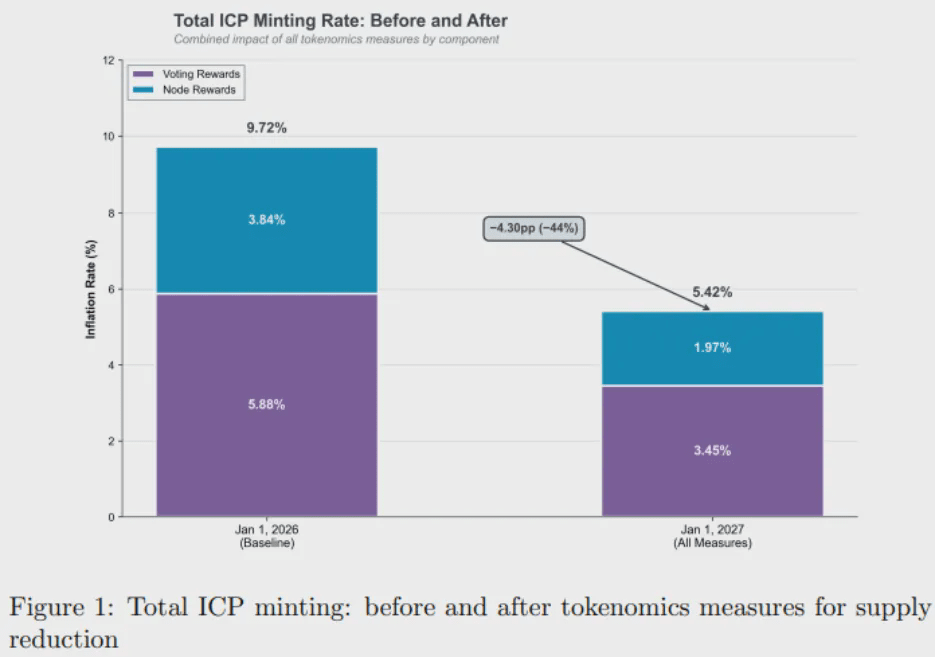
The Mission 70 proposal first 'stanches the bleeding' on the supply side, by modifying the incentive parameters of the NNS (Network Nervous System), is expected to achieve a 44% 'absolute token reduction amount'. The logic of this model lies in sacrificing part of the nominal yield to exchange for lower inflation and higher asset scarcity, thus ensuring the long-term scarcity of the tokens, which is essentially a deep value game.
The white paper points out that while reducing voting rewards short-term lowers the nominal yields for stakers, by increasing token value and reducing circulation pressure, the risk-adjusted returns for long-term holders may actually be optimized due to reduced liquidity risk.
Additionally, the reduction in node incentives is based on improvements in provider operational efficiency and the multiplier effect brought by rising ICP prices: when ICP prices increase, the amount of ICP needed to issue to pay the equivalent fiat value of node fees will be reduced.
Relying solely on supply-side 'throttling' makes it difficult to achieve the total reduction target of 70%. To fill the remaining 26% reduction target, DFINITY is betting on the AI track, developing a demand expansion strategy around the 'Caffeine AI' platform.
Caffeine is positioned as the world's first commercial 'self-writing internet' platform, relying on on-chain large language models (LLM) to enable natural language programming (NLP), allowing non-technical users to directly develop, deploy, and run full-stack applications on ICP through text descriptions, aiming to transform internet users from mere consumers into active builders.
In the economic model, all network behaviors driven by Caffeine, such as computation and storage, will consume 'Cycles'. Cycles are the unit used in the ICP ecosystem to quantify and compute storage resources, representing the cost of executing a single instruction, created by destroying ICP.
DFINITY aims to attract more AI models and enterprise-level cloud engines to run directly on ICP, burning Cycles on a large scale through these applications with high computing and storage demands, thereby creating a sustainable deflationary effect on ICP.
This also means that ICP's value capture will no longer depend on speculation but will be directly linked to the real demand for decentralized AI computing worldwide.
Related reading: DFINITY Foundation bets on AI, how can Caffeine drive ICP's surge?
The underlying logic of this economic operation is DFINITY's precise judgment of its development stage: the subsidy expansion period has ended, and it must enter the value capture period. It attempts to address the value dilution problem most criticized since ICP's inception, shifting market attention from inflation to actual on-chain resource consumption.
Active development ranks second globally, creating three major competitive barriers.
The market is often easily confused by price fluctuations; DFINITY's major economic reform is built on a solid technological foundation, and the activity level of the codebase is usually the most objective visible indicator of a project's long-term viability.
CryptoMiso data shows that in the past 12 months, Internet Computer's GitHub submissions reached 4,185, ranking second among all blockchain projects globally, ahead of established public chains like Bitcoin, Ethereum, and Solana.
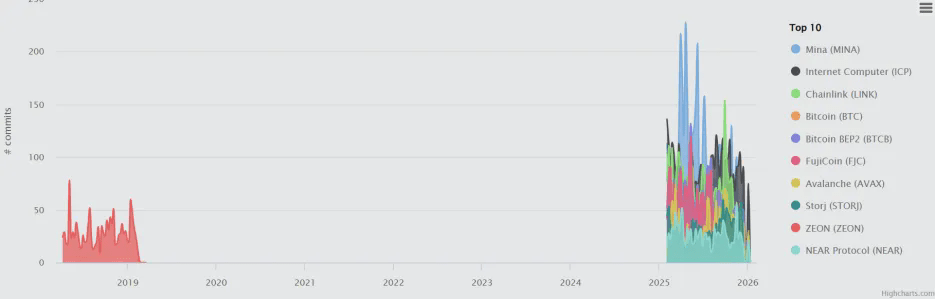
This high-intensity development pace mainly stems from the large development team of the DFINITY Foundation, and this development activity is not blindly piled up, focusing on:
Subnet expansion: A series of upgrades in 2025 will increase the storage capacity of subnets to 2 TiB and introduce dynamic load balancing, significantly enhancing the network's ability to process massive data.
Wasm execution efficiency optimization: Continuously pushing the performance limits of WebAssembly, allowing ICP to execute complex smart contract calculations at near-native speeds.
Threshold cryptography iteration: Continuously strengthening Chain Fusion technology, enabling ICP contracts to directly manage native assets of external public chains like Bitcoin, Ethereum, and Solana without going through riskier cross-chain bridges.
The high active development rhythm and ongoing technical deliveries indicate that despite the market cycle's ups and downs, the developer community of ICP has not dissipated but is instead steadily advancing towards the goals set by the DFINITY Foundation.
And these technological accumulations are precisely the foundation for DFINITY to dare to launch an 'economic operation'.
With the iteration of technological architecture, Internet Computer has evolved from a purely L1 chain into a cloud platform with sovereign computing capabilities. In the fierce market competition, its competitive advantages mainly lie in three dimensions:
First, consolidate the practical capabilities of on-chain AI; Internet Computer is one of the few public chains that can natively run AI inference models, unlike other projects that run AI off-chain and return results through zero-knowledge proofs (ZKP), it can directly load neural network models, making this advantage difficult to replace against the backdrop of the explosion of AI+Web3.
End-to-end encryption and privacy: Internet Computer has achieved encrypted storage of sensitive data on-chain to ensure that AI models cannot be viewed by node providers when processing users' private data.
Cost-effectiveness: The integrated cost of running AI inference on Internet Computer is over 20% lower than traditional SaaS giants like Palantir, giving it strong commercial competitiveness in the decentralized machine learning (DeML) field.
Secondly, building a seamless interoperable future, ICP contracts can run as native addresses of other chains. In the context of frequent safety accidents of cross-chain bridges, the 'Chain Fusion' technology provided by Internet Computer may represent the future direction of interoperability.
Native integration of BTC and SOL: Internet Computer has now achieved direct operations on native assets of Bitcoin chain (such as Ordinals, Runes) and Solana assets without involving any wrapped tokens or centralized custodians, significantly enhancing the security of multi-chain asset management.
Full-chain DeFi hub: This capability may make Internet Computer the 'glue' connecting fragmented public chain ecosystems, allowing developers to build seamless multi-chain deployed DeFi applications.
Finally, eliminating the barriers to large-scale adoption, ICP's 'reverse Gas model' is a powerful weapon to attract mainstream developers. Under this model, users can use DApps without purchasing tokens or installing plug-in wallets, greatly lowering the entry barrier for Web3. The user experience can match Web2; combined with Internet Identity 2.0, users can achieve seamless login through fingerprint or facial recognition on their mobile devices, a feature that far exceeds that of established public chains.
The 'heaven's demise' label may deter new funds, directly facing ecological and liquidity challenges.
Despite the grand technological vision, DFINITY's path to becoming a 'world computer' is still fraught with thorns, currently facing multiple challenges from market bias, ecological scale, and execution risks.
On one hand, since the mainnet launch in 2021, the price of ICP tokens has plummeted from a peak of over $400 to single digits, leaving countless investors with substantial losses. Although DFINITY insists this is due to market manipulation, long-term investor lawsuits and accusations of foundation sell-offs remain persistent.
Despite DFINITY's multiple requests to the court to dismiss related cases, the legal scrutiny over market manipulation remains a looming sword of Damocles over the project.
This stereotype of the 'heaven's demise project' may somewhat limit the willingness of new entrants to participate.
On the other hand, ICP faces the phenomenon of technical and application inversion.
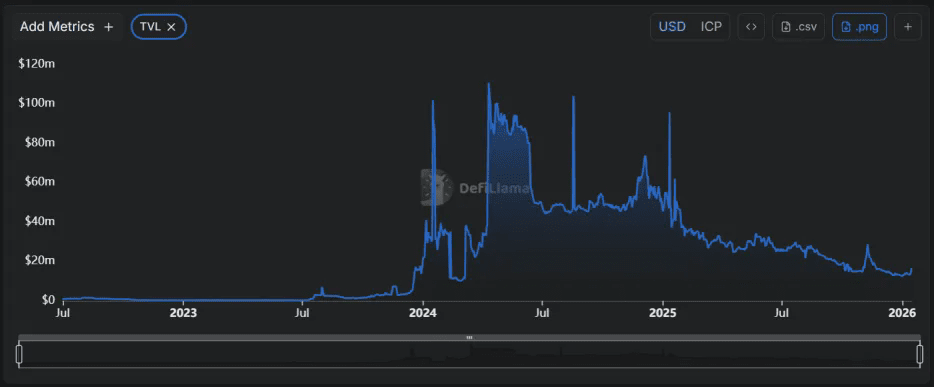
First, the scale of DeFi lags behind; compared to Ethereum or Solana, the DeFi ecosystem scale of Internet Computer still has a significant gap. As of January 16, its on-chain TVL is only about $16 million.
Second, liquidity depth is insufficient; although the protocol possesses strong cross-chain technology, the liquidity depth of on-chain native assets such as ckBTC and ckETH is inadequate, facing high slippage risk for large transactions.
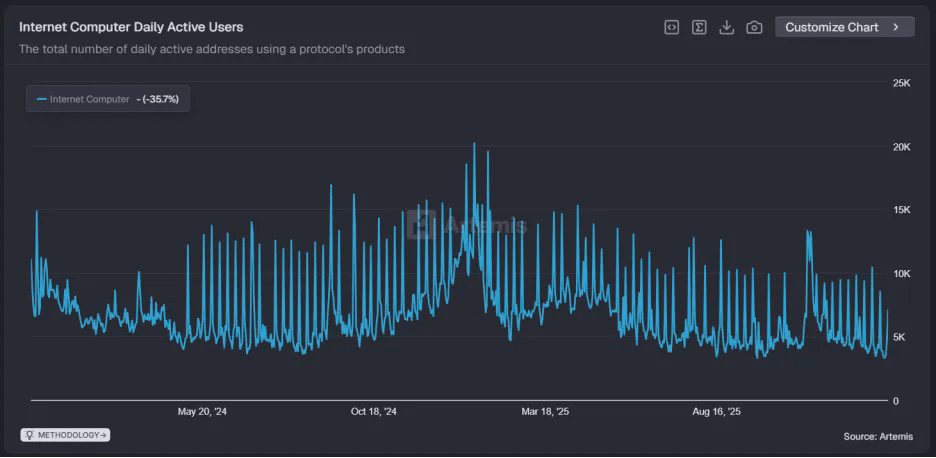
Third, the user base is weak, with Internet Computer's daily active address count being only around 7,000, which still shows a significant magnitude gap compared to the top ten public chains by market cap. How to translate the vision of a 'self-writing internet' into real user traffic is its immediate priority.
The area of highest uncertainty lies in the execution effect of the 'inflation surgery'; Mission 70 is a precise economic experiment, and its success mainly relies on the synchronous realization of two premises: first, that reducing rewards does not lead to a massive loss of node providers, and second, that Caffeine AI can bring exponential growth in Cycles burning.
If the implementation of the AI platform does not meet expectations, simple reward reductions may evolve into a blow to ecological vitality, even falling into a vicious cycle of 'price decline - inflation intensification'.
DFINITY is attempting to turn the tide with a new tokenomics model; if ICP in 2021 rose to fame based on the vision of a 'world computer', then ICP in 2026 intends to prove its value creation and capture capabilities to the market with a precise deflationary model and real data.
For investors, the underlying logic for judging ICP's price has changed; it is no longer the vague ecological prosperity but focuses on two quantifiable and traceable hard indicators: the burning rate of Cycles and the call frequency of on-chain AI inference.
The short-term increase in token price may just be a release of emotion, while the actual execution effect of the new tokenomics model Mission 70, and whether it can break the curse of 'strong technology, weak ecology', will be key to determining whether ICP can return to the ranks of top public chains.
View the 'Mission 70' white paper:
internetcomputer.org/whitepapers/mission70.pdf
The IC content you care about
Technical Progress | Project Information | Global Events

Follow the IC Binance channel
Stay updated with the latest news