
As we move through the first quarter of 2026, the blockchain landscape has shifted from the "wild west" of speculative tokens toward a more mature era of institutional-grade infrastructure. At the heart of this transformation is @Dusk , a project that has spent years quietly building the foundational layers necessary to merge the worlds of Traditional Finance (TradFi) and Decentralized Finance (DeFi). With the recent successful activation of the Dusk Mainnet and the highly anticipated rollout of DuskEVM, the conversation around Real-World Assets (RWA) is no longer about "if," but "how fast."
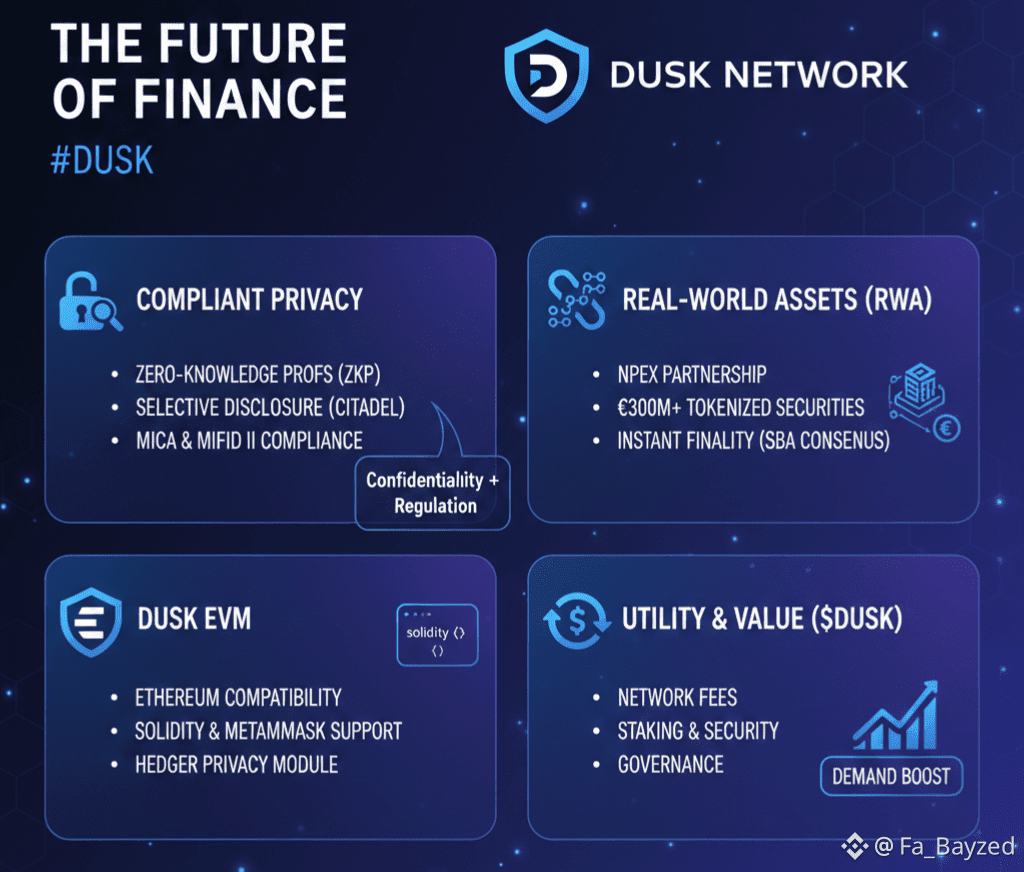
The primary hurdle for financial institutions entering the blockchain space has always been the conflict between transparency and confidentiality. Most public blockchains are fully transparent—a feature that is a "bug" for a bank or a private fund that cannot legally or competitively broadcast its entire balance sheet and transaction history to the public. The network solves this through a unique architecture centered on Zero-Knowledge Proofs (ZKP). Unlike older privacy coins, this protocol doesn’t just hide data; it provides "Compliant Privacy." This means confidentiality is maintained by default where transaction amounts, balances, and participant identities remain encrypted. Through the Citadel protocol, users and institutions can provide cryptographic view keys to regulators or auditors, allowing for full compliance with frameworks like the EU’s MiCA and MiFID II.
One of the most significant catalysts for the #Dusk ecosystem in 2026 is its partnership with NPEX, a licensed Dutch stock exchange. This is a pipeline for bringing over €300 million in regulated securities directly on-chain. By using the infrastructure, NPEX can facilitate the issuance, trading, and settlement of tokenized assets with instant finality. This is made possible by the Segregated Byzantine Agreement (SBA) consensus mechanism, which ensures that once a transaction is confirmed, it is irreversible—a mandatory requirement for any serious financial settlement layer.
The introduction of DuskEVM has been a game-changer for the developer community. It allows developers to use familiar tools like Solidity, Hardhat, and MetaMask while deploying existing Ethereum dApps onto the network with minimal changes. By integrating the Hedger module, they can add privacy features to their smart contracts. This bridge is expected to drive a surge in DeFi applications that finally meet the privacy standards of high-net-worth individuals and corporate treasuries.
The $DUSK token is the lifeblood of this entire ecosystem and its utility is multifaceted. Every RWA issuance, trade, and smart contract execution requires the native token for gas as network fees. Furthermore, the SBA consensus relies on validators staking their assets to secure the network, and token holders have a say in the evolution of the protocol through governance, ensuring the network remains decentralized. As the volume of tokenized securities on-chain grows, the demand for the underlying fuel for these transactions creates a robust, usage-driven economic model.
In 2026, the industry has realized that the projects that win are those that solve real-world problems. By providing a permissionless Layer-1 built for regulated finance, @dusk_foundation is positioning itself as the "Global Financial Fabric." Whether you are a developer or an institution seeking to tokenize assets, the #Dusk network provides the tools, privacy, and legal certainty required to succeed.
