

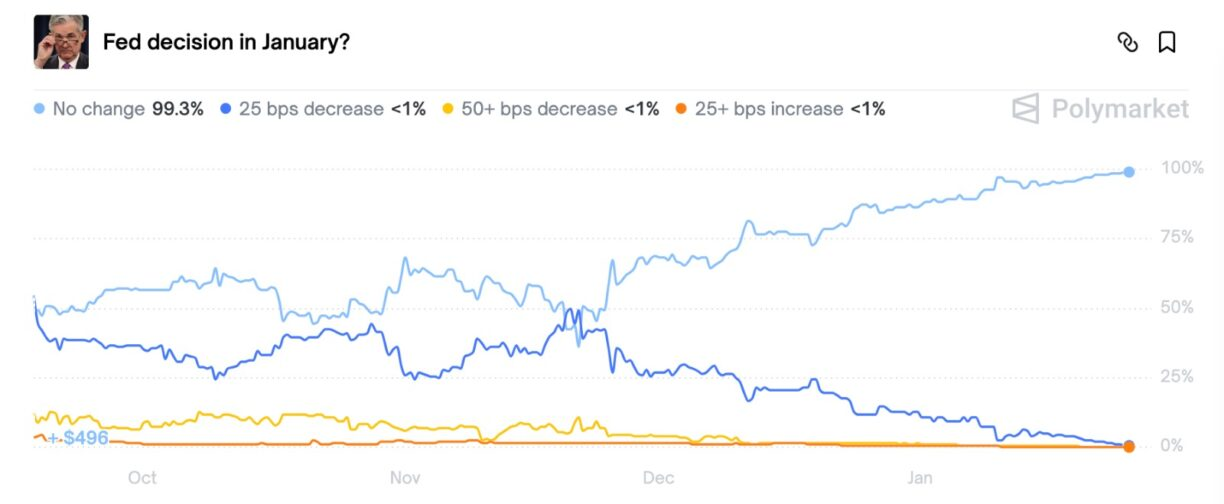
According to the latest Polymarket odds:
The probability of the Federal Reserve cutting rates in January has dropped to below 1%, and the market almost unanimously believes that no actions will be taken this month;
Meanwhile, the probability of 'keeping interest rates unchanged' has skyrocketed to over 99%.
This sudden concentration of probability is a very obvious market expectation repricing**, not a minor fluctuation.
This wave is not just about the 'interest rate cut expectation turning around'
Let's break down why this matters for crypto:
🔹 The market initially expected easing, but then no longer expected it.
Previously, everyone bet that the Fed would cut rates again after the CPI and employment data, but now that expectation has almost been 'canceled'. This regression from 'easing to pause' will directly shrink the 'pricing space for risk assets', with high beta assets like BTC/ETH reacting first.
🔹 Rumors of USD/JPY intervention amplify uncertainty.
The Federal Reserve and Japanese relevant departments have shown signs of intervention in the foreign exchange market, with the USD/JPY experiencing severe fluctuations in the short term, and U.S. Treasury yields also being pressured. This instability in the foreign exchange market often disturbs global risk preferences.
🔹 This 'policy suspense' does not bring liquidity, but rather hesitation.
The market often fears 'lack of direction' the most — when the possibility of rate cuts nearly disappears but there are political and intervention factors causing turmoil, people hesitate to place bets. The decline in BTC/ETH is largely suppressed by this uncertainty in expectations, rather than a specific piece of bad news.
📉 Why is BTC/ETH more sensitive than you think?
In simple terms, here are my personal thoughts:
Crypto is not a single currency — it is simultaneously a risk asset, a funding substitute, and a liquidity carrier.
When the policy expectation shifts from 'possible rate cuts' to 'stable rates + intervention discussions', it essentially pulls the market's risk preference back from 'offensive mode' to 'defensive mode'. This is more stimulating to volatility than an actual rate cut.
Expectations influence the market more than results do.
Just like before several FOMC meetings, BTC had already moved, yet the actual results led to little price movement. The market had priced in most expectations long ago.
The directional nature of the US dollar itself is an implicit variable in crypto.
Once the US dollar shows a 'changing channel', it not only affects the exchange rate but also transmits layer by layer to the crypto market through funding costs, global liquidity, arbitrage strategies, and more.
This is why when we look at BTC/ETH, we cannot only consider on-chain factors; macro expectations are also a variable.
I believe this round of market activity really has two layers of distinction:
1️⃣ Restoration or regression at the macro expectation level.
When the market reduces the probability of 'rate cuts' to near zero, it essentially freezes the idea of 'easing to save the market' temporarily. This will cause all risk assets to lose a layer of support that they could originally rely on.
2️⃣ Monetary policy is not an isolated event.
Not only has the probability of rate cuts fallen, but also the rumors of USD/JPY intervention, political pressure on the Federal Reserve, and global asset repricing are all layering into a ripple of uncertainty. The volatility of BTC/ETH is more caught in this macro resonance rather than a single 'rate value change'.
Overall, it's not that BTC is incapable, but rather that the market lacks a 'clear next direction'.
When macro conditions are not clearly communicated, prices naturally turn around.

