If you just take '300 million euros' as a promotional figure, I suggest you pause. Because in the RWA track, numbers are never casually written KPIs, but are results extracted layer by layer by regulation, law, accounting, and clearing systems.
In my view, the 300 million euros that Dusk and NPEX are throwing out is more like an 'institutional permitted upper limit' rather than a lower limit of ambition.
To illustrate this point, I must first compare Dusk with similar projects; otherwise, it's easy to be carried away by emotions.
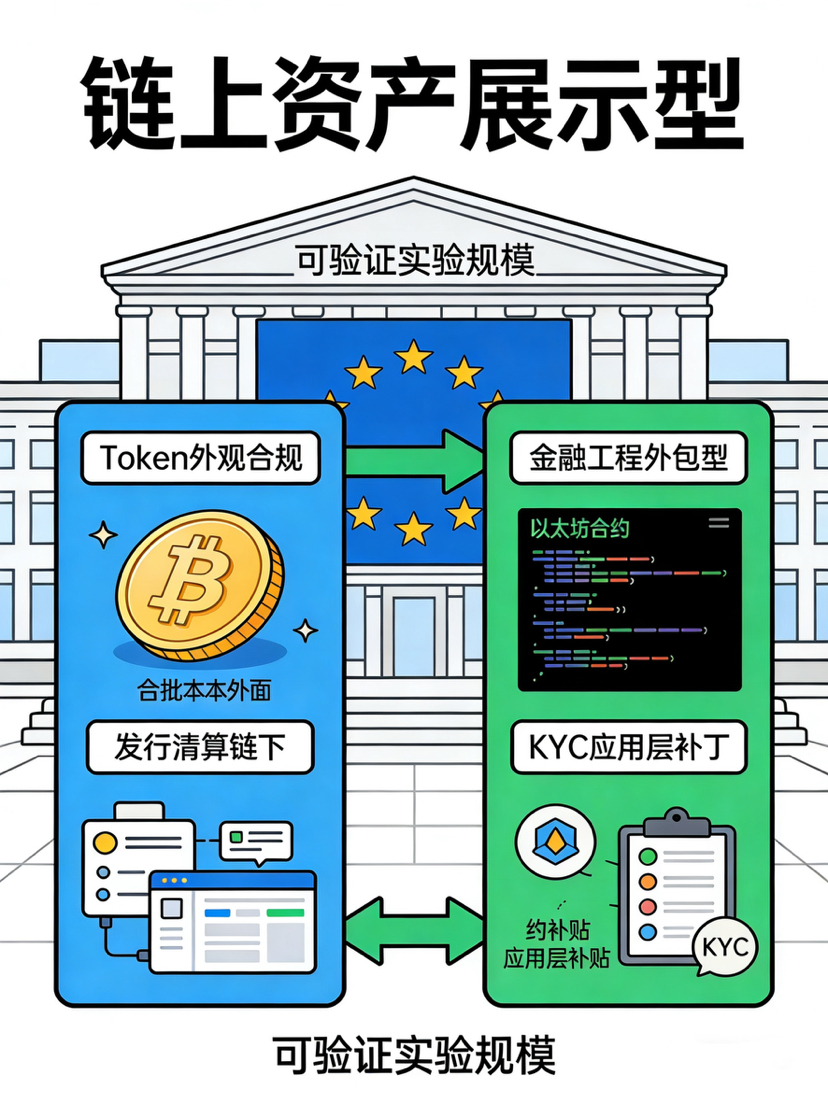
In the past few years, RWA projects have generally been divided into two categories. One is 'on-chain asset display type', which turns real estate, bonds, and fund shares into tokens that appear compliant, while in reality, issuance, clearing, and the investor registry are still off-chain; the chain is merely a bookkeeping UI. The other is 'financial engineering outsourcing type', which directly creates contracts on Ethereum or L2, and then adds KYC, whitelists, and freeze functions at the application layer, hoping to exchange contract complexity for compliance certainty.
Both of these paths have a common problem: they cannot bypass the core financial system. What regulators truly care about is not what the token looks like, but the issuance scale, investor qualifications, information disclosure, clearing responsibility, finality, and who is responsible when something goes wrong.
And these things, most chains are not 'unable to do', but 'cannot be written into the protocol layer'.
This is precisely the watershed moment between Dusk and similar projects.
Dusk has never intended to rely on 'application-level patches' to mix into RWA. It chose a slower path that is closer to real finance: making compliance itself a system capability. Identity, qualifications, auditing permissions, finality, and data traceability are not product features, but the infrastructure of the chain.
Understanding this, when you look back at '300 million euros', the flavor is different.
In traditional European capital markets, 300 million euros is a very subtle numerical range. It is large enough to cover multiple bond issuances, financing for several medium-sized enterprises, and continuous secondary market transactions; but it is not large enough to trigger the strictest level of systemic financial institution regulation.
What does this mean? It means that this is a verifiable, implementable experiment scale that can be accepted by regulatory systems.
Dusk and NPEX are not 'testing the waters for RWA', but are using a real, operable scale to verify whether a complete set of on-chain financial processes can form a closed loop.
Specifically, this process is completely different from what most people imagine.
First is identity and qualifications. Traditional RWA projects often say 'we support KYC', but in actual transactions, identity is not a one-time verification but a continuous state. Being compliant today does not mean you can buy tomorrow; being able to participate in primary issuance does not mean you can enter the secondary market.
Dusk's Citadel compliance engine essentially turns 'identity and qualifications' into on-chain state variables. The contract does not judge who you are, but whether you meet the compliance conditions for the current transaction, and this judgment is auditable, revocable, and updatable.
This step directly determines whether it can support a real issuance scale. Without this layer, once the issuance amount goes up, compliance costs will explode exponentially.
Second is the balance between transaction privacy and auditing.
Many projects directly choose sides here, either sacrificing privacy for transparency or hiding behind privacy while pretending to be compliant. #Dusk chooses the third path: transactions are encrypted by default, but auditing rights exist at the protocol level.
This means that regulatory or compliance audits are not about 'trusting the data provided by the project party', but about verifying state changes through the chain itself.
This is also why I believe that 300 million euros is not a 'marketing test', but a compliance stress test. You can manually supplement the process at a scale of tens of millions, but at this level, every transaction and every state transition must be automatically interpretable by the system.
The third point, which is also the easiest to overlook, is finality.
In the DeFi world, finality is a technical parameter; in the financial world, it is a boundary of responsibility.
When a transaction becomes irreversible, who explains the anomalies, and which transactions are valid during the upgrade period—these are not things written in a blog, but must be able to be written into SOPs and audit reports.
Dusk's emphasis on finality at the consensus and settlement layer is essentially reserving 'legal space' for the real issuance of this scale. This is also why regulated trading venues like NPEX are willing to place issuance and trading processes on this chain instead of simply assembling them with Ethereum contracts.
With that said, looking back at the 'trillion-level gateway' will no longer seem exaggerated.
Trillions are not achieved by a single issuance, but through model replication.
If the issuance, trading, settlement, and auditing of 300 million euros can run completely on Dusk, then the next question is no longer 'can it go on-chain', but 'can it scale to more asset classes and more jurisdictions'.
And this is precisely where Dusk's potential value lies.
From the personal perspective of Tang Tang, what I truly care about regarding @Dusk is not whether it is the 'strongest privacy chain', but whether it is attempting to answer a question that many projects intentionally avoid:
If you really want to serve regulated assets, is the chain willing to relinquish some degree of freedom for financial responsibility?
Dusk's answer is yes, and it is willing to exchange this with cryptography and protocol design, rather than with centralized power.
Of course, this path is bound to be slow and expensive. Toolchains, development thresholds, and compliance integration will all slow down the speed of ecological expansion. This is also why I do not view it as a short-term narrative project.
But it is precisely this slowness that makes 300 million euros seem real.
It is not the endpoint, but a starting point allowed by real finance.
If you ask me why it is worth paying attention to, my reason is very simple:
While most RWA projects are still proving 'whether assets can be done on-chain', Dusk has already started proving 'whether the chain can bear responsibility'. Once this is proven, the subsequent scales are merely replication issues.