

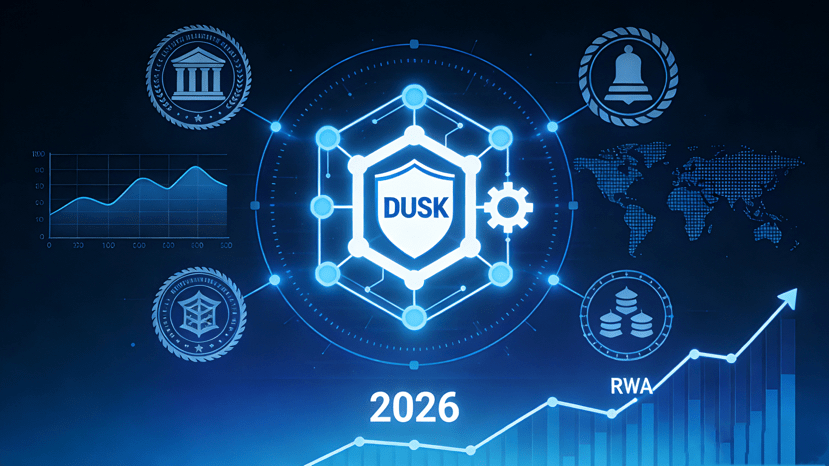
The Davos World Economic Forum 2026 hasn't started yet, but the atmosphere is already quite clear.
Over the past two weeks, I've reviewed a lot of leaked topic directions, with keywords highly concentrated on three main issues: the institutionalization of digital assets, cross-border compliance, and 'trusted infrastructure.' Hardly anyone is discussing 'the next hundredfold coin'; the focus is entirely on 'who will take responsibility.'
This point forms an interesting contrast to the sentiment at Binance Square today. The market is still scoring projects based on price, but the system in Davos is concerned with:
If the scale really reaches trillions, will the system crash first?
It is in this context that I carefully re-examined the design of the @Dusk 'Compliance Sentinel' node. To be honest, if viewed solely from a crypto perspective, this design is not attractive at all; but from the perspective of institutions and regulators, it is very 'Davos'.
First, let's put Dusk back among similar projects to see the differences more clearly.
In the past two years, most RWA projects have taken the 'trust transfer' route. What does that mean?
It's not about making the system more trustworthy, but rather shifting trust from regulators to project parties, from project parties to multi-signatures, and then from multi-signatures to audit reports. The chain is just an execution tool; the real compliance judgment still happens off-chain.
This model can run at a small scale, but once it involves cross-border assets, secondary market liquidity, and ongoing disclosure obligations, problems begin to concentrate and explode:
Who can freeze assets under what conditions?
Who has the authority to judge whether a transaction is non-compliant?
If the on-chain state is inconsistent with regulatory judgments, whose word do you listen to?
You will find that many so-called 'compliant RWA' ultimately still rely on human guarantees.
Dusk's approach is completely different. It does not attempt to 'outsource' regulation to applications, but rather turns compliance itself into a network role.
The so-called 'compliance sentinel' node is not essentially about reviewing transaction content, but rather responsible for the legality of the state: whether the identity is valid, whether the qualification has expired, and whether the assets are within the lifecycle allowed for circulation.
This step is very critical because it directly changes the responsibility structure.
In traditional finance, what institutions fear most is not market volatility, but unclear responsibilities.
You can accept losses, but you cannot accept discovering afterwards that this trade shouldn't have happened in the first place.
The value of the compliance sentinel node lies here: it is not a post-audit, but embeds compliance judgment before state transition.
Transactions can be private, amounts can be encrypted, but the matter of 'whether it is allowed to happen' must be confirmed at the system level.
This is also why I think the design of #Dusk is more like a preparation for that group in Davos, rather than for retail investors.
Let me mention a more specific real-world case, which is NPEX.
NPEX is not an 'experimental platform'; it is a regulated trading venue in the Netherlands, serving real businesses that need financing, issuance, and clearing.
For it, going on-chain is not a technical upgrade, but a legal act.
In this scenario, the role undertaken by the compliance sentinel node is actually very clear:
It is equivalent to a decentralized institutional executor. It does not replace regulation but ensures that regulatory rules are not circumvented on-chain.
There is a point here that many people overlook:
What regulators really need is not to 'see all data', but to be able to confirm that rules have been executed when needed.
The privacy compliance model of #Dusk just happens to meet this point. Transaction details are not publicly disclosed by default, but compliance status, qualification certificates, and audit interfaces are natively supported by the system. This means that regulators do not need to trust a specific company, but rather verify the proofs provided by the network.
From a technical perspective, this changes 'compliance' from a process into a state; from a financial perspective, this shifts 'responsibility' from people to systems.
Speaking of which, let's return to 'why 2026'.
My personal judgment is:
The year 2026 will not be the starting point for the RWA explosion, but rather the starting point for selection. What can truly enter the institutional vision is not the projects that make the loudest narratives, but the underlying networks that have clearly defined responsibility structures, compliance boundaries, and finality.
In occasions like Davos, no one will ask you about TPS, and no one cares how lively your community is; they will only ask three things:
Who is responsible when something goes wrong?
Can the system be audited?
Will it become uncontrollable as the scale increases?
Dusk at least provides a complete answer at the architectural level. It does not guarantee success, but its design direction is aligned with traditional financial logic for a few.
So why do I say that institutions 'only trust' such nodes?
Not because Dusk's name is so loud, but because only such nodes can help them sleep at night.
Lastly, let me share my own views.
If you view Dusk as a market indicator, then articles of this kind are indeed not important today;
But if you are looking for 'which chain might actually appear on the Davos discussion table', then Dusk has at least moved the chair over.
For RWA to reach trillions, it relies not on hype, but on solving every institutional problem that is 'too embarrassing to write in promotional materials' in advance.
And this is precisely the reason I continue to pay attention to @Dusk .
