

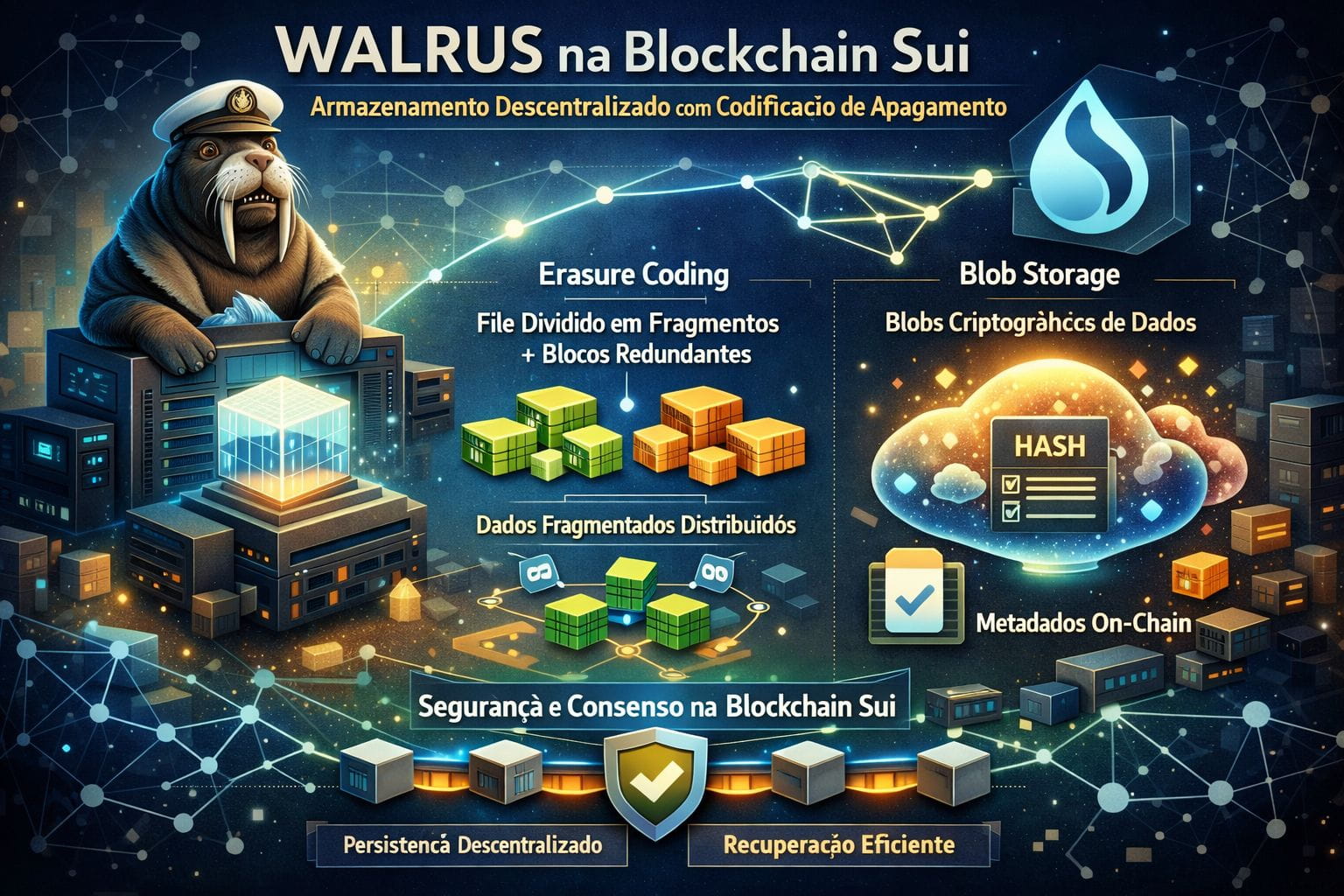
WALRUS is a decentralized storage layer built to operate natively on the Sui blockchain, focused on the efficient persistence of large volumes of data through blobs. Its architecture combines erasure coding with distributed storage, ensuring high availability, fault tolerance, and cryptographic integrity of the data.
In erasure coding, an original file is fragmented into multiple data blocks, and then additional redundant blocks are mathematically generated. This approach allows the file to be fully reconstructed even if part of the fragments is unavailable, eliminating the need for complete replication and drastically reducing storage costs. WALRUS uses this method to distribute fragments among different nodes, maintaining resilience against Byzantine failures and loss of availability.
The concept of blob storage in WALRUS refers to handling data as immutable large objects, identified by cryptographic hashes. These blobs are not executed on-chain, but their existence, metadata, and availability guarantees are anchored on Sui. The Sui blockchain acts as the coordination, validation, and consensus layer, recording cryptographic commitments that ensure that data stored off-chain remains verifiable, auditable, and recoverable.
The operation of WALRUS on Sui benefits from the object-oriented model of the blockchain, allowing efficient state management, parallelism in verification, and high scalability. This integration creates a system where large files can be stored in a decentralized manner, with strong cryptographic guarantees, low recovery latency, and full alignment with the security and performance principles of Sui.


