

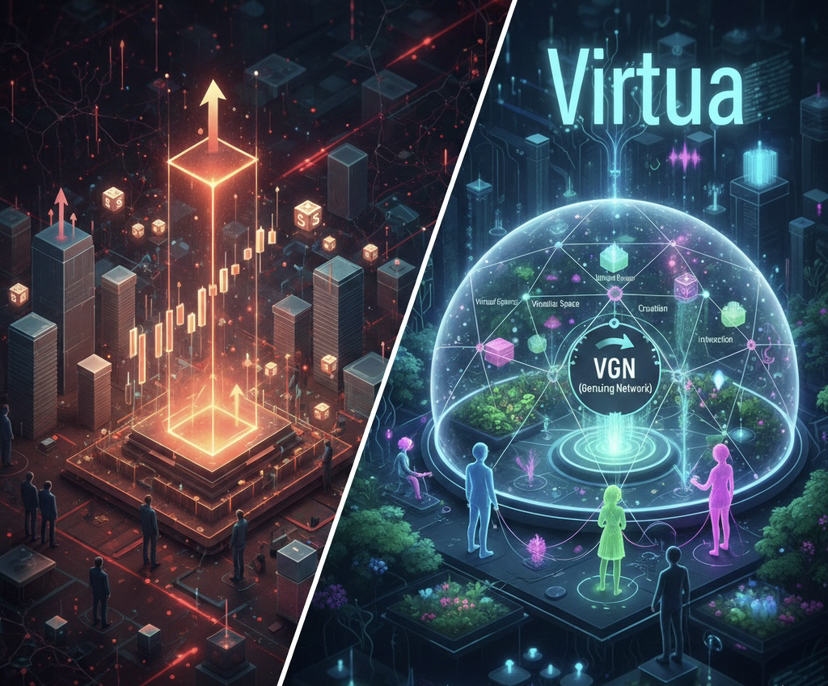
This morning while browsing cryptocurrency news, my mind was almost blown by two things happening simultaneously: on one side was the news of Grayscale submitting the #BNB ETF, and on the other was a new interaction I found in the virtual world Virtua @Vanarchain . The former represents a hard intervention of traditional finance into the crypto world, while the latter is the softest power in the digital ecosystem—emotional immersion and behavioral feedback. I can't help but think that by putting these two together, we can see an interesting contrast: capital betting on the future vs. users investing in experience, and surprisingly, the ways of value generation are completely different.
First, let's talk about the grayscale BNB ETF. Many people get excited as soon as they see the news: the ETF is launched, institutional money will flood in, the price of BNB may rise, and the entire market may be driven up. But I’m thinking differently, the logic of the ETF is very clear - it captures financial value, price expectations, and capital flow, and this logic is entirely based on 'external market recognition of assets'. This way of playing is very stimulating for short-term speculators, but it essentially does not touch on user behavior itself. In other words, ETFs can drive prices up, and allow capital to flow in and out, but it will not increase user participation in the ecosystem, nor change their relationship with the blockchain.
In contrast, the scenes I see in Virtua are completely different. Today, I participated in an immersive online event, interacting with several players: some were unlocking achievements in virtual space, some were participating in virtual creations, and others were using $VANRY or renewable energy credits for behavioral verification. Each interaction was recorded by the system, but you can't feel the presence of 'transactions' or 'pledges'; it was completely integrated into the experience. I suddenly realized that the value creation happening here is behavior-driven and emotionally immersive. Virtua recorded the sense of presence of participants, while VGN mapped these behaviors into ecological feedback, forming a closed loop.
This is what I mean by the flywheel effect: emotional immersion (Virtua) + behavioral interaction (VGN). When users invest time, energy, and attention in Virtua, the system will reinforce these behaviors through VGN, creating a positive cycle of participation and token rights. Everything you do in the space drives value generation for the next person, the next content, and the next interaction. This closed loop is very similar to the community effects in the real world, but more directly perceptible - tokens, points, and interactive behaviors are completely coupled, forming a dynamic value cycle.
I thought carefully about it, this kind of flywheel and ETF are completely not on the same dimension. ETF is financial leverage, it reflects the market's recognition of assets; Virtua+VGN is behavioral leverage, it reflects the ecosystem's recognition of participants. The former stimulates price volatility, while the latter enhances user stickiness and emotional sedimentation. In the short term, ETFs may be more eye-catching, and can even be hyped by the media into a hot topic; but in the long run, the closed loop of Virtua and VGN is the core driving force for the sustainability of the ecosystem. User behavior in the ecosystem will continue to accumulate, this value is observable and transferable on-chain, but it is extremely difficult to measure with a single price.
I can even imagine it as two paths of value generation: ETFs are linear, based on capital flow; Virtua+VGN is non-linear, based on the sedimentation of time, emotions, and participation behaviors. ETFs can make the market excited in the short term, but won’t leave user traces; every interaction of Virtua+VGN will leave memories in the ecosystem, accumulating over time to generate compounding effects. In other words, the former is 'financial enthusiasm', while the latter is 'emotional assets'.
What interests me more is that the design logic of this behavioral closed loop aligns very well with #Vanar 's consistent strategy of 'de-blockchain feel'. You won’t feel the existence of the underlying chain, wallet operations, or gas; behaviors happen, and value naturally accumulates. Just like the virtual space creation activity I saw today, users naturally receive VANRY and renewable energy credits while completing their creations, and even invisibly influence the dynamic simulation of the ecological economy. This invisible value recording is more resilient than any short-term market speculation.
I began to realize that if #Vanar could combine this behavioral closed loop with participation in the real world, such as green energy usage, community contributions, and sustainable interaction with creative content, then Virtua would not just be a metaverse; it would be a database of behaviors and emotions. It records not just digital assets, but the entire process of human participation in the ecosystem—time investment, emotional fluctuations, interactive contributions, and creative traces, all quantified and feedbacked back to the ecological economy.
So today I think, when the market is excited about ETFs and focusing on price trends, what I care more about are the traces left by users in the virtual world; they are the real accumulated value. Once the flywheel effect is activated, behavior drives emotion, and emotion in turn reinforces behavior; this self-consistent mechanism can support the long-term operation of the ecosystem.
I even boldly predict that this type of value model may become a core competitiveness more significant than short-term financial volatility in the future: not looking at prices, not looking at transactions, but focusing on how much real participation and emotion the ecosystem can retain.
The grayscale BNB ETF showed me the driving force of the capital world on the market; the flywheel effect of Virtua+VGN showed me the capturing ability of the ecological world on user behavior. The former is the explosive point, the latter is sedimentation. Capital can come and go, but once time and emotions are recorded, they exist forever.
Today in Virtua, I saw not only the interactions of players but also how Vanar writes emotions and behaviors into the ecological ledger. ETFs can make prices dance, but flywheels make ecosystems breathe. Short-term hot spots are eye-catching, but long-term immersion determines belonging.
I was thinking that perhaps the future crypto world is not just financial products and speculative tools, but a system of emotional and behavioral closed loops, where every investment of time and emotion has its own value cycle. Virtua and VGN are the first experiments in this world.
