

The likelihood of the U.S. government shutting down this week is at a record high, and looking broader, the story is not just about short-term politics.
Let me add a little more to give you a clearer picture of the U.S. government shutdown and why the market always reacts quite sensitively to this event.
Essentially, a shutdown occurs when Congress fails to pass a budget, causing many federal agencies to halt operations. Employees go without pay, public services are disrupted, and important economic data is delayed in publication. It may seem like just an administrative issue, but its repercussions lie in trust.
The financial market operates heavily based on expectations and cash flow. When the US government (the center of the global financial system) falls into a state of 'temporary paralysis', investors tend to become defensive. Short-term cash flows usually withdraw from risky assets, stocks become more volatile, and liquidity contracts. Crypto is no exception, even being affected quickly because this is a 24/7 trading market and reacts very emotionally.
Another consequence that few people notice is that shutdowns often slow down policy decisions. The Fed, the Treasury, and regulatory agencies cannot coordinate smoothly. In the context of high public debt and large deficits, each shutdown is like a reminder that the system is operating on a 'patchwork' basis, not long-term stability. This further raises concerns about America's ability to handle debt in the future without needing to... print more money.
Today I watched a pretty good video by Lawrence Lepard (he is the founder of Equity Management Associates) about a statement: the fact that the US continues to print money exponentially is almost unavoidable and this is not necessarily a subjective opinion but a consequence of mathematics and the current debt system structure.
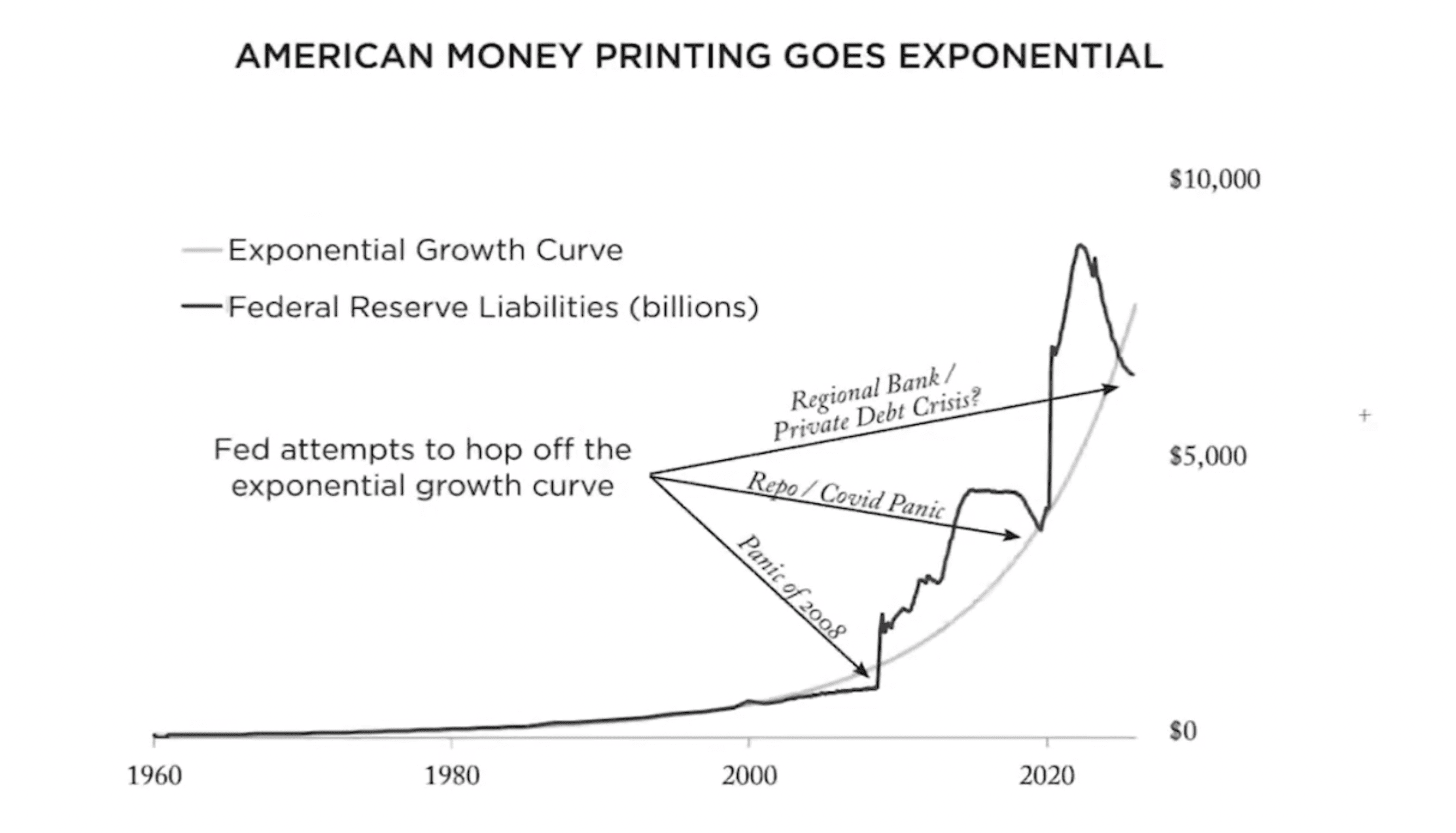
If you look at this chart, you will see that Fed debt and obligations are increasing exponentially; each time the market faces a crisis from 2008, the repo crisis, Covid to recent banking issues, the Fed has 'temporarily escaped' the curve by injecting more liquidity. The problem is that each time like this, the baseline is higher, and the next time they must print more than before to keep the system from collapsing.
The Fed may try to tighten in the short term, but with the current public debt, private debt, and interest costs, returning to a 'normal' trajectory is almost impossible. If they do not print money, the system collapses. And if they print money, then the value of fiat currency continues to be eroded over time.
So, stories like shutdown, debt ceiling, or banking crises are actually just symptoms, not root causes. The core issue is that the system is forced to choose inflation over collapse.
Those who look at the long term will understand why more and more people are turning to scarce, decentralized assets. It's not because they like risk, but because the biggest risk lies in holding cash for too long in a system that must print money to survive.
My personal view is that in the short term, the market may still be volatile and fluctuate, but in the long run, money will always find a way to escape that money printing curve. And that's the story you should think about when building strategies for the coming years, not just the next few weeks.
