
There’s an old saying that still applies in the AI era: what truly matters is not how well you can imitate, but whether you can actually deliver results.
In today’s market, many projects rely on big concepts, ambitious roadmaps, and TPS comparisons. It all sounds exciting, but in reality, most of it boils down to two familiar excuses: “waiting for the ecosystem” and “waiting for the bull market.”
My interest in Vanar doesn’t come from how good its story sounds, but from how clearly it defines its positioning. On its official website, Vanar does not present itself as a dApp with a chatbot slapped on and labeled “AI on blockchain.” Instead, it explicitly frames itself as an AI-native infrastructure stack, focused on PayFi and tokenized real-world assets.
What “Preparedness” Actually Means
For me, preparedness can be reduced to three very practical questions:
Is anyone genuinely willing to pay for the product?
Can that payment be consistently converted into repurchases?
Can those repurchases translate into real on-chain settlement frequency?
Vanar begins answering these questions through myNeutron, a consumer-facing product that proves one critical point: there are real users willing to pay. This matters because it pulls the term “AI-native” down from marketing language into real, everyday pain points.
Anyone who actively uses AI tools knows the frustration: switching between ChatGPT, Claude, Gemini, and Google Docs isn’t painful because the models are unintelligent, but because context breaks. Each switch forces you to re-explain background information, instantly dropping productivity to zero.
myNeutron targets this exact problem by building cross-platform memory. Users can choose to permanently anchor that memory on Vanar, or store it locally to maintain control. Either way, the ownership and choice remain with the user.
Memory Is Not a Feature—It’s an Asset
Vanar does not treat “memory” as a flashy selling point. Instead, memory is designed as an asset that can be:
called
reused
injected into any AI conversation
In simple terms, Vanar creates a universal knowledge base with cross-platform context injection. This allows users to switch AI models without starting from scratch, while every interaction feeds back into future conversations—forming a system of compound learning.
This is what preparedness means to me: not “we will be powerful someday,” but “we are already reducing real costs today.”
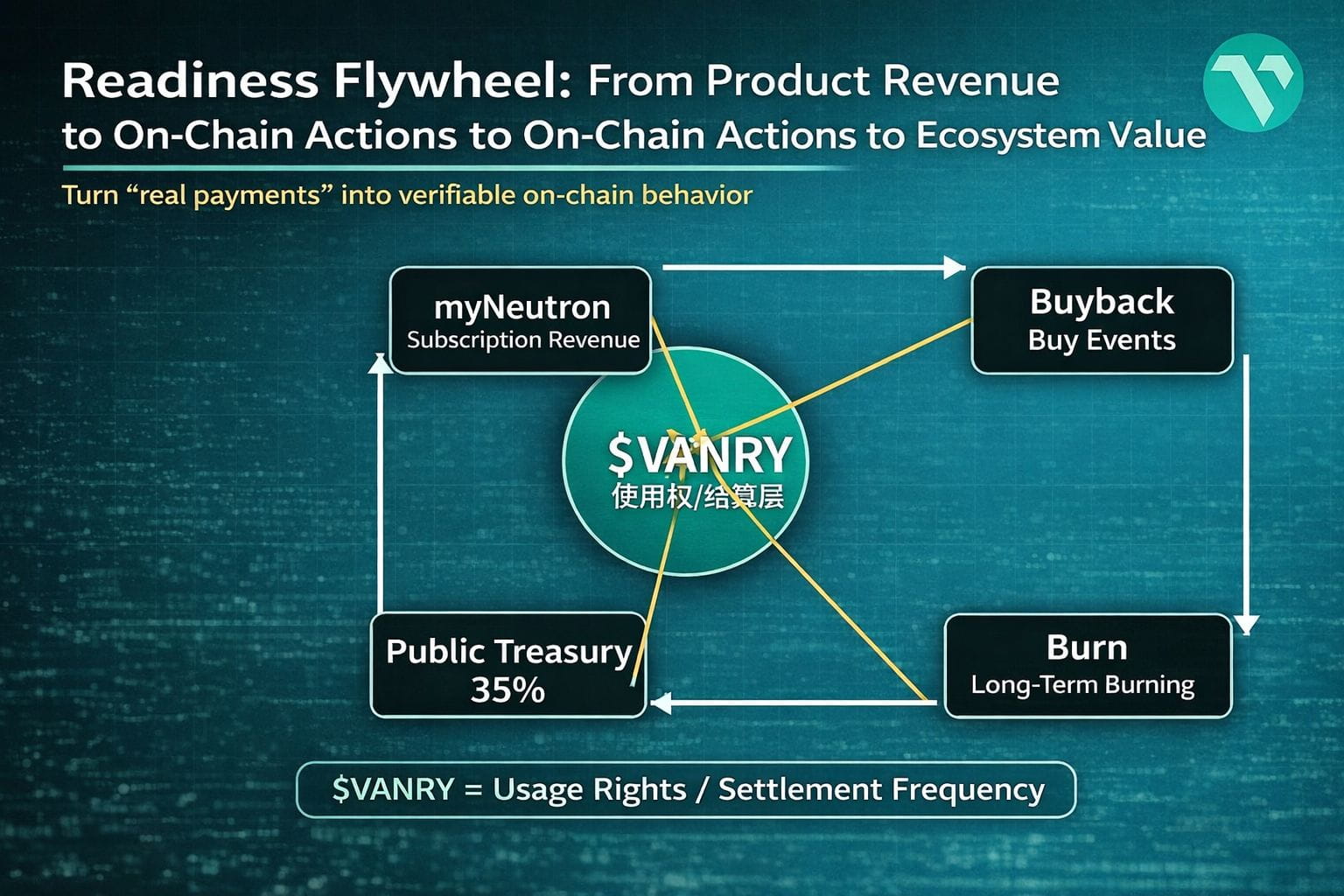
From Product Revenue to Token Mechanism (The Hardest Part)
One of the most important—and often avoided—questions in crypto is how product revenue connects to token mechanics. Vanar directly addresses this.
According to official statements, starting December 1, 2025, paid subscriptions from myNeutron will be converted into $VANRY, triggering market buy events and contributing to long-term burn mechanisms. The converted $VANRY will then be allocated across four core fund pools, with 35% assigned to the public treasury.
I deliberately avoid saying “the price will definitely go up.” That kind of language is just hype. A more accurate framing is this: Vanar is attempting to transform real payments into verifiable on-chain behavior, and return part of that value to the ecosystem and supply side—rather than relying purely on inflationary incentives to force growth.
Is $VANRY “Just a Narrative”?
Before jumping to conclusions, it’s worth examining the least glamorous—but most important—layer: the necessity of the native token.
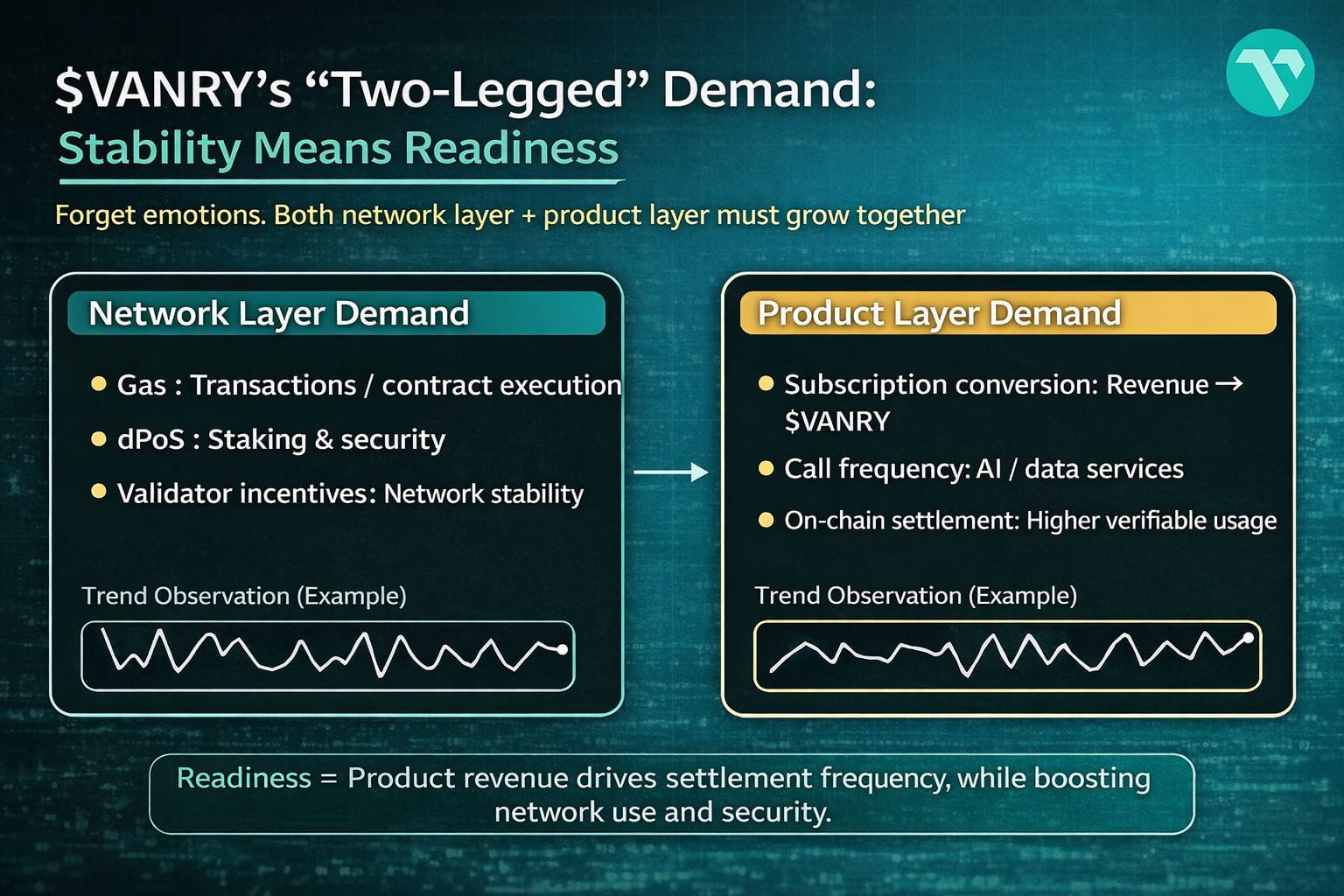
Vanar’s official documentation clearly defines the role of VANRY:
used as gas for transactions and smart contracts
supports dPoS staking and validator incentives
acts as a core asset for ecosystem-level interactions
Even if you completely ignore buyback and burn mechanisms, VANRY already has network-layer demand through gas and security. If products like myNeutron, Neutron Seeds, and Kayon achieve sustained usage, VANRY gains an additional product-layer demand through subscriptions, calls, and settlement frequency.
Whether these two demand layers can reinforce each other is the real test of Vanar’s preparedness.
Why Vanar Keeps Saying “It’s Not About the Concepts”
Once you look at the product stack, the emphasis becomes clearer.
Neutron converts raw files into compact, queryable, AI-readable “Seeds,” storing them directly on-chain. This transforms invoices, compliance documents, and proofs from static files into triggerable logic.
Kayon functions as an on-chain inference engine that can query and reason over this compressed, verifiable data—turning compliance and constraints into executable logic.
If you view this pipeline as data → rules → execution → settlement, it becomes clear why “preparedness” is not an emotional term here, but an engineering path that can be validated through products.
How Ordinary Users Should Track This Rationally
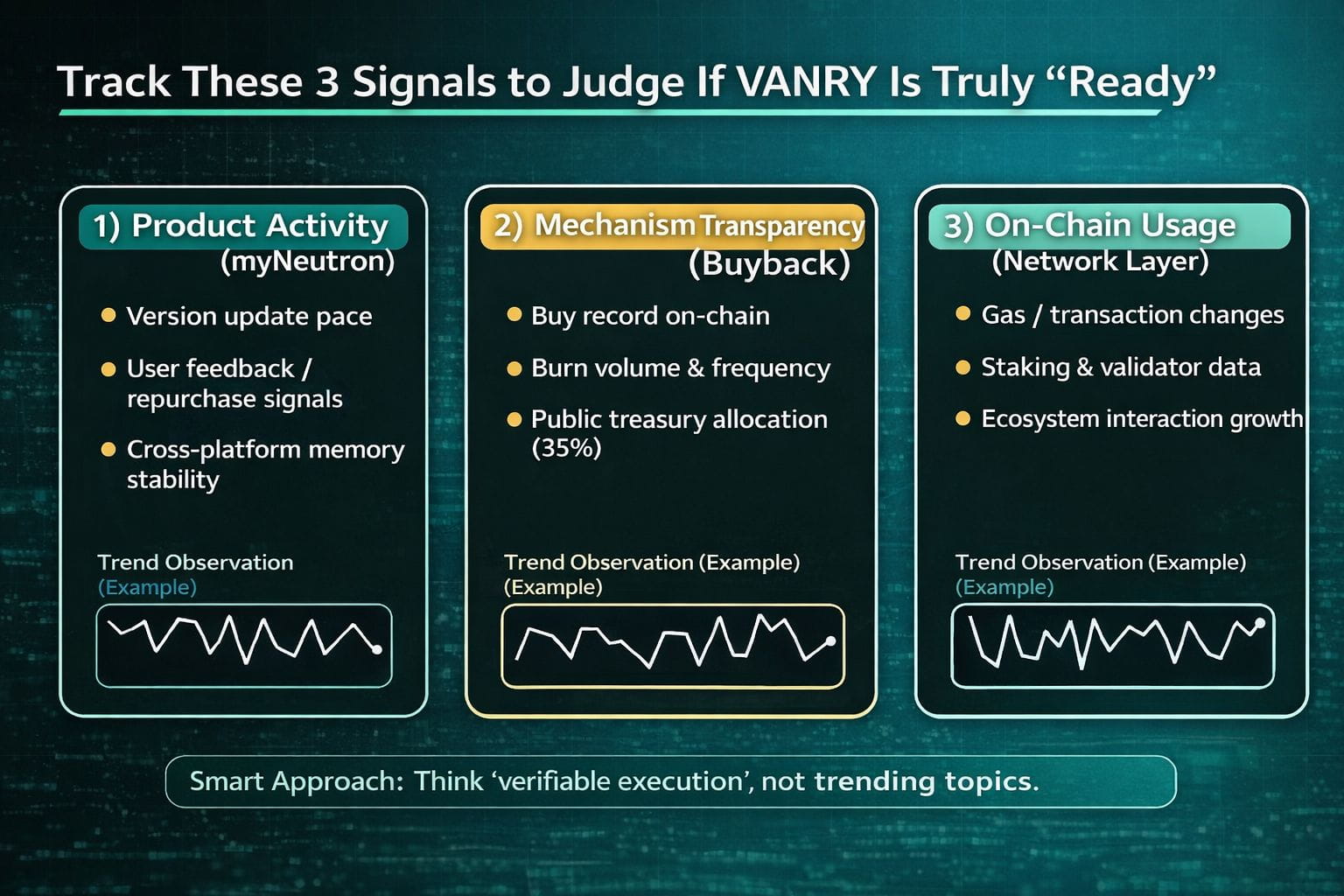
To avoid being driven by emotion or trending narratives, I suggest focusing on three signals:
Continuous product updates and real user feedback for tools like myNeutron—this shows whether people are actually using them.
Transparency and on-chain execution of buyback and burn mechanisms—no matter how good the promises sound, if it doesn’t land on-chain, it means nothing.
Growth in network-layer usage (gas, staking, ecosystem interactions) that rises alongside product adoption.
This approach allows you to judge preparedness through data, not sentiment.
A Final Note from “Sunmoon"
If you treat Vanar as just another AI narrative for speculation, it will eventually be overshadowed by projects that tell better stories.
But if you view it as an infrastructure experiment for the agent era, then your focus should be on products, payments, settlement frequency, and verifiable execution.
When those pieces come together, VANRY has a chance to evolve from a hype-driven asset into one that maps real cash flow to real usage.
#vanar #VANRY $VANRY @Vanarchain
