@Plasma Much of today’s blockchain-based economic activity has shifted away from pure speculation. Instead, it increasingly resembles traditional financial operations: payments, treasury management, exchange settlement, merchant transactions, and the cross-border movement of dollar-backed liquidity. At the core of this transformation are stablecoins. They function as the primary unit of account for crypto trading, the settlement medium for exchanges and OTC desks, and a practical payment method in regions where banking systems are costly, slow, or constrained. In this context, the most important factor is no longer storytelling or token mechanics, but the ability to move value quickly, cheaply, and with certainty between parties.
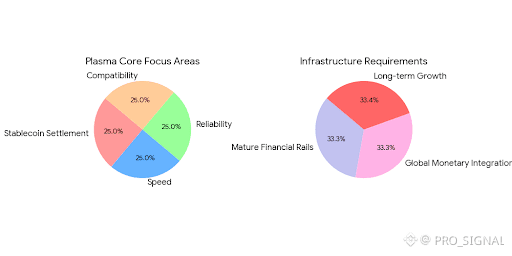
Plasma is built around this exact premise. Rather than positioning itself as a general-purpose blockchain for social applications or NFTs, it is designed as a Layer 1 network dedicated to stablecoin settlement. Its architecture assumes that assets like USDT and USDC form the foundation of crypto finance and optimizes the chain specifically for transferring and clearing these assets at scale. This approach contrasts with most blockchains, which treat stablecoins as just another application layered on top of a generic base.
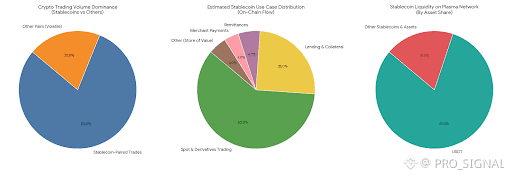
From the standpoint of trading and payments, this specialization is significant. The majority of crypto liquidity is already denominated in stablecoins. Spot trading, derivatives collateral, lending markets, merchant payments, and remittance flows are largely dollar-based on chain. Plasma aims to make these flows behave more like a purpose-built financial infrastructure rather than a shared, general compute environment.
Technically, Plasma is built around two key components. The first is full compatibility with the Ethereum Virtual Machine through Reth, a modern Ethereum client. This allows existing Ethereum smart contracts, wallets, custody solutions, trading systems, and infrastructure to operate on Plasma with minimal modification. For funds, exchanges, and payment providers, this dramatically lowers integration friction and enables reuse of existing tooling instead of requiring entirely new systems.
The second component is PlasmaBFT, a custom consensus mechanism engineered for sub-second finality. Transactions reach a definitive and irreversible state almost immediately, rather than relying on slow or probabilistic confirmations. For stablecoin settlement, this is critical. Payment processors, exchanges, and treasury desks need clear signals of finality before releasing funds, goods, or credit. Fast and deterministic settlement reduces operational delays and counterparty risk.
Plasma also rethinks transaction fees. Instead of forcing users to hold a volatile native token for gas, the network supports stablecoin-denominated fees and gasless USDT transfers. Practically, this means users can pay fees in dollars and, in some cases, avoid thinking about gas entirely. This aligns the network with real-world financial behavior: balances and costs are both denominated in stable value. For high-volume payment and trading flows, this simplifies accounting and reduces exposure to unnecessary assets.
Security and neutrality are reinforced through Bitcoin anchoring. Plasma periodically anchors its state or checkpoints to Bitcoin, using the most established and censorship-resistant blockchain as a reference layer. Bitcoin does not execute Plasma transactions, but it serves as a highly credible root of trust. For institutions and users operating in politically or regulatorily sensitive environments, this provides additional assurance. A settlement system that can cryptographically reference Bitcoin’s history is more difficult to alter or censor without detection.
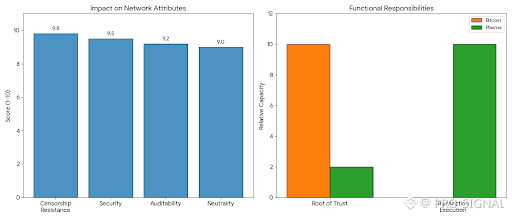
Plasma is designed to serve two groups that are often difficult to align. One consists of everyday users in regions where stablecoins function as practical financial tools, who require fast, low-cost, and intuitive dollar transfers. The other includes institutions involved in trading, payments, and finance, which demand predictable settlement, auditability, and compatibility with compliance and treasury workflows. A stablecoin-first architecture is intended to bridge these needs.
This focus also comes with trade-offs. By prioritizing stablecoin settlement, Plasma sacrifices some flexibility compared to fully general-purpose Layer 1 networks. Applications centered on NFTs, complex token economies, or non-financial use cases may find fewer incentives to deploy. Anchoring to Bitcoin strengthens security but introduces reliance on an external network, which can add operational considerations. Additionally, gasless and stablecoin-based fee models require careful economic design to ensure validator incentives and prevent abuse.
As with any new Layer 1, adoption remains critical. A settlement network only delivers value if liquidity, users, and counterparties actively use it. Exchanges, wallets, issuers, and payment providers must integrate Plasma for its technical advantages to translate into meaningful transaction volume.
Viewed within the broader crypto landscape, Plasma reflects a growing trend toward specialization. Rather than attempting to support every possible use case, newer networks are increasingly optimized for specific financial functions. Stablecoins already underpin much of the crypto economy. A blockchain built explicitly to move, clear, and secure them could reduce friction across trading, payments, and international finance.
For long-term growth, infrastructure like this becomes increasingly important. As crypto integrates more deeply into global monetary systems, dollar-denominated activity on chain needs to operate on rails that resemble mature financial infrastructure rather than experimental platforms. Plasma represents an effort to build such a rail focused on stablecoin settlement, engineered for speed and reliability, and compatible with the tools the market already relies on.