
When I first looked at Plasma I did not come away thinking about speed. I came away thinking about Plasma consistency. That might sound like a thing but in the current market Plasma consistency matters more, than ever.
Plasma starts from that reality instead of fighting it. It assumes stablecoins are not a temporary phase. They are a base layer of digital finance that needs to work every time.
Crypto is a bag right now. You have ups and downs happening all the time. Bitcoin is an example of this it has gone back up to between 40,000 and 45,000 dollars, which shows how quickly peoples opinions can change.
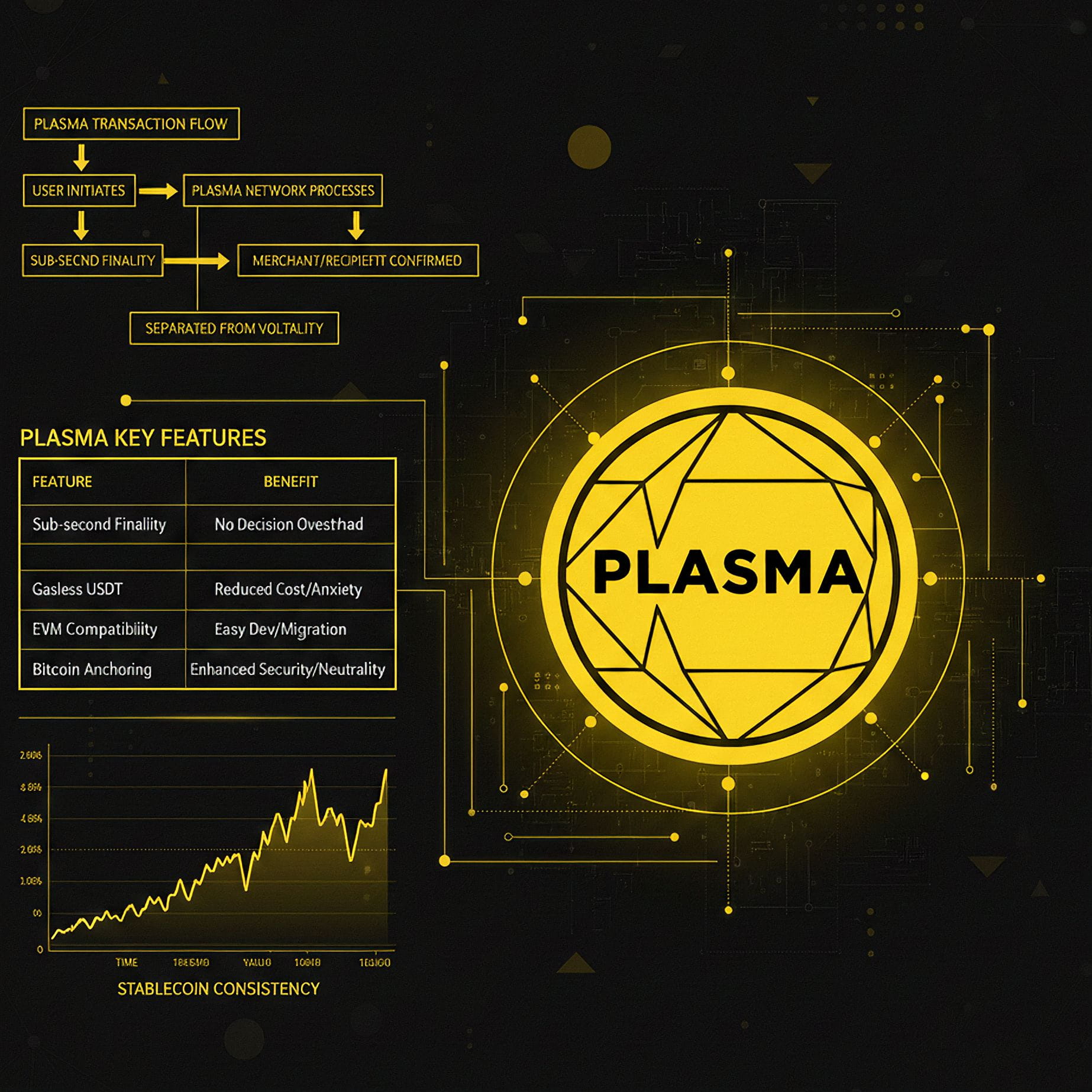
On the surface, Plasma offers sub-second finality. That sounds like another performance claim until you translate what it actually changes. A payment that finalizes in under a second doesn’t just feel faster. It removes decision-making overhead. Merchants don’t wait. Payroll systems don’t queue. Remittances don’t sit in a pending state that creates anxiety for both sides. Underneath, what Plasma is really compressing is uncertainty. And uncertainty is expensive.
That compression creates another effect. Applications no longer need to design around failure first. On slower or probabilistic chains, developers build buffers, retries, and confirmations into their logic. Plasma reduces the need for that defensive architecture. If this holds at scale, it lowers development complexity and operational cost at the same time. The risk, of course, is whether that finality remains steady under heavy usage. Early signs suggest it does, but infrastructure earns trust over years, not months.
Gasless USDT transfers are another place where Plasma’s thinking shows through. Most chains inherited their fee models from early crypto assumptions. You pay fees in volatile assets because that’s how it started. Plasma breaks that inheritance. On the surface, users don’t need to think about gas. Underneath, the network is separating transaction execution from price volatility. That separation is subtle, but it’s foundational if you expect non-crypto-native users to participate.
This design choice also reveals who Plasma is built for. It’s not optimized for traders refreshing dashboards every minute. It’s optimized for people who want money to move without drama. That includes merchants, remittance providers, payroll platforms, and institutions experimenting with on-chain settlement. These users don’t care about narratives. They care about outcomes.
EVM compatibility through the Reth client fits neatly into this picture. Plasma doesn’t ask developers to abandon existing tools. Solidity contracts, Ethereum libraries, familiar workflows all still apply. On the surface, this looks like convenience. Underneath, it’s about reducing migration risk. If even a small fraction of Ethereum-based stablecoin activity moves to faster, more predictable rails, the network effect compounds quietly. No marketing push required.
Security is where Plasma’s long-term thinking becomes most visible. By anchoring parts of its security model to Bitcoin, Plasma ties itself to a network that currently secures hundreds of billions of dollars in value and spends billions annually on security. That context matters. It signals that Plasma is prioritizing neutrality and censorship resistance, not just throughput. The tradeoff is dependency. Anchoring introduces assumptions outside Plasma’s direct control. But for financial settlement, borrowing Bitcoin’s credibility may be worth the complexity.
$XPL exists to support this system without dominating it. Its role is to secure the network through staking, align validators, and enable governance. What struck me is how intentionally invisible the token is in everyday usage. Users aren’t forced to touch it constantly. That control reduces speculative noise and keeps incentives closer to network health.
The current market makes this approach timely. Regulatory discussions around stablecoins are moving forward. Institutions are cautiously re-engaging after stepping back during uncertainty. Payment companies are exploring on-chain settlement internally before rolling it out publicly. In that environment, blockchains optimized for experimentation face friction, while blockchains optimized for predictability start to look like infrastructure.
There are risks Plasma can’t escape. A stablecoin-first network is exposed to regulatory shifts by definition. Liquidity concentration can become a vulnerability. And fast finality systems must prove they can remain stable during stress events, not just calm periods. Plasma doesn’t eliminate those risks. It chooses to manage them directly instead of pretending they don’t exist.
What Plasma reveals is a broader pattern forming underneath the market. Crypto is slowly separating into layers. One layer chases optionality and narratives. Another layer focuses on reliability and earned trust. Plasma is clearly positioning itself in the second group.
If that positioning holds, Plasma won’t be remembered for being the loudest chain of its cycle. It will be memorized for being there quietly, when money needed to move without surprises.
Sometimes the most important systems are the ones you stop noticing once they starte work.


