

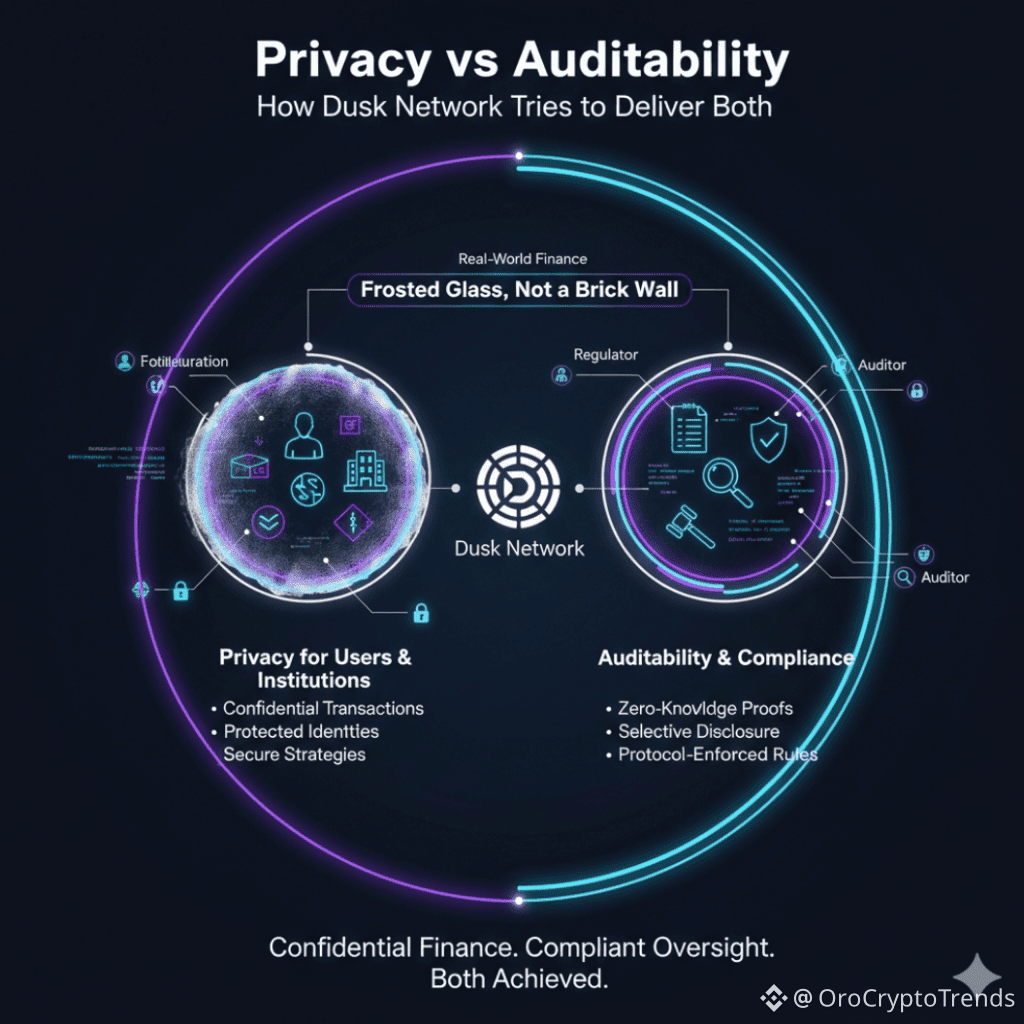
Why Confidential Finance Doesn’t Have to Mean Hidden Risks
How Dusk Mixes Privacy Tech With Real Compliance
Let’s face it, the debate around privacy and transparency is one of the biggest ongoing conversations in the crypto world. Most public blockchains are built on the premise of radical transparency—every transaction, every wallet balance, every contract is out there for anyone to examine. On the surface, this open access is great for building trust and accountability, showing that the system has nothing to hide. But, for many users, this level of exposure comes at a steep cost.
There’s a real human side to this. For individuals, privacy isn’t just about secrecy—it’s about personal safety, autonomy, and control over sensitive financial data. No one wants their entire transaction history, investment activity, or even salary payments available for anyone to map out. For larger organizations and financial institutions, the stakes are even higher. Client information, proprietary trading strategies, and confidential deal flows are valuable assets that need to stay secure. Yet, these same players have to operate within the rules—regulators and auditors still demand visibility to ensure compliance and prevent abuse.
It’s a constant balancing act. Too much privacy and the system starts to look suspicious—potentially enabling illicit activity or hiding risks. Too much transparency and the network becomes unusable for real financial operations, with sensitive data leaking out and competitive advantages lost.
Dusk Network is attempting to bridge this divide—offering a solution that aims to satisfy both sides of the equation.
The Real Issue: Public Chains vs Real-World Finance
Think of traditional blockchains as glass bank vaults. Every move—deposit, withdrawal, transfer—is on display for all to see. While this works for simple value transfers and basic crypto use cases, it simply doesn’t scale to complex, regulated financial activities. If you want to put tokenized stocks, bonds, or institutional trades on-chain, you can’t have everything exposed. Real-world finance is built on confidentiality and controlled information sharing.
Institutions want the ability to:
- Keep transaction details confidential, so trade sizes, counterparties, and strategies aren’t broadcast to competitors
- Protect ownership records, ensuring only authorized parties can verify or update them
- Control who can access sensitive data, limiting exposure to only those who truly need it
At the same time, regulators and auditors need certain guarantees:
- Assurance that market rules are being enforced correctly
- Access to a provable transaction history for investigations or audits
- The ability to step in and review specific activities if something goes wrong
This is where Dusk’s approach becomes unique, offering a way to meet the needs of both privacy-seeking participants and oversight authorities.
How Dusk Handles Privacy
Dusk leverages zero-knowledge cryptography, a breakthrough in privacy technology that allows for verification of facts without revealing the underlying data. It’s like being able to prove you’re old enough to enter a bar without handing over your ID or date of birth. The network can check that transactions and smart contracts follow the rules, but the sensitive details—amounts, identities, strategies—remain confidential to outsiders.
In practice, this approach delivers several key benefits:
- Trading activity is shielded from the public, so market participants can transact without tipping off rivals or leaking strategies
- Investor identities stay protected, reducing risks of targeted attacks or unwanted profiling
- Competitors can’t spy on deal flow or copy successful strategies, preserving fair competition
Importantly, the aim isn’t to enable illicit activity or foster a black market. Dusk’s design is about limiting exposure to just what’s necessary—protecting privacy while still enabling oversight.
So, How Do You Audit the System?
A natural concern arises: If you can’t see the details, how do you know everyone’s playing by the rules? If everything is private, what stops someone from cheating the system or hiding risk?
Dusk avoids the extremes of either total secrecy or radical openness. Instead, it relies on selective disclosure and cryptographic proofs—tools that allow verification without unnecessary data leakage.
Here’s what sets Dusk apart:
1️⃣ Proof Without Revealing Everything
Zero-knowledge proofs let the network enforce rules—like balance checks, trade validity, or ownership transfers—without showing the actual transaction details or the parties involved. This means the system can guarantee compliance with protocol rules, preventing double-spending or fraud, all while keeping user data under wraps.
2️⃣ Controlled Access for Auditors
Recognizing that some situations require extra scrutiny, Dusk enables special, permissioned access for auditors and regulators. These trusted parties can be granted the ability to review specific transactions or user activity, but the public still can’t see this information. This model supports regulatory needs without undermining the privacy of all users.
3️⃣ Compliance From the Ground Up
Dusk doesn’t treat compliance as an optional add-on. Instead, it’s built into the very infrastructure of the network. Features like ID verification, transfer restrictions, and investor limits are enforced at the protocol level, automating much of the heavy lifting required to meet financial regulations. The network itself acts as a compliance engine, reducing the risk of accidental or intentional breaches.
In essence, Dusk is not about choosing between total privacy or total transparency. It’s about orchestrating a system where each participant—users, institutions, regulators—gets access to the information they genuinely need, and nothing more.
Why This Actually Matters
As more real-world assets—equities, funds, debt instruments—find their way onto blockchains, the lines between traditional finance and crypto blur. But banks, asset managers, and large corporations won’t embrace blockchain tech unless their core requirements are met. They need a platform that won’t leak sensitive information or expose them to regulatory risk, but they also can’t operate in a black box with no oversight.
Dusk’s goal is to provide that elusive middle ground:
- Privacy robust enough for institutions and investors to trust the system and participate with confidence
- Auditability and transparency sufficient for regulators and the broader market to maintain trust, prevent abuse, and enforce rules
If Dusk can deliver on this vision, it’s not just about making crypto safer. It’s about making blockchains truly suitable for the world of institutional finance—opening the door to a future where mainstream financial assets can exist, trade, and settle on-chain without compromise.
Frosted Glass, Not a Brick Wall
A helpful way to visualize Dusk’s approach is to think of frosted glass.
A brick wall is total secrecy—nothing gets through, but nothing can be checked.
Clear glass is full transparency—everything is visible, but nothing is protected.
Frosted glass lands in the middle. You can see that activity is happening, you might make out broad movements or shapes, but the fine details remain obscured.
This is the balance Dusk is striving for: enough visibility to guarantee rules are followed and trust is maintained, but enough privacy that sensitive information never falls into the wrong hands.
By blending cutting-edge privacy technology with compliance features from day one, Dusk aims to build a financial system that is secure, compliant, and ready for the demands of institutional and individual users alike.
If successful, this model could transform blockchains from tools of speculation into the backbone of global, regulated finance.
Disclaimer: Not Financial Advice
