
The blockchain space has historically lived more on the strength of tales than it has lived on the strength of reality. Indeed, more often than not, what has ended up moving the space more than anything else was not so much what was possible but rather what was being said or promised. However, these are slowly becoming different times. And Vanar is right at the heart of the change from a world centered more around narratives to a world centered more around actions. The latter is a world of usage driven growth.
In simple terms, narrative driven growth relies on ideas, brands, and future visions. Usage driven growth, on the other hand, relies on users using the product. While it sounds minor, it is a huge difference. If a blockchain is used by millions of users, has millions of transactions, and has applications used to solve real problems, it becomes a business with a real value. Vanar’s recent direction of development speaks to this kind of mindset. Instead of being heavily focused on marketing stories, it has been heavily investing in infrastructure to support users and day to day use, such as AI powered on chain data compression, flat transaction fees, and tools to automate complexity.
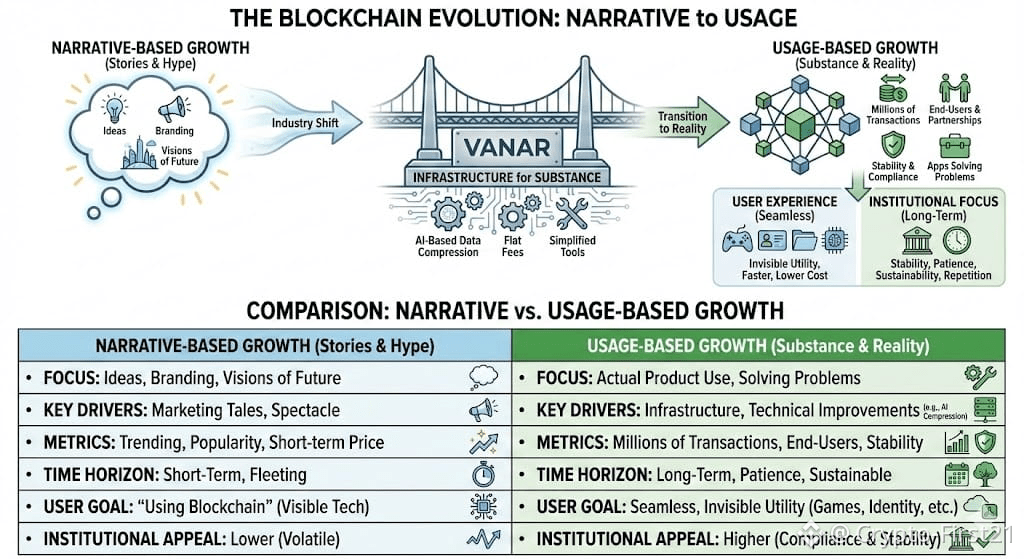
Recent network data reveals a steady growth in the number of transactions and an increase in ecosystem partnerships, a suggestion that real usage is starting to become the fundamental driver. More developers are building applications based on sustained activity instead of speculative hype. Value is created by repetition and reliability, not by excitement alone, within this environment. This would also attract institutions, which really have a lesser care for short term price movements and stability, compliance, and predictable performance. The quiet churning of millions of transactions on a blockchain is far more interesting to them than one trending in social media for a week.
From the perspective of user experience, this is a healthy shift. Most people do not want to use blockchain; they want to play games, manage digital identities, store data, or interact with AI tools. If blockchain disappears into the background and simply works, adoption becomes natural. Vanar's technical approach tends toward this philosophy, particularly because it simplifies storage, lowers costs, and removes friction. The technical words on chain compression or AI native infrastructure may sound complex, but the result is pretty simple: faster apps, lower fees, and more reliable digital services.
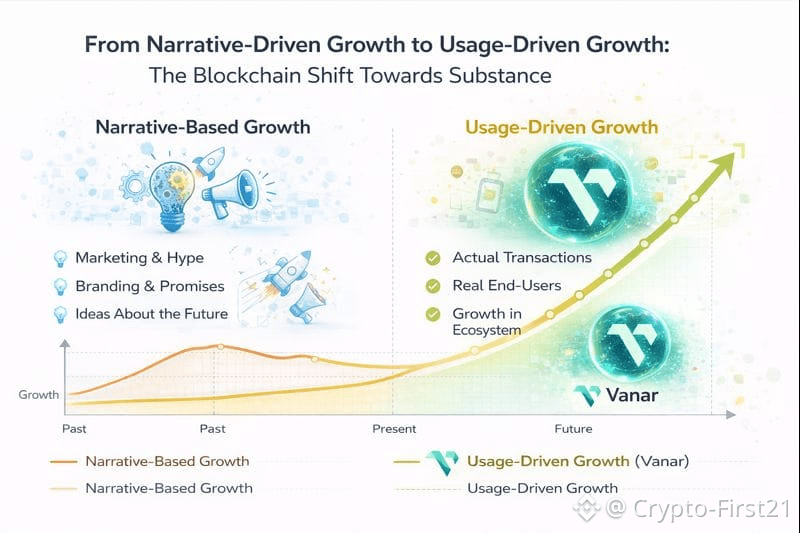
There's also a cultural shift underneath, I think. These kind of usage-driven systems privilege patience, thinking long term, and designing well. They encourage you to think in terms of sustainability, not sensation. When I think about the most impactful technologies, I've found that the ones you forget to worry about because they're so ubiquitous might be more impactful than the ones that get buzz because they're so new. Enthusiasm for the slow movement of blockchain might not be as glamorous, but it's more hopeful.
In the long run, this process may help determine which projects endure. Hype dies down, but usage does not. As users return daily, as developers continue to build, and as organizations gradually integrate projects into their lives, growth stabilizes. The journey of Vanar is an embodiment of this broader development of the blockchain industry, as value is increasingly determined by usage rather than artfully constructed narrative. It may be argued, if blockchain is ever going to become mainstream, this may be the single largest step of all.
