
Initially, the concept of blockchain privacy might seem to be an intricate technical problem suitable for cryptographers and programmers only. Dusk, however, attempts to address this problem from a rather human centered angle. Instead of focusing on how much complexity it can incorporate, it has focused on how much simplicity it can provide. Its zero knowledge strategies are not only for concealing information, but also for influencing the manner in which human beings or organizations might interact with digital financial systems. Zero knowledge technology allows users to prove that something is true without actually revealing what it is about. In simpler terms, this is like proving you have enough money to spend on something without revealing the amount in your account.
Dusk’s architecture is built on the assumption that privacy alone is not enough. It is not enough on its own, for it needs to coexist with compliance, usability, and performance. Some of the previous attempts to design privacy centric systems failed because they withdrew from the real world laws and institutional needs. Dusk’s architecture is designed to bring some degree of disclosure.
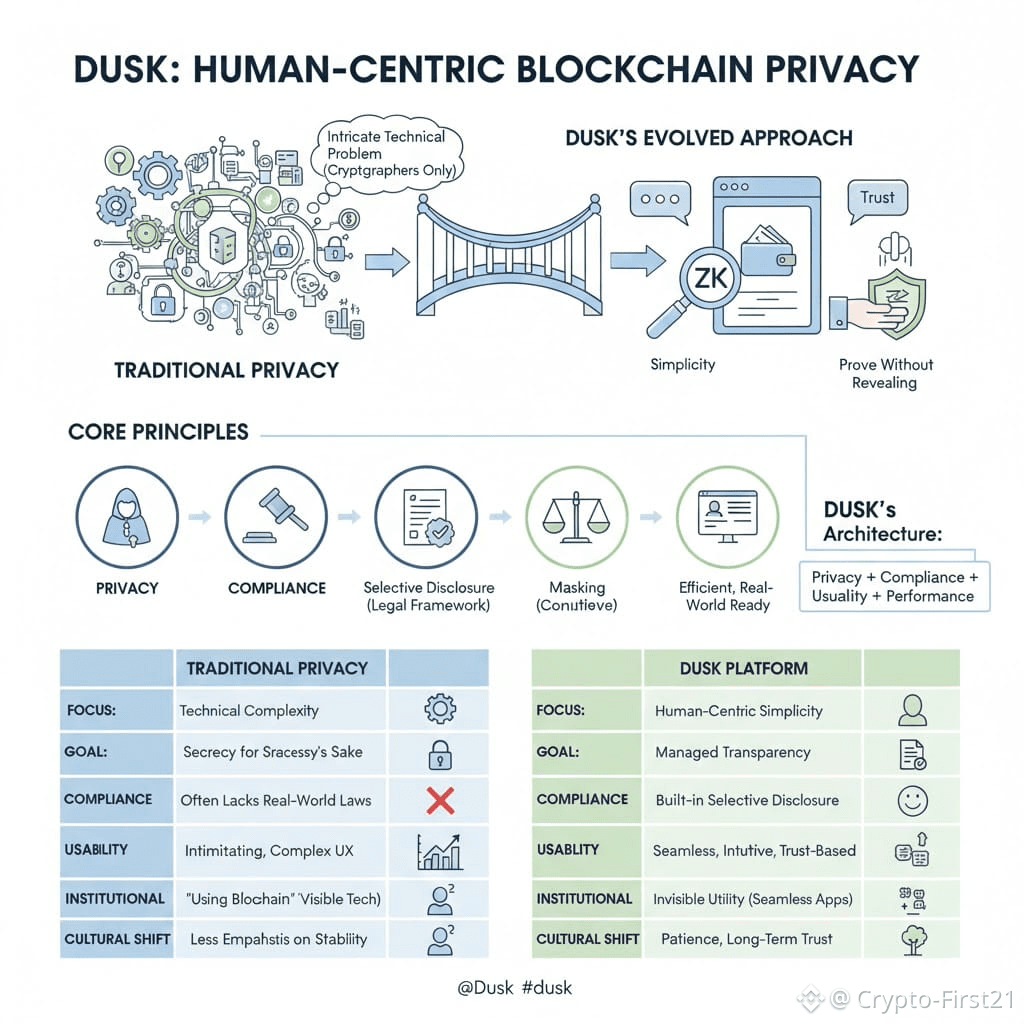
Dusk seeks to bridge this gap by providing a feature called selective disclosure, which means that data can be kept confidential by default and still be disclosed when necessary within a legal framework. This is a telling change and points to a more nuanced awareness of how financial systems actually work. These organizations aren’t seeking secrecy for its own sake; they’re seeking a form of transparency that can be managed. Dusk is providing this by default, and in doing so, it’s not a rebellious technology; it’s an evolved form of the existing architecture.
However, it is through ease of use that only minimal awareness of zero knowledge proofs is realized. And this is where Dusk distinguishes itself: rather than making users aware of all the complexities that are going on, it seeks to mask them. Transactions are recognizable, interaction is expected, and trust is cultivated over time. People use something that they feel is safe and makes sense, not something that is merely cutting edge. One only needs privacy when it is no longer intimidating.
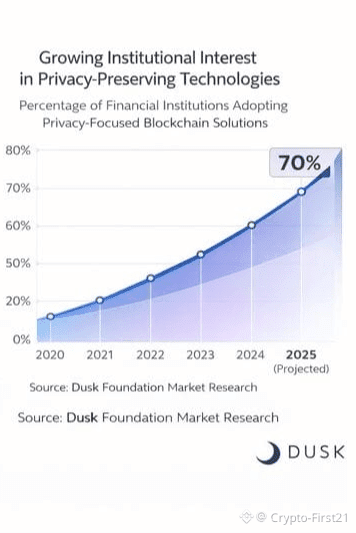
Looking into the data we can find in the financial market over the past few years, it is easy to understand the growing trend related to the interest in the application of privacy preserving technologies, especially in regions where data protection regulations are quite strict. In the case of Dusk, it is easy to understand that this platform is quite in tune with the requirements investors related to this market segment would like to see, thus indicating that we might be able to talk about the long term perspective rather than short term speculation.
From my own point of view, I find this kind of approach to design quite refreshing, as it attempts to respect human psychology as much as the reality. There is something quite reassuring about technology that actually works very hard behind the scenes so that humans do not have to. In many ways, this might be the most powerful design decision of all.
