
The walrus is becoming an important part of web3. It is quietly becoming the shared data layer of web3. This means that the walrus is helping to make sure that data can be shared easily between parts of web3. The walrus is doing this quietly which is why not many people are talking about it.. The walrus is still very important to web3. The walrus is like a layer that helps all the different parts of web3 work together. This is why the walrus is becoming the shared data layer of web3. The walrus and web3 are going to be very important, in the future.
When I first looked at Walrus, what really caught my attention was not what people were saying about how fast it's how quickly it can get things done. It was the fact that other teams were already using Walrus and building things with it. To me that is usually a sign. Walrus does not need to advertise itself. The fact that people are actually using Walrus is what matters.
Walrus is like a helper that works under Web3. It is a way to store things like pictures, videos and big files that computers use to learn. These are things that regular blockchains have a hard time handling. People need them for their apps.
Walrus does not try to put all of this data on the blockchain. Instead it spreads the data across different computers and then it tells the blockchain that the data is still there.
In words Walrus can show that your data is safe without having to keep it all in one place on the blockchain. Walrus is a decentralized storage layer, for Web3. It is designed to handle big and real data like media files and AI datasets and website assets.
The design choice is important because partners matter a lot in this situation. Partners are really important here. That is why partners matter much.
Take Baselight for example. Decentralized storage can be pretty boring on its own. You put your data there and it just stays there doing nothing.. Baselight is different. It directly connects to the datasets you have stored on Walrus. This makes your data interactive. You can search through it easily. You can even ask questions using language. Baselight does not need SQL or any backend setup. This completely changes what storage is, for. Data is not something you store away anymore. Baselight makes data something you can actually work with. You can use Baselight to make your data useful. Baselight and Walrus work together to make this happen.
Underneath all that experience the Walrus is doing some work. The Walrus is keeping the datasets available for the Walrus to use. The Walrus is also making sure the integrity of the data is good. The Walrus is handling the scale so the Baselight can focus on how easy it's for people to use. This way of doing things is really important for the Walrus. The Walrus does not try to be better, than the analytics tools. The Walrus helps the analytics tools do their job.
Then there is Nami Cloud, which deals with an issue. A lot of decentralized infrastructure does not work because users do not like things that're complicated. Nami Cloud uses Walrus as the basis for storing things. It makes the complicated parts simple. This means that apps can use storage without needing users to know about things, like nodes, proofs or blobs. That is how Nami Cloud actually helps users use the infrastructure. Nami Cloud makes it easy for users to use storage.
Tusky offers a view. It uses Walrus to store the files that real users upload today. These are not just experiments or test files. They are things that people upload because they want to use them. This is what really matters, not just what people write about in papers. It shows that Walrus can handle the way people really use it not just when everything is perfect.
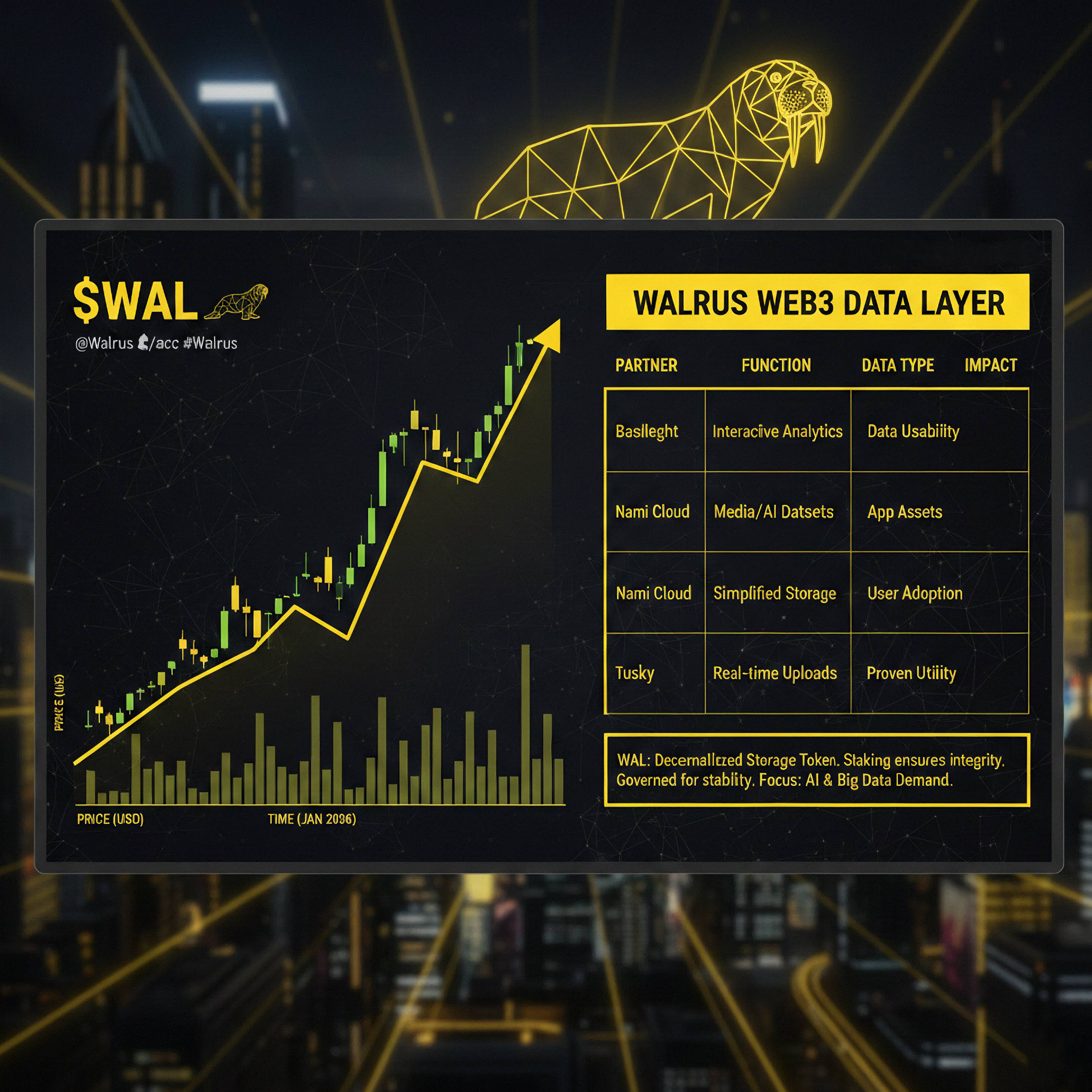
What ties all of this together is $WAL .
WAL is not meant to be fancy. The people in charge of WAL tell you how much you have to pay for storage away so you know what to expect. WAL makes sure the people running the nodes are doing their job by using something called staking which means they have to be honest and keep everything running smoothly all the time. WAL also makes sure that any big changes are thought through carefully which means it takes a longer to make decisions but it is safer, for everyone who uses WAL.
That slowness is a thing, not a bad thing. In a market that's still all about the stories people tell Walrus seems like it is made for something that is more stable. The amount of data we have is getting bigger and bigger. The need for Artificial Intelligence is getting stronger and stronger. People do not trust the companies that control everything as much as they used to. Storage is becoming very important again. Walrus is ready for this because Walrus is built for something. The demand, for Artificial Intelligence is. Walrus is part of this.
Walrus does not say it will replace the cloud away. It does not have to do that. Walrus just needs to be something that people can count on so that builders will continue to choose Walrus for the things they build on top of it like the products they make with Walrus.
If this keeps going on the Walrus will not be remembered for being loud. The Walrus will probably be known for something. The thing that people will remember about the Walrus is not that it is loud. It is something that the Walrus does. Has that is not related to being loud. The Walrus is going to be remembered for something, than its loudness.
The data will be remembered for being when the data really mattered. The data was important. People will recall that the data was available when it was needed.