
BTC broke through the 87,000 mark within an hour, and the entire network saw a collective liquidation of 25 million USD in leveraged positions. Many long positions' stop-loss orders were wiped out, waking several people up in the early morning with liquidation text messages. They had to cut losses and exit. The trigger for this plunge was neither the Federal Reserve's interest rate hike nor a whale's sell-off, but rather a 'false ball' from the US government—planning to build a 2.8 billion USD BTC strategic reserve, resulting in the theft of 40 million USD from a contractor's managed seized wallet, exposing a huge security vulnerability in the decentralized custody system.
The market instantly voted with its feet: if even the US government, which holds regulatory power, cannot protect BTC, what assurance do ordinary investors have for the safety of their assets? Panic selling followed in droves. However, as investors deeply involved in the crypto market, we must remain clear-headed: this plunge is not a collapse of fundamentals, but an emotionally driven correction sensitive to policy; the short-term panic releases risk, but in the long run, the incident may instead accelerate the compliance process of the crypto industry, creating a trillion-dollar bonus for institutional custody. Today, we will discuss the real impact of this event on coin prices and investments from four dimensions: market data, underlying logic, policy linkage, and practical suggestions—it's all hardcore market analysis, without a single wasted word.
The essence of the $25 million liquidation is "emotional trampling," rather than capital outflow.
Within 12 hours of the event's exposure, BTC quickly dropped from $91,000 to $86,000, a decline of 4.4%. The total leveraged liquidation across all cryptocurrencies reached $25 million, of which 90% was BTC long positions. However, looking at the essence through the data, this decline has two key characteristics that determine it is merely a short-term emotional trampling:
First, the liquidation scale is far smaller than previous crashes. Compared to the $865 million liquidation caused by last year's trade war or the $120 million liquidation due to ETF fund outflows, the $25 million scale can only be considered "small-scale selling pressure," indicating that core market funds have not fled but rather that short-term speculative positions exited due to panic.
Second, the spot trading volume has not expanded; the trading volume turnover rate of exchanges increased by only 12% compared to the previous day. In contrast, real capital outflows during crashes are often accompanied by a doubling of spot trading volume. In simple terms, the market is not panicking because "BTC is worthless now," but rather because "the favorable expectations of the U.S. government's involvement have collapsed." Such emotional declines are often quickly repaired after panic is released.
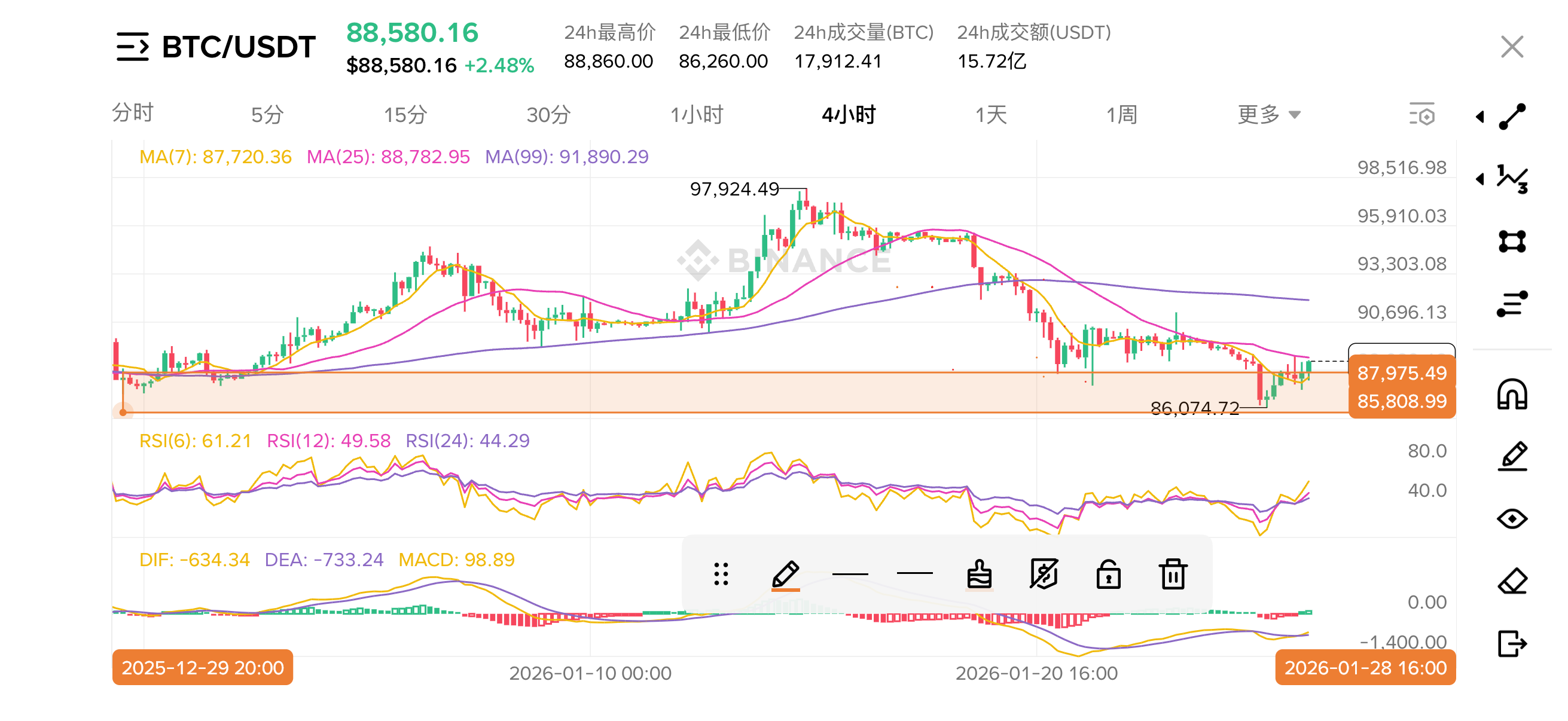
However, this does not mean there are no risks in the short term: $86,000 is a key support level for BTC recently. If there are further negative policies, it may dip to the previous low of $85,000; if the support holds and sentiment improves, BTC will likely return above $90,000. Opportunities are hidden in panic, but so are traps. The core of short-term operations is "do not chase falls, do not hold positions," and controlling leverage is the top priority.
Short-term selling pressure stems from a "crisis of trust," while long-term benefits come from "compliance-driven" pressures.
Many people are puzzled: $40 million is just a drop in the bucket compared to the $2.8 billion reserve plan, so why did the market react so strongly? The answer is simple: the market is not concerned about the $40 million loss, but rather the U.S. government's ability to manage BTC custody and whether the underlying logic of "institutional entry" holds water.
In the short term, the collapse of trust in government custody has directly reversed the market's "policy favorable expectations." Before this, the U.S. government planned to establish a BTC strategic reserve and held nearly 198,000 BTC, including those confiscated from Silk Road and recovered from Bitfinex. The market generally believed this was an important signal of "official recognition of BTC as a strategic asset" and a core logic for the continued entry of institutional funds. However, this theft case exposed the vulnerabilities of the government's decentralized custody system—multiple institutions and third-party contractors jointly manage wallets, lacking unified security standards and processes, leading to market skepticism: if the government cannot manage BTC well, how can institutions confidently increase their positions? This reversal of expectations is the core reason for the selling pressure, rather than merely a negative event.
However, in the long run, this incident is not a negative but rather will become a "catalyst" for the compliance of the crypto industry, with the core basis being the rigid requirements of the H.R.5166 bill. This bill has long made it clear that the U.S. Treasury must establish a "safe and efficient custody plan for federal digital assets" within 90 days of the bill's enactment, including core elements such as custody architecture, network security controls, and cross-institutional flow processes, even requiring monthly disclosure of asset custody data. This theft case will accelerate the Treasury's implementation of this plan, forcing the entire crypto industry to establish unified institutional-level BTC custody standards.
It should be noted that the current institutional custody sector in the crypto market has been in a state of "no unified standards, with various institutions fighting their own battles," which is one of the biggest concerns for institutional capital entering the market. As the U.S. government sets the "benchmark," the custody standards it establishes will become a reference for the global industry, completely dispelling institutions' security concerns and attracting more traditional financial capital into the market. In other words, this $40 million theft case is essentially "tuition paid for industry compliance." The short-term pain will bring long-term industry dividends.
Policy linkage: SEC + CFTC coordinated regulation, banks anti-stablecoin profits, revealing a core signal.
If we view this custody theft case in the context of recent U.S. crypto policy, a clear trend emerges: U.S. regulation of cryptocurrencies has shifted from "one-size-fits-all suppression" to "trial and error while establishing rules," with the core being "regulation rather than prohibition." This is also a key basis for our judgment of the long-term trend in the crypto market.
First, the regulatory coordination meeting between the SEC and CFTC is an important signal that crypto regulation is moving towards "unification." Just today, the SEC and CFTC held a joint event on "regulatory collaboration" with plans to restart a joint advisory committee. Prior to this, the two agencies had significant differences in regulating crypto: the SEC defined most cryptocurrencies as securities, while the CFTC viewed BTC and others as commodities. This divergence left institutions and project parties confused. This coordinated regulation means that the U.S. will establish a unified crypto regulatory framework, reducing policy uncertainty, which is a long-term boon for the market.
Moreover, the U.S. banks' opposition to stablecoin yields is essentially a "battle of interests," not a denial of crypto. The American Bankers Association has listed "banning stablecoin yields" as a top priority for 2026, with the core reason being that the yield function of stablecoins will erode the low-cost deposit profits of banks, rather than the existence of systemic risks in stablecoins themselves. In fact, the reserve funds of stablecoins ultimately flow back into the banking system. The banks' opposition is merely to protect their own interests, not to deny the value of crypto finance. Furthermore, the U.S. government has not supported a comprehensive ban by banks but has instead regulated stablecoin development through the GENIUS Act, indicating that policy is more inclined towards "balancing innovation and interests" rather than stifling the crypto industry.
Combining this BTC custody incident, the logic of U.S. crypto policy has become very clear: it does not reject crypto assets becoming legitimate financial assets, and even acknowledges BTC's strategic value, but requires the crypto industry to establish compliant and secure operational systems according to the standards of traditional finance. Custody standards, regulatory frameworks, and stablecoin rules reflect this logic. This trend of "compliance" is the necessary path for the crypto market to transition from a "speculative market" to an "institutional market." In the long run, it will only make the market healthier and more attractive.
Practical investment advice: Retail investors should avoid volatility, while laying out the institutional custody technology track is key.
Having discussed the underlying logic and policy trends, the most practical approach is to provide everyone with actionable investment advice, splitting it into short-term retail operations and medium-to-long-term track layouts to suit investors with different risk preferences, all based on rational judgments of the market situation:
Retail short-term operations: Avoid "policy-sensitive fluctuations," do not hold leverage, and safeguard spot positions.
1. Abandon short-term contract speculation: Recently, the crypto market has been greatly influenced by policy news, SEC/CFTC meetings, the rollout of the Treasury's custody plan, and proposals for bank stablecoins, all of which could cause significant market fluctuations. In such an environment, leveraged trading can easily be trampled by emotions; last night's $25 million liquidation is a lesson.
2. Accumulate spot positions on dips, do not chase highs or sell lows: $87,000 to $85,000 is a strong recent support level for BTC. If it pulls back to this range, one can gradually buy spot positions. The core logic is that the U.S. government holds nearly 200,000 BTC and will not abandon the $2.8 billion reserve plan due to a single theft case; the long-term logic for institutional entry has not changed.
3. Stay away from small-cap altcoins: During emotional panic, funds tend to flow back from altcoins to mainstream coins like BTC. The declines in small-cap coins will be much larger than in mainstream coins, and there is even a possibility of liquidity drying up. Observing more and acting less in the short term is the best choice.
Medium to long-term track layout: Focus on institutional custody technology upgrades, which is a trillion-dollar compliance dividend.
This theft case has made the market fully realize that institutional-level BTC custody technology is the core necessity for the crypto industry to move towards institutionalization. The implementation of H.R.5166 will make custody technology the "golden track" of the crypto arena, focusing on two directions:
1. MPC multi-party computation and multi-signature technology: This is the current core technological direction for institutional custody. MPC splits private keys into multiple fragments held by different parties, ensuring the complete private key never appears on a single device, fundamentally avoiding single-point theft; multi-signature requires multiple private key authorizations to execute transactions, suitable for government and institutional co-management scenarios. Currently, leading custody institutions are ramping up investments in these two technologies, and related technical service projects will become a focus for institutional funds.
2. Compliant institutional custody platforms: With the rollout of the Treasury's custody standards, custody platforms with "compliance qualifications + technical capabilities + cross-institutional collaboration capabilities" will become highly sought after in the market. Especially those that can connect with traditional financial institutions and government departments will directly benefit from the custody demand of institutional funds and government reserves, with enormous growth potential.
3. Blockchain security services: The core of custody security is blockchain security, including wallet security, transaction risk control, and network protection. This government custody security loophole will lead the entire industry to increase investment in blockchain security, and related security service projects will also see a dual increase in performance and valuation.
In addition, attention can also be paid to the compliance infrastructure of the BTC ecosystem, such as settlement systems connecting traditional finance and asset tracing platforms. These are all rigid market demands following the implementation of U.S. regulatory policies, a hundred times more reliable than purely speculative concept coins.
Short-term emotions will eventually dissipate; compliance is the long-term main line of the crypto market.
BTC fell to $86,000, with $25 million in leveraged liquidations. The U.S. government's $40 million BTC theft case appears to be the "darkest hour" for the crypto market, but in reality, it is an "inevitable path" toward the industry's maturation.
The development of the crypto market has never been smooth sailing: from the collapse of Mt. Gox to the FTX explosion, from regulatory crackdowns to institutional entry, each crisis pushes the industry to eliminate outdated models and establish more complete rules. This government's custody theft case is essentially the same—it exposes the industry's shortcomings but also accelerates the compliance process, making the path for institutional funds smoother.
For us investors, the most essential ability is to maintain rationality amid emotional panic and to see long-term trends amid short-term fluctuations. The long-term value of BTC has never been altered by a single short-term policy event; the long-term trend of the crypto industry has also never reversed due to a single emotional correction. In the short term, the market may still experience policy-sensitive fluctuations, but in the long term, compliance, institutionalization, and globalization remain the three major trends in the crypto market.
Hold onto spot positions, lay out compliance tracks, and stay away from speculative gambling; this is the best strategy to deal with the current market. After all, in financial markets, those who ultimately succeed are always those who see trends clearly and maintain their core values.