
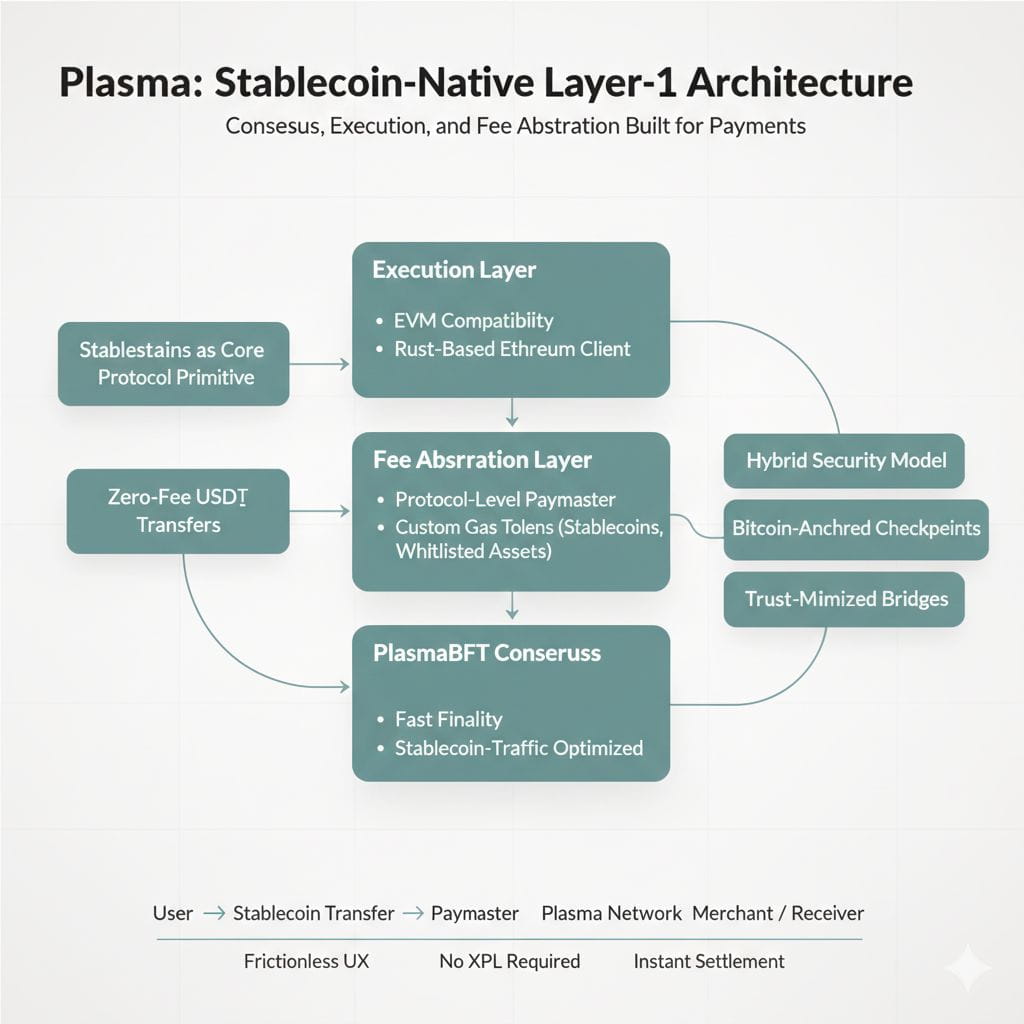
Plasma is a Layer-1 blockchain that focuses on making stablecoin transactions frictionless and scalable, distinct from general-purpose DeFi or speculative trading. Its design treats stablecoins as the core primitive of the chain, rather than as an add-on feature.
Plasma's architecture is built on three things: consensus, execution, and fee abstraction. PlasmaBFT consensus offers deterministic and fast finality, which is essential for high-frequency stablecoin traffic. Additionally, the network is EVM compatible, allowing developers to deploy contracts using familiar Ethereum tooling without changes.
A distinctive element is the protocol-level paymaster system. This mechanism sponsors the gas costs for basic USD₮ transfers, allowing users to not hold XPL for simple stablecoin sends/receives. This keeps the UX clean and lowers barriers for entry, which matters in real-world use cases like remittances and merchant payments.
Additionally, custom gas token support has been provided in Plasma. Users can pay transaction fees in stablecoins or whitelisted assets like BTC, which increases both ecosystem flexibility and adoption ease.
The hybrid model's dependency on Bitcoin and Ethereum is also its technical anchor. The Plasma network enhances security and settlement certainty by using trust-minimized bridges and Bitcoin-anchored checkpoints, while EVM compatibility provides access to a broader developer ecosystem.
$XPL is central to the token ecosystem. It serves as a governance asset for staking, utility for transaction fees, and long-term governance participation for network security. With an initial supply capped at 10 billion, it incentivizes XPL validators and sustains network economics.
During the market introduction, XPL generated significant interest — listings occurred on major exchanges and the stablecoin TVL integrated within the tens of billions range. However, the volatility of token price and liquidity dynamics highlighted that the gap between infrastructure promise and real adoption is still present.
The thesis of Plasma is clear: stablecoins have become the largest use case for blockchain, and now they need their native rails to make payments, remittances, and commerce seamless. However, building infrastructure and scaling real-world usage are two different things. The path ahead will be defined by adoption metrics, real transaction volumes, and partner integration.