
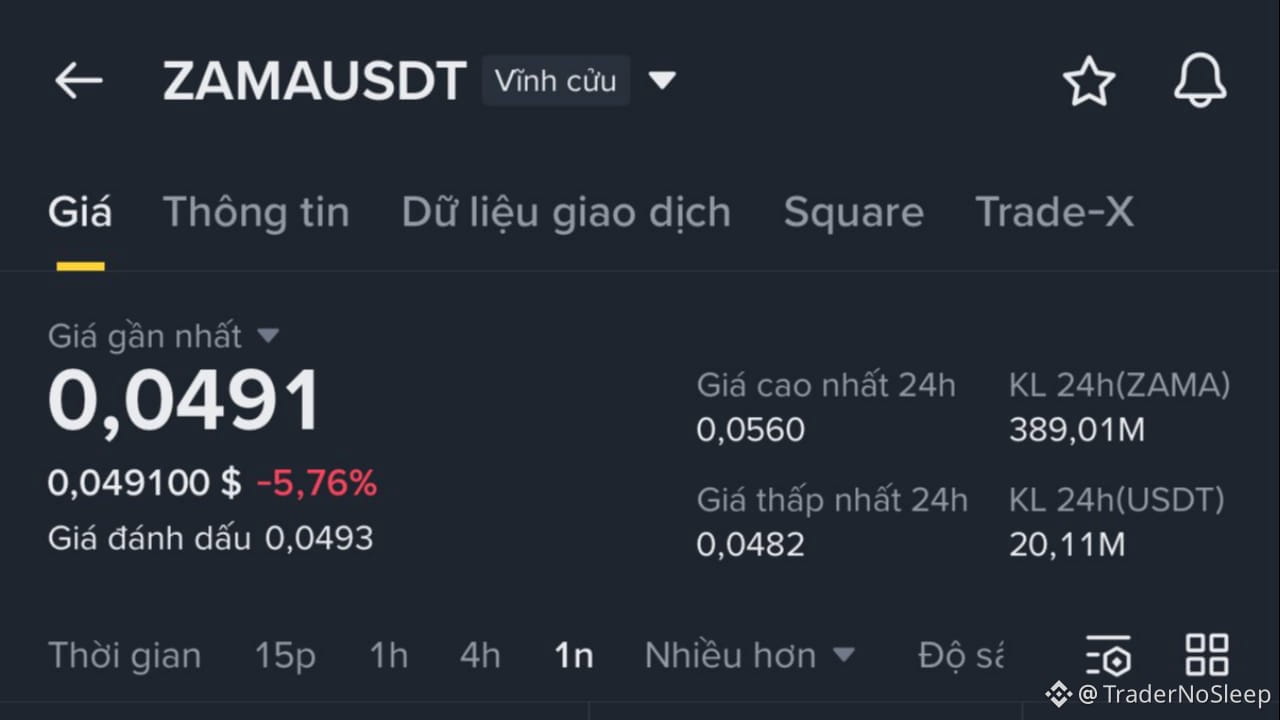
In the period before the token officially lists, the market often experiences pre-market trading (OTC, IOU, futures, early auctions...). The prices during this stage may not be the 'real price', but they reflect quite clearly the expectations, psychology, and positioning of the project in the eyes of smart money.
1. What is Pre-market?
Pre-market is where:
Investment funds, KOL, market maker
Early investors, insiders
Professional traders
Token trading when:
Not all supply unlocked
Limited liquidity
Information not fully public
Therefore, the pre-market price is not just a number, but an expected future valuation.
2. The pre-market reflects 4 core factors
🔹 (1) Confidence in technology & narrative
A project has:
Strong core technology (like Zama with FHE, privacy computation)
Cycle-appropriate narrative (AI, RWA, Privacy, Infrastructure)
→ The pre-market price is often higher than the average because the market bets on the long-term infrastructure role, not just short-term pumps.
🔹 (2) Quality of the investment fund behind
When:
a16z, Multicoin, Pantera, Binance Labs…
Long lock token, high valuation
Then the pre-market will reflect:
"This is institutional holdings, not retail speculative trading."
The pre-market price at this time is often anchored at a high FDV level, as the market believes that:
There will be a top listing
There is a strong market maker
There is follow-up cash flow
🔹 (3) Expectations of supply – demand in the early stage
The pre-market reflects:
How many people want to buy before listing
How many holders are willing to sell early
If the pre-market price:
Steady, not heavily sold → early supply is low, holders have confidence
Deeply pressed → unlock pressure, a desire to escape early
This is an important indicator to measure hidden selling pressure when TGE.
🔹 (4) Positioning future FDV
In fact, the pre-market is answering the question:
"What tier does this project deserve in the ecosystem?"
For example:
Infrastructure tier (L2, DA, Privacy, AI compute) → FDV usually ranges from several hundred million to several billion
Application tier → lower FDV, depending on user growth
High pre-market price = the market categorizes the project into the core infrastructure group, not a short-term coin.
3. The pre-market is neither a bottom nor a peak
Important to understand:
The pre-market is not the cheapest price
But it is also not an illusory price
It is:
The price level balances future expectations and unproven risks.
When listed:
If the narrative explodes + FOMO cash flow → the price can be much higher than pre-market
If the market is bad + strong unlock → the price can be lower than pre-market
But in the long term, the pre-market is often a reference point for value positioning, similar to:
Seed round valuing the company before IPO.
4. How to use the pre-market to make decisions
Smart investors do not ask:
"How much is reasonable for the pre-market?"
But ask:
This FDV compared to:
Technology?
Team?
Competitors in the same sector?
Market size (TAM)?
Compared to projects with the same narrative in previous cycles.
If:
Pre-market lower than intrinsic value → accumulation opportunity
Pre-market has reflected too many expectations → needs risk management, no FOMO.
Conclusion
Pre-market price is not simply the early trading price, but is:
The valuation belief of smart cash flow into the future of the project.
It reflects:
Technology level
Fund quality
Cycle narrative
Long-term FDV expectations
Understanding the pre-market correctly, you will not be swept away by emotions at listing, but see the true position of the project in the larger picture of the crypto market.
#tge #BinanceSquareTalks #JourneyIntoCrypto