

If you examine the trend of digital world development, you will see that people are no longer interested in temporary experiences that disappear with server restarts or platform closures. They want persistence, memory, and trust. A persistent digital world, whether it is a gaming world, virtual reality world, financial world, or AI-based world, requires a system that is capable of storing data in a reliable manner, handling identity in a secure manner, and scaling without failing under pressure. Vanar was created with this in mind. Rather than optimizing for pure speed, Vanar optimizes for the structural needs of a persistent digital world. What this means is that it is intended for reliable data storage, predictable costs, energy efficiency, and systems that institutions can trust. While these may seem like technical specifications, at the end of the day, they are all about one thing: making digital worlds feel trustworthy.
A persistent digital world requires memory. Without memory, experiences are fleeting and disjointed. Vanar solves this problem by designing its infrastructure to store data directly on chain in a compressed manner, rather than relying on external servers for storage. In other words, this enables key information, assets, and logic to be accessible and verifiable in the long term. This is less complex for developers. It also means that users’ history, achievements, and ownership are not lost. In the gaming and financial sectors, for example, where having long term records is important, this architecture is critical. Market trends already indicate that those platforms that provide continuity and ownership of assets retain customers for longer, and institutions are increasingly requiring open data trails for compliance and auditing purposes.
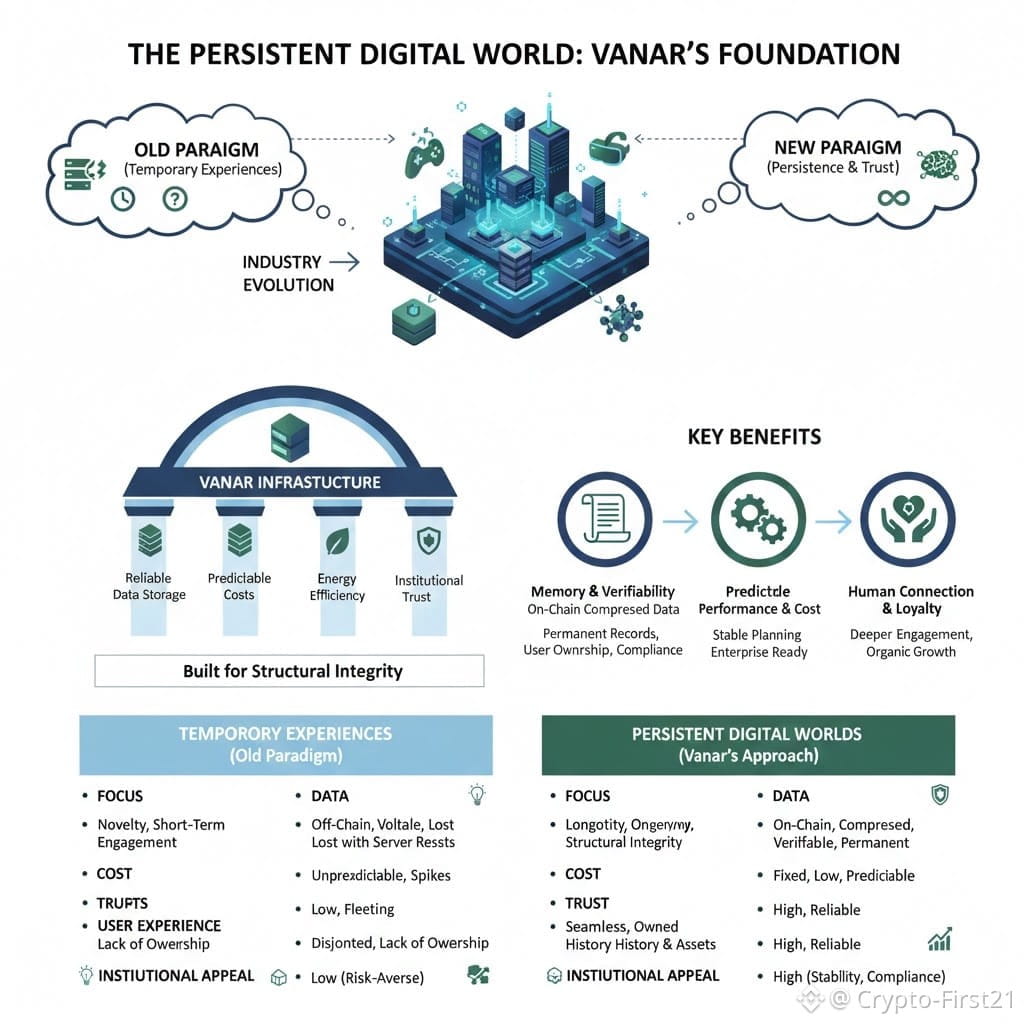
Another important aspect of persistent worlds is predictable performance and cost. If costs become unpredictable or skyrocket, or if systems become sluggish, trust is quickly lost. Vanar’s fixed and low cost transaction fees are intended to prevent this from happening, so applications can plan long term behavior without economic surprises. This is particularly important for enterprises, which budget, forecast, and model risk. For them, stability is often more important than innovation. In the past few years, institutional adoption of blockchain technology has been largely driven by applications that require high levels of reliability, such as payments, data validation, and asset management. Vanar’s approach is consistent with this philosophy.
In other words, this makes it possible for important information, resources, and logic to be accessible and verifiable over time. This is a simplification for developers. For users, this means that their history, achievements, and ownership are not lost. In industries such as gaming and online finance, where record keeping over a long period of time is important, this architecture is even more important.
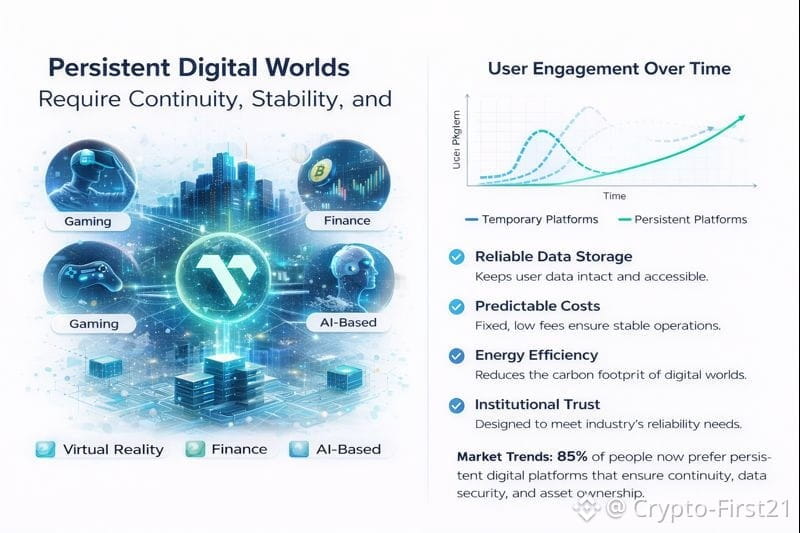
There is also a human side to this. Digital worlds are not just systems; they are emotional spaces where people invest time, imagination, and identity. When a system feels solid, people form deeper connections with it. I have seen that users remain in spaces where they feel their actions truly count and are remembered. This is a space of continuity that inspires loyalty and trust, which cannot be replicated by any marketing campaign. Another personal insight is that simplicity is often the key. Systems that conceal complexity and allow users to focus on experience tend to develop organically, without needing to be forced upon others.
Ultimately, the key to the success of digital worlds will be less about the bells and whistles and more about the substance. Vanar’s strategy is a reflection of this. It is a strategy that is centered on the idea of structural integrity, the persistence of data, and the ability to provide institutional grade stability. This is a strategy that will help to create a future where digital worlds are just as real and tangible as the physical world.
