

They drift off course in small, forgettable moments.
A transfer that should feel instant stretches into a pause. Someone checks a balance they didn’t think would matter. A confirmation takes just long enough for doubt to sneak in. Nothing is technically wrong, but the interaction already feels unreliable. That feeling is enough to change behavior next time.
This is the environment stablecoins now live in.
For many users, stablecoins are not an experiment. They are working tools for holding and moving value. People use them for routine needs — sending money to family, paying contractors, settling trades, managing business flows. The expectations are simple: the value should move when asked, and it should feel finished when it arrives.
But the infrastructure beneath stablecoins still often assumes users are willing to manage complexity mid-transaction.
Plasma approaches the problem from a narrower angle. It’s a Layer 1 shaped around stablecoin settlement as the primary job, not one use case among many. That focus changes what gets optimized. Instead of adding more features, the system removes points where payments typically stall.
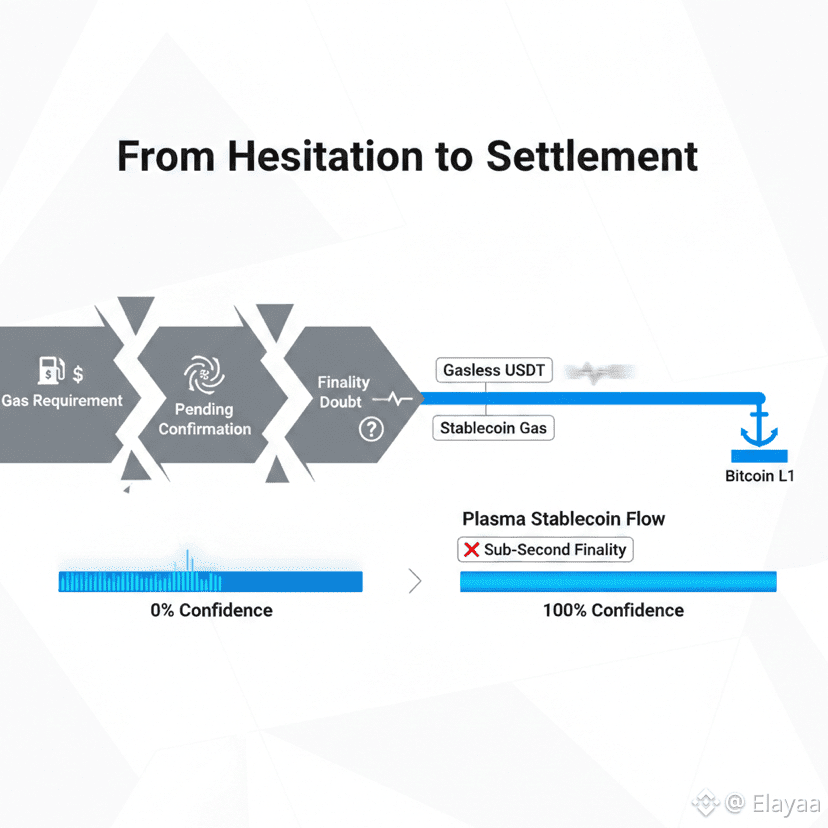
Gas is the first of those points. On most networks, gas is treated as background infrastructure. In practice, it’s a recurring interruption. Someone holds USDT but can’t send it because they don’t have a separate token for fees. That moment doesn’t feel like a technical requirement. It feels like a contradiction.
Gasless USDT transfers eliminate that contradiction. Stablecoin-first gas removes another layer of dependency. The system no longer asks users to prepare before acting. The path from intent to execution shortens, and with it, the number of ways a payment can fail before it even begins.
This isn’t about convenience. It’s about reducing the surface area where hesitation can grow.
Finality introduces another quiet source of friction. PlasmaBFT provides sub-second finality, but the real impact isn’t a number on a dashboard. It’s the timing of certainty. The transaction settles before attention has time to turn into doubt. No refreshing. No checking whether the state might still change.
The interaction ends quickly, and that quick ending shapes trust more than raw speed ever could.
There’s a pattern across payment systems that persist over time. They don’t encourage users to watch them work. They minimize the need for confirmation rituals. They aim to disappear as soon as the transaction is complete. Plasma’s settlement behavior fits that pattern.
Security, too, plays a background role. Bitcoin-anchored security isn’t presented as spectacle. It’s a long-term positioning choice. Anchoring to Bitcoin suggests that settlement integrity should remain neutral and resistant to sudden shifts. For a system focused on stable value, that stability matters more than rapid change.
Neutrality here isn’t abstract. Stablecoins move across jurisdictions, institutions, and economic cycles. A settlement layer that behaves consistently through those shifts reduces one more unknown in an already complex environment.
Ethereum compatibility through Reth supports this without becoming the headline. Developers can work with familiar execution tools, but the chain itself operates under different priorities. Compatibility becomes a bridge for builders, not a signal that everything else is the same.
What Plasma avoids is just as important as what it includes. There’s no strong push to be a universal playground for every application type. Payment-focused infrastructure tends to lose reliability when it accumulates too many parallel goals. Each additional pathway becomes another place for friction to appear under stress.
Retail users often notice these dynamics first. In regions where stablecoins are already part of daily financial life, people don’t want to understand network mechanics. They want transfers to behave predictably. When payments work without explanation, usage grows quietly. The system fades into the background of routine.
Institutions encounter a different set of pressures. Delayed settlement complicates accounting. Ambiguous finality creates reconciliation overhead. Edge cases turn into operational costs. For them, predictability reduces noise. A system that resolves cleanly is easier to integrate and harder to question.
Plasma sits where these needs overlap, focusing on a shared failure mode: hesitation. When a payment hesitates, it stops feeling like money in motion and starts feeling like a process to manage.
There’s a broader shift underway in how blockchain infrastructure is judged. Less attention goes to theoretical capability. More attention goes to how systems behave during ordinary, repeated use. Infrastructure earns trust by being uneventful in the right ways.
Plasma doesn’t seem designed to hold attention during use. It’s designed to release it quickly. The transaction completes, and the user moves on to something else.
Those moments don’t generate dramatic metrics. They don’t trend. But they accumulate. Systems that don’t interrupt get reused. Systems that don’t surprise become habits.
Most networks optimize for activity and engagement. Plasma’s settlement layer appears optimized for completion — for the point where the transaction is no longer something to think about.
That difference doesn’t show up as a headline feature. It shows up in the absence of friction. In transfers that don’t turn into questions. In payments that end before doubt begins.
Over time, those quiet endings matter more than any visible innovation.

