

Today's movement of DUSK is quite intuitive: a decline, weak rebounds, continuing to probe downwards, with no clear signals to stop the decline. Many people instinctively attribute this kind of market to 'emotions have collapsed' or 'someone is dumping,' but if we only use this explanation, we might miss more important information. The price continues to decline without a panic exit, which itself is a state worth dissecting. By the way, if it keeps raining outside, people will also slow down.
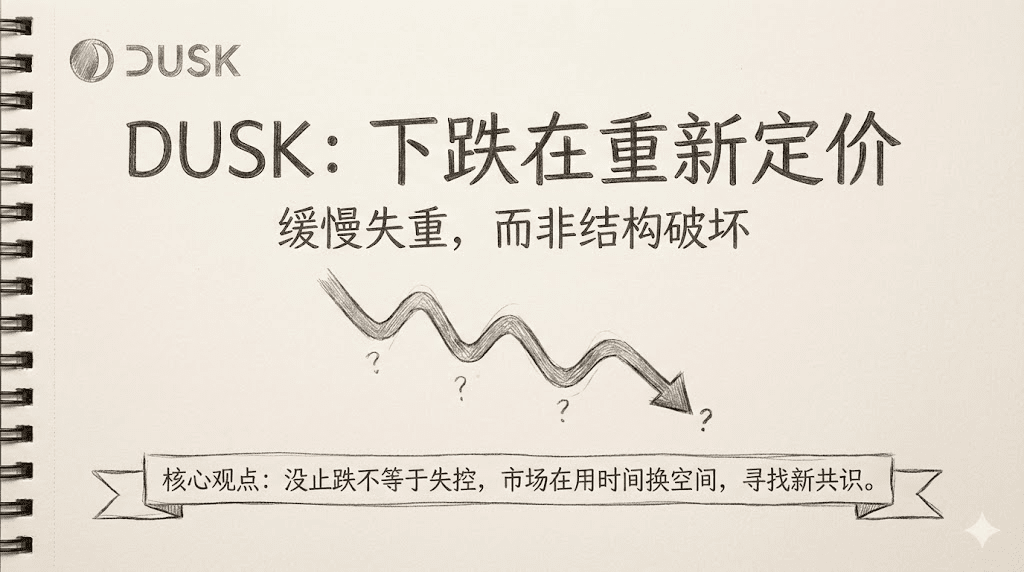
1. The decline itself is not uncommon; the key is 'how it declines.'
First, let's clarify: the decline of DUSK today is not the kind of emotional sell-off that suddenly increases volume and quickly breaks through multiple support levels. On the contrary, it resembles a process of 'slow weightlessness.' The price moves down in segments, each rebound is brief and weak, yet the selling pressure is not concentrated in a panic.
This type of trend is fundamentally different from typical panic selling. The characteristics of panic selling are urgency, intensity, and chaos; today's prices resemble the market continuously lowering expectations for 'reasonable prices', yet no one is in a hurry to escape. This decline is not out of control; rather, it reflects a downward shift in consensus.
Secondly, the absence of a bottom signal does not indicate 'heading to zero', but rather that no one is willing to provide a conclusion first.
Many traders are waiting for something: a clear bottom structure. But the reality is that bottoms never appear naturally; one side needs to step up and bear the cost first.
Today's issue with DUSK is that there has been no obvious proactive support below. It's not that no one is buying, but that the buying is very restrained. Every drop sees someone buying, but not much and not aggressively. What does this indicate? It shows that the current price range is still not sufficient for capital to form a consensus of 'worth taking action'.
Thus, prices can only continue to test downwards until a position is found that more people are willing to stop at. It's like looking for a parking spot; the first few are too crowded, so you might as well drive a bit further.
Thirdly, from the perspective of trading structure, this is a 'price adjustment', not 'structural damage'.
Judging whether a round of decline is dangerous is not primarily about the extent of the drop, but whether the structure has been damaged.
At present, DUSK's decline is closer to price adjustment rather than a trend collapse.
Why? Because throughout this process, there has been no continuous breakout through key structural levels. Prices are weakening, but the weakening is very orderly. Selling is not concentrated but persistently present; buying is not disappearing but selectively appearing. This indicates that the market has not given up on this asset but is renegotiating terms.
Many people will make misjudgments at this stage, equating 'no bottom' directly with 'further significant declines'. However, in trading, the more common situation is that prices need to go down to force bulls and spectators to reprice risks. There may still be unwashed dishes in the kitchen, but this has nothing to do with the market.
Fourthly, why is this type of market the easiest to deplete judgment?
A continuous decline that does not accelerate is the most exhausting market condition.
Going short, there is no obvious acceleration in profit;
Going long, each attempt to catch the bottom feels like catching a knife.
The essence of this type of trend is that the market is 'buying time'. It is neither in a hurry to wash people out nor to provide opportunities, but rather through continuous declines, slowly lowering participants' expectations. Only after completing this stage will two possibilities emerge: either continued support appears below, forming a structure; or a breakout occurs, clearly indicating a weakening trend.
Before this, all actions predicting a bottom were more about emotional needs than structural judgments.
Fifthly, an unappealing conclusion.
Starting from today's price behavior, my viewpoint is not aggressive:
The current issue with DUSK is not how much it has dropped, but that the market is not yet ready to reach a consensus at the current price level.
No bottom does not mean panic;
Continuous declines do not necessarily mean loss of control.
It is more like the market is using prices to say: it's not cheap enough yet, or at least, not certain enough. As for the question of 'enough', it can only be answered by subsequent transactions, not decided by emotions. Sometimes a cat will stare blankly at a corner, which makes no sense.
**What truly needs vigilance is not today's decline, but one day in the future: when the decline suddenly becomes very fast and decisive.
Before that, this slow and continuous weakening resembled a calm yet brutal repricing process.
The above content is merely personal analysis and does not constitute any investment advice.
