

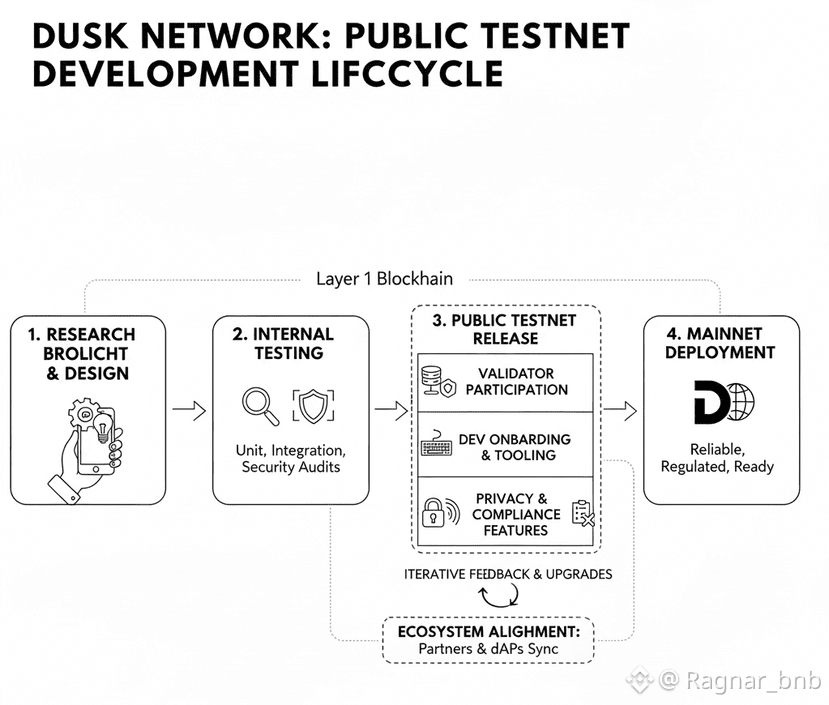
 Think of public testnet releases as dress rehearsals for the Dusk Network. They're like open labs where we can kick the tires on new features, try out different agreement methods, run smart contracts, and play with dev tools. It's all done in a setting that feels real, but without messing with the real money on the main network. For a blockchain that's designed for the finance world, these testnets aren't just messing around—they're important steps in a carefully thought-out plan.
The Dusk Network has been using public testnets to slowly introduce and test the important stuff that makes it tick. This includes the Dusk agreement and settlement layer, the Rusk node setup, ways to keep transactions private, and the environments where smart contracts can run. Each testnet phase has certain goals, like making sure the network is stable, seeing how validators act, checking that the cryptography is correct, and making sure developers can use it easily.
One of the biggest moments in the public testnet was the release of the DuskEVM test environments. DuskEVM lets people use Ethereum Virtual Machine within the Dusk system. This means coders can roll out and test Solidity-based smart contracts while taking advantage of Dusk’s privacy and compliance focused design. The DuskEVM testnet lets coders double-check contract logic, gas usage, and how things interact before launching apps for real.
Testnet releases are also there to check how DuskDS and DuskEVM work together. DuskDS is the base for settlement, agreement, and data, while DuskEVM handles the actual running of code. Public testnets let the network check the built-in bridge that links these layers. This means checking that transactions are final, that states are in sync, and that smart contract results are correctly settled across the whole system.
Validator participation is another thing we watch closely in public testnets. Validators, known as provisioners, use testnets to set up nodes, bet test tokens, join agreement committees, and get a feel for the whole block production and confirmation process. These environments let the Dusk Foundation see how committee-based Proof of Stake acts, how blocks move through Kadcast, and how well the rules for punishing bad behavior work under real conditions.
Public testnets also help test privacy features in a way that’s clear and can be checked. Private transactions, zero-knowledge proofs, and ways to reveal info only when needed are all tested at scale. Coders and checkers can confirm that privacy features are working as intended while still allowing for clear finality and compliance checks. This is super important for a network that needs to balance privacy with keeping regulators happy.
Identity and compliance parts are often added or expanded during testnet phases. Things like Citadel-based identity proofs, permissioned access controls, and role-based limits can be tested by coders and finance partners. Testnets let these people simulate KYC and AML processes, check that credentials are being anchored correctly on the chain, and make sure that compliance logic is correctly enforced by smart contracts and rules.
Another key purpose of public testnets is getting developers up to speed. The Dusk documentation, SDKs, and tools are all aligned with testnet releases so coders can learn the platform in a live setting. Wallet integrations, RPC endpoints, and contract deployment pipelines are tested and polished based on coder feedback. This back-and-forth helps make sure that the coder experience is stable and predictable before real use.
Public testnets are also used to test upgrades and protocol changes. New versions of Rusk, improvements to the Piecrust virtual machine, updates to cryptographic libraries, and changes to agreement settings can all be rolled out in testnet environments. This lets the network see how changes play out under pressure and find potential problems before they hit the main network.
From a governance and transparency view, public testnet releases show the Dusk Foundation’s dedication to openness and verification. By putting new features and design changes out for public review, the network allows outside coders, researchers, and partners to check claims about performance, privacy, and compliance. This is especially important for getting finance people on board, where trust is earned through proof, not just marketing.
Testnets also help with ecosystem coordination. Partners building regulated assets, tokenized securities, or compliant marketplaces can line up their development with testnet phases. This makes sure that apps are ready when mainnet features go live and lowers the chance of things not lining up between protocol powers and app needs.
In short, public testnet releases are a base part of the Dusk Network’s development plan. They offer a controlled space for checking agreement, privacy, compliance, execution, and coder tools in real-world conditions. Through constant testnet phases, including DuskEVM testnets, the network checks its tech, strengthens security, and gets the ecosystem ready for a reliable mainnet launch. These testnets aren't just options—they're needed steps in making a production-ready blockchain for regulated and privacy-focused finance.
