

Most blockchain projects talk about AI after the fact. They retrofit tools or sprinkle in features, hoping to keep pace with the conversation. Vanar took a different approach. It assumed from the start that intelligent systems autonomous agents, reasoning engines, persistent memory modules would be part of its ecosystem. That single assumption shapes every layer of design.
Human-centric chains rely on wallets dashboards and session-based actions. That works for humans because they tolerate friction, delays, and resets. AI does not. Agents do not click, they do not wait, they do not restart politely when context disappears. Infrastructure that treats AI as an add-on eventually fragments or fails at scale.
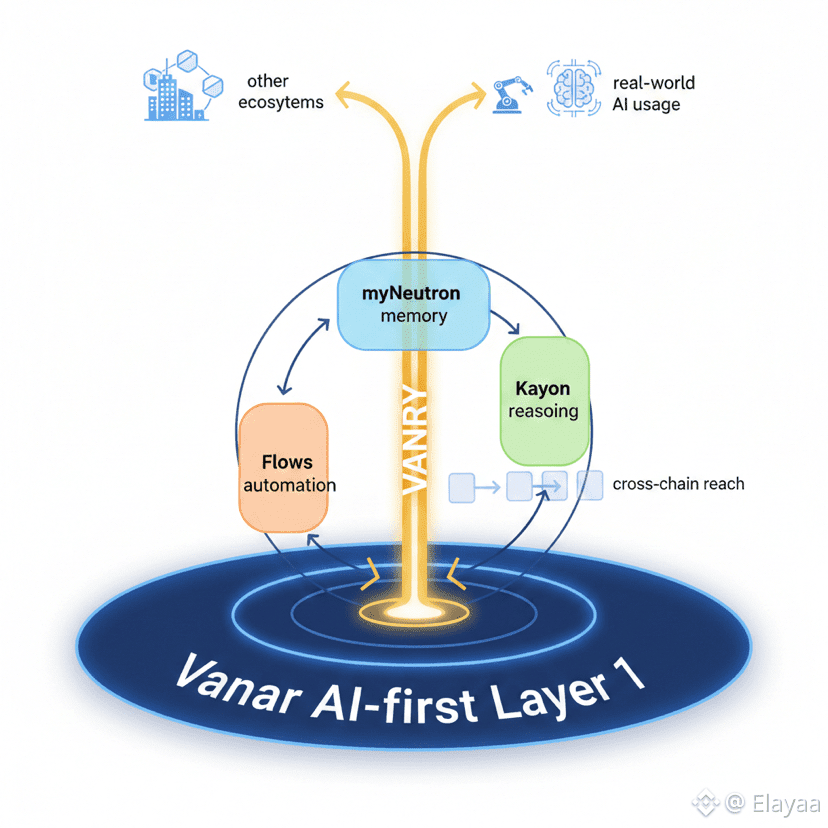
Vanar prioritizes persistence and native intelligence over raw throughput. Memory, reasoning, automation, and settlement exist at the base layer. myNeutron pushes semantic memory into the core. Kayon embeds reasoning and explainability on-chain. Flows transforms intelligence into controlled automated action.
These systems form an integrated loop: memory informs reasoning, reasoning drives action, action triggers settlement. VANRY powers the loop, enabling real economic activity rather than experimental demos. Cross-chain availability starting with Base extends this intelligent stack into live ecosystems, connecting agents to users and liquidity where it already exists.
Vanar is quiet, deliberate, and designed to run when others are still retrofitting features. It’s built for agents, enterprises, and real-world adoption, not for hype.
