
The history of the digital age is a history of centralization. For the past two decades, the vast majority of the world's information has migrated into the hands of a few colossal entities. While we perceive the internet as a free and open space, the physical reality is that our data—our photographs, our financial records, our websites, and our scientific models—resides in data centers owned by a handful of corporations. We have rented our digital lives, believing we owned them.
The blockchain revolution promised to change this. Bitcoin proved that we could decentralized money. Ethereum and subsequent networks like Sui proved that we could decentralize computation and agreements. Yet, a glaring paradox remains at the heart of the Web3 ecosystem. While the logic of our applications is decentralized, the data itself is not. We have built unstoppable applications that rely on stoppable servers. We have constructed immutable ledgers that point to files that can be deleted.
This is the final frontier of the decentralized revolution. To secure the future of the internet, we do not just need a new currency or a faster blockchain. We need a new way to remember. We need a decentralized memory.
This is the mission of the Walrus Protocol.
The Walrus Protocol: A New Paradigm for Data
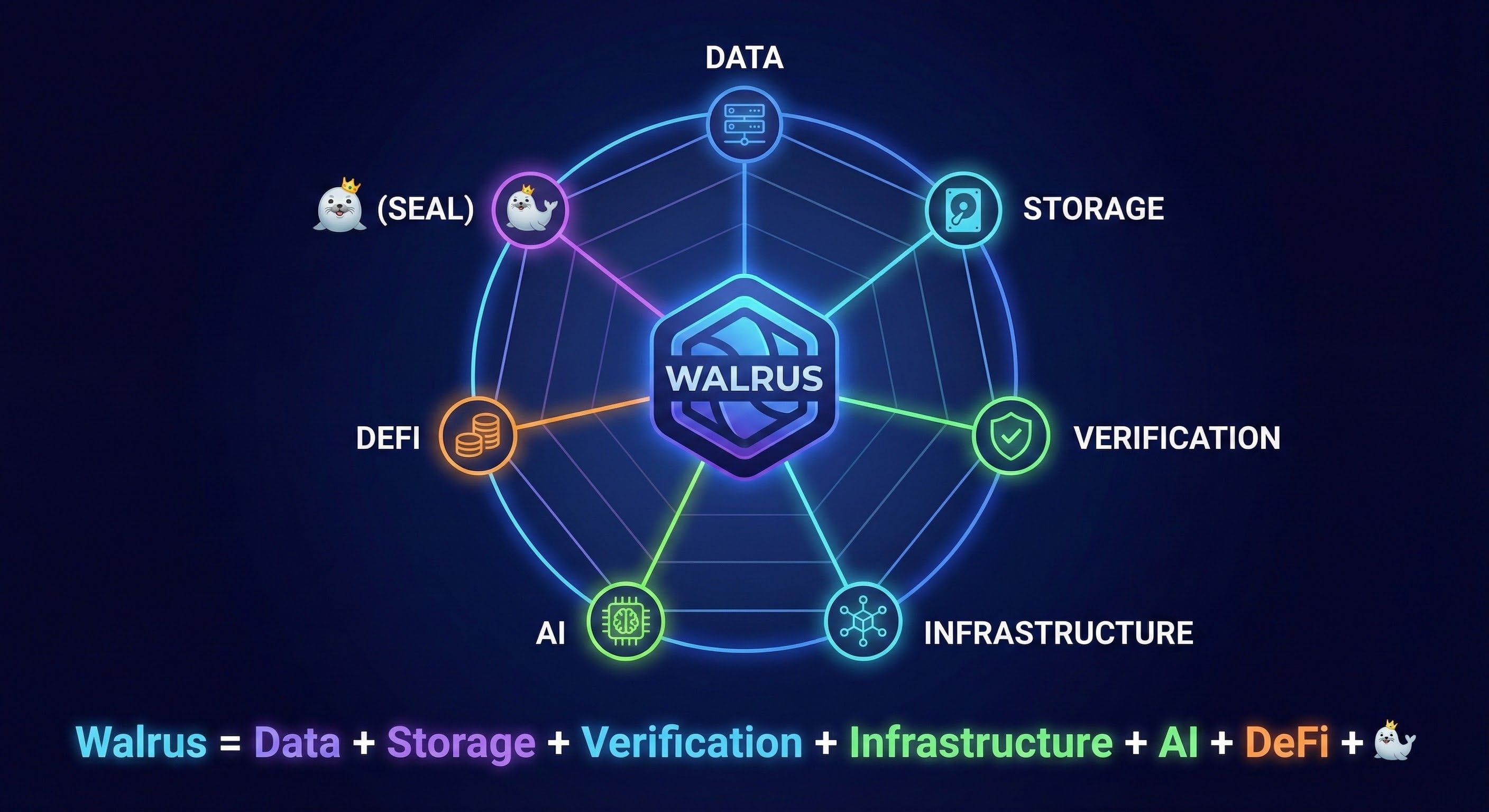
Walrus is a decentralized storage network designed to serve as the permanent, encrypted, and verifiable hard drive for the blockchain ecosystem. Built natively to leverage the high-performance architecture of the Sui network, Walrus is not merely a competitor to traditional cloud storage; it is a fundamental rethinking of how digital assets are preserved.
The protocol addresses the three critical failures of the current storage landscape: high cost, lack of privacy, and the risk of censorship. By creating a system where data is distributed across a global network of independent nodes rather than concentrated in a single data center, Walrus ensures that the internet becomes resilient against failure and immune to centralized control.
The Technology: Beyond Simple Replication
To understand the genius of Walrus, one must understand the inefficiency of traditional storage. In the world of cloud computing, reliability is usually achieved through replication. If a company wants to ensure your file is safe, they make three or four complete copies of it and store them in different locations. While this works, it is incredibly wasteful. It requires massive amounts of hardware, electricity, and bandwidth, costs that are ultimately passed down to the user.
Walrus abandons this outdated model in favor of a sophisticated mathematical approach known as erasure coding. In the technical documentation of the protocol, this specific implementation is often referred to as Red Stuff.
Imagine you have a valuable digital file. Instead of making five full photocopies of it, the Walrus protocol effectively shreds the file into a grid of mathematical slivers. These slivers are then encoded and scattered across the network to hundreds of different storage providers. The breakthrough lies in the recovery process. Because of the advanced mathematics involved, you do not need to retrieve every single sliver to restore your file. You only need a fraction of them.
If a significant portion of the network goes offline—whether due to a natural disaster, a power outage, or a coordinated attack—the file remains safe. The network can mathematically reconstruct the missing pieces from the remaining fragments. This allows Walrus to offer a level of durability that exceeds traditional cloud storage while using a fraction of the hardware. It is leaner, faster, and mathematically more secure.
The Symbiosis with Sui
Walrus does not exist in a vacuum. Its integration with the Sui blockchain is a strategic masterstroke. Most storage networks struggle with the speed of coordination; it takes time to negotiate storage deals and verify proofs. By utilizing Sui as its management layer, Walrus inherits the incredible speed and parallel processing capabilities of the underlying blockchain.
This means that storage operations on Walrus happen at the speed of modern finance. It allows for the creation of dynamic applications where large data files can be read and written with the same fluidity as a simple token transaction. This deep integration ensures that Walrus is not just a cold archive for dead data, but a hot storage layer for active, living applications.
The Economic Engine: The Role of the WAL Token
No decentralized network can survive without a robust economic model. The native currency of the protocol, the WAL token, is the lifeblood of this ecosystem. It is designed to align the incentives of all participants, ensuring that the network grows stronger as it grows larger.
The primary utility of the token is payment. In order to store data on the Walrus network, users and developers must pay fees in the native token. This creates a fundamental, organic demand for the asset. As the usage of the network expands—as more NFT collections, websites, and datasets are uploaded—the demand for the token increases proportionally. This is not speculative demand; it is utility-driven demand.
Furthermore, the token serves as the shield of the network. Walrus operates on a Delegated Proof-of-Stake model. Storage providers, the individuals and organizations running the hardware, must stake tokens to participate. This stake acts as a bond of good behavior. If a node stores data correctly and serves it quickly, they are rewarded with more tokens. If they act maliciously or lose data, their stake is penalized.
This system creates a circle of trust. Token holders who do not wish to run hardware can delegate their tokens to reliable nodes, earning a share of the rewards. This ensures that the security of the network is shared by the entire community, and the economic benefits are distributed widely.
Governance and Community Ownership
A truly decentralized internet cannot be owned by a corporation. It must be owned by its users. The WAL token serves as a governance instrument, giving holders a voice in the future of the protocol. Decisions regarding fee structures, technical upgrades, and treasury allocations are not made behind closed doors. They are proposed and voted upon by the community. This ensures that Walrus remains a public good, responsive to the needs of developers and users rather than the profit margins of shareholders.
The Killer Use Cases: Artificial Intelligence and Finance
The technical architecture of Walrus is impressive, but its real value lies in what it enables. The protocol is positioning itself as the critical infrastructure for the two most transformative technologies of our time: Artificial Intelligence and Decentralized Finance.
In the realm of Artificial Intelligence, we are witnessing an explosion of data. Large Language Models and autonomous agents require vast libraries of information to learn and function. Currently, this data is siloed in corporate servers, raising serious questions about bias and access. Walrus offers a solution: decentralized AI. By storing training data and model weights on Walrus, developers can build transparent AI systems. We can verify exactly what data a model was trained on, ensuring it is free from manipulation. Furthermore, Walrus provides a neutral home for AI agents to store their memories and logs, allowing them to operate autonomously without relying on a centralized off-switch.
In the world of Decentralized Finance, Walrus solves the fragility of the frontend. While smart contracts are immutable, the websites users interact with are not. We have seen instances where decentralized exchanges were effectively shut down because their web hosting provider pulled the plug. Walrus allows developers to host their entire website infrastructure—the HTML, CSS, and JavaScript—directly on the decentralized network. This creates truly unstoppable applications. As long as the network exists, the application exists. It cannot be censored, blocked, or removed by any third party.
Verification: The Antidote to the Era of Fake
As we move deeper into the digital century, the ability to distinguish truth from fabrication is becoming the world's most valuable resource. We are entering an age of deepfakes and AI-generated misinformation. Walrus places a heavy emphasis on the concept of Verification.
Because every piece of data stored on Walrus is cryptographically signed and linked to the blockchain, it establishes a perfect chain of custody. When a user retrieves a news article, a video evidence file, or a legal contract from Walrus, they are not just receiving the data. They are receiving mathematical proof that the file is authentic and has not been altered since the moment it was uploaded. This feature alone has the potential to transform industries ranging from journalism to legal technology, restoring trust in digital media.
Conclusion: The Foundation of Digital Sovereignty
The transition to Web3 is about more than just speculation and trading. It is about the fundamental right to ownership. True ownership is impossible if the object you own resides on someone else's computer.
Walrus completes the puzzle of the decentralized web. By combining the speed of Sui, the efficiency of advanced cryptography, and the security of a decentralized network, it provides the solid ground upon which the next generation of the internet will be built. It ensures that our digital history is preserved, our applications are unstoppable, and our data remains truly ours.
The future of the internet is not in the cloud. It is in the collective. Walrus is the backbone of that collective future.

