
Dusk sits in a rare position. It was created in 2018 as a layer one blockchain with a very specific purpose: to become the privacy focused infrastructure for regulated finance. Instead of starting from speculation and trying to retrofit compliance later, it begins with financial regulation, privacy, and institutional grade workflows built in from the protocol upward.
On most networks, regulation shows up as an afterthought. Institutions are expected to trust separate compliance layers, gated front ends, or patchwork legal wrappers bolted on top of public ledgers. Dusk flips this around. It treats laws, licenses, and confidentiality as first class features, and then exposes them to developers as tools they can build with every day.
That is why Dusk can credibly talk about bringing real world finance fully on chain. Not as a slogan, but as a design goal that drives its architecture, its licensing strategy, and its technical roadmap. @duskfoundation uses that focus to shape everything from how assets are issued to how transactions are audited and how data remains private.
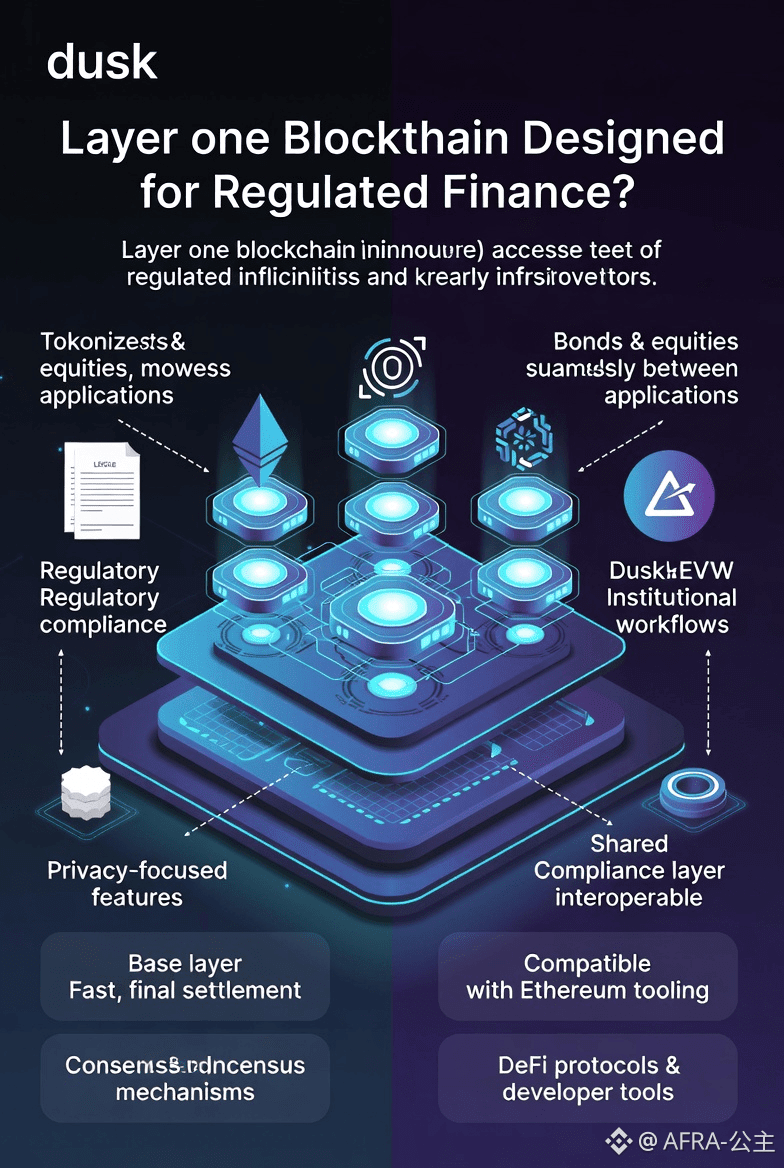
Regulatory coverage at the protocol layer
The most defining trait of Dusk is that regulation is not confined to a single application or gateway. Instead, licenses and compliance guarantees are embedded at the base layer. Through its partnership with NPEX, Dusk inherits a set of regulatory permissions that map directly onto real market activity.
That includes permission to operate a regulated multilateral trading facility, to act as a broker sourcing and executing trades in securities such as bonds or money market funds, to offer crowdfunding style investment products to retail participants across the European Union, and to add a distributed ledger based framework for the native issuance of regulated assets.
Combined, these rights cover the entire lifecycle of financial instruments. Issuance, investment, trading, and settlement can all take place inside one shared environment instead of being fragmented across several disconnected systems. On Dusk, that environment is the blockchain itself. The chain becomes the venue where assets live, move, and settle under a coherent legal framework instead of relying on informal off chain promises.
This is a subtle but important shift. Other networks often rely on isolated compliance wrappers. Each product, exchange, or gateway implements its own know your customer process and legal logic. As a result, compliance is siloed, and composability is fragile. By contrast, Dusk pushes those concerns down into the protocol, so that applications can inherit them instead of reinventing them.
For institutions, this answers a practical question. They need confidence that if they bring regulated instruments on chain, they are not accidentally stepping outside existing regimes such as MiCA, MiFID style rules, or privacy regulations. With Dusk, those requirements are built into the rails they use.
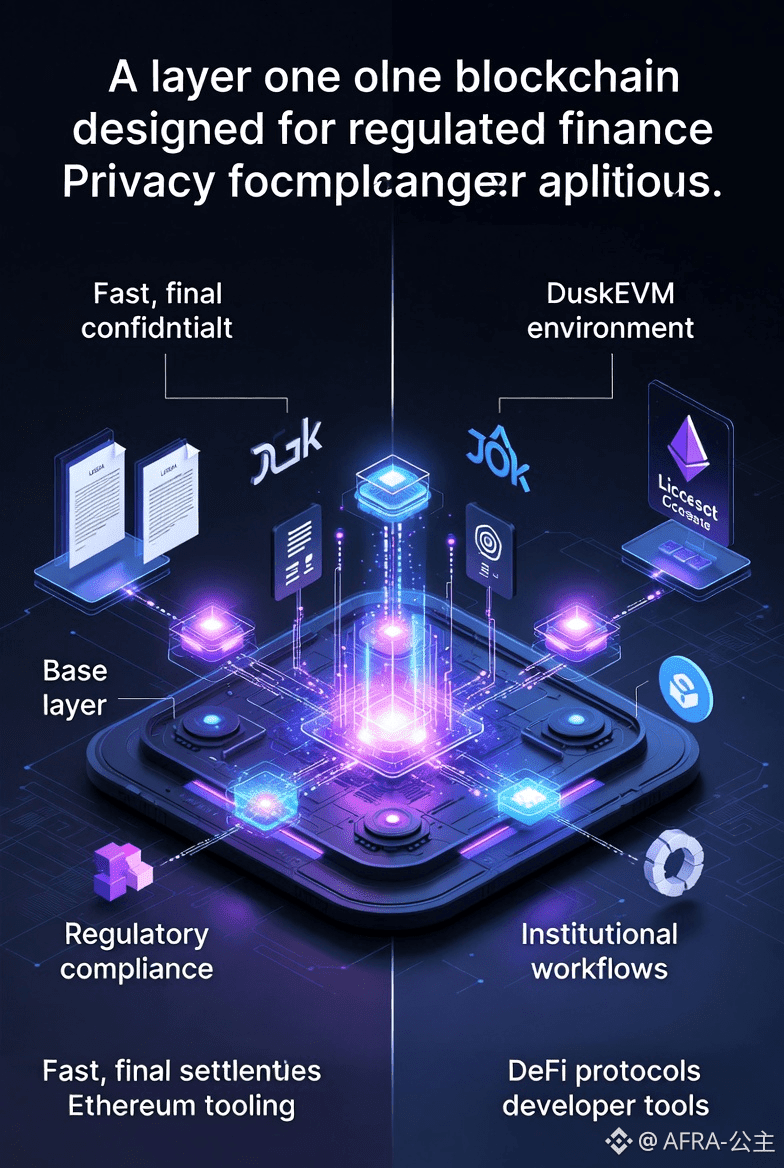
What protocol level licensing unlocks
Embedding licenses at the base layer has direct consequences for what can be built. It enables native issuance of regulated assets, such as tokenized funds, treasuries, or equities, where the asset itself is born on chain, not wrapped after the fact.
It allows developers to create applications that are licensed by design instead of relying purely on terms of service. Every app that taps into these rails builds on the same legal and technical foundation, so flows can interoperate instead of living in isolated silos.
User onboarding becomes more straightforward. Because the identity and compliance stack is shared, a participant can complete know your customer checks once and then access multiple venues and instruments governed by the same ruleset. That is very different from the experience on many public networks, where each protocol runs its own incompatible onboarding.
Most importantly, it restores true composability to regulated DeFi. Assets that are issued under a shared license regime can move between applications while retaining their constraints. A tokenized bond can be used as collateral in a lending protocol, traded on a secondary venue, and settled in a payment rail without losing its regulatory character. That level of network native, legally aware composability is what sets Dusk apart.
The NPEX application and real world access
The vision described above is not purely theoretical. It takes visible shape in the NPEX application stack, which serves both as a regulated back end for tokenized securities and as a user facing interface for accessing those instruments.
The back end implements the regulated processes that issuers, intermediaries, and market operators rely on today, from order handling to settlement workflows. The front end exposes this to users and institutions as a clear entry point into the Dusk ecosystem.
Developers can treat the NPEX stack as foundational infrastructure. Instead of building a compliance engine from scratch, they can connect to a system that is already aligned with the licenses Dusk inherits. This lowers the barrier to entry for teams that want to offer institutional grade products without maintaining their own legal machinery.
The application runs on DuskEVM, the execution environment that is compatible with standard Ethereum tooling. That means wallet providers, infrastructure teams, and developers who already know the Ethereum stack can integrate with Dusk more easily. They get access to a regulated environment without having to abandon their existing tools.
From launch, NPEX is seeded with tokenized assets sourced from licensed venues and institutional players. This sets the tone for the broader ecosystem: real instruments, real regulatory context, and a clear path for new products to join over time.
Modular architecture and the split between settlement and execution
Under the hood, Dusk is structured as a modular platform. It separates the responsibilities of settlement and data availability from computation and application logic. This separation appears through two key components.
The first is a base layer responsible for consensus, data availability, settlement, and the privacy enabled transaction model. This is where finality is enforced, and where the chain keeps track of balances, state transitions, and compliance relevant metadata.
The second is DuskEVM, an execution environment compatible with the Ethereum virtual machine. Here, developers deploy contracts, build DeFi protocols, integrate tokenized assets, and design application specific logic. The native token is used as gas, and existing Ethereum tools can be plugged in with minimal friction.
Bridging between these components is native and intentional. Assets can move between layers depending on their needs. Settlement heavy instruments that require strong privacy or strict regulatory flows can rely on the base layer. More flexible applications that benefit from composability and developer familiarity can live on DuskEVM while still inheriting the guarantees of the underlying system.
This modularity allows Dusk to tune each environment to its primary job. Settlement can be optimized for finality, data integrity, and regulatory reporting. Execution can be optimized for developer experience, flexible contract logic, and integration with existing tools.
Consensus with fast, final settlement
Institutional use cases leave little room for probabilistic finality or reorganization risk. Markets that handle large orders, corporate actions, or settlement obligations require a clear answer to the question of when a transaction is truly final.
Dusk addresses this with a proof of stake consensus design that focuses on deterministic finality. Once a committee has validated and ratified a block, the network treats it as final. Users and applications do not have to worry about reorgs in ordinary conditions.
This property is essential for delivery versus payment flows for tokenized securities settlement and for any workflow that relies on aligning multiple ledgers or external systems When a block is final in Dusk external systems can treat that fact as an anchor for their own records without waiting for long confirmation periods
The design aims for high throughput and low latency which aligns with the needs of modern trading venues and payment rails The goal is not pure maximal throughput at all costs, but an effective balance between speed, security, and regulatory grade predictability.
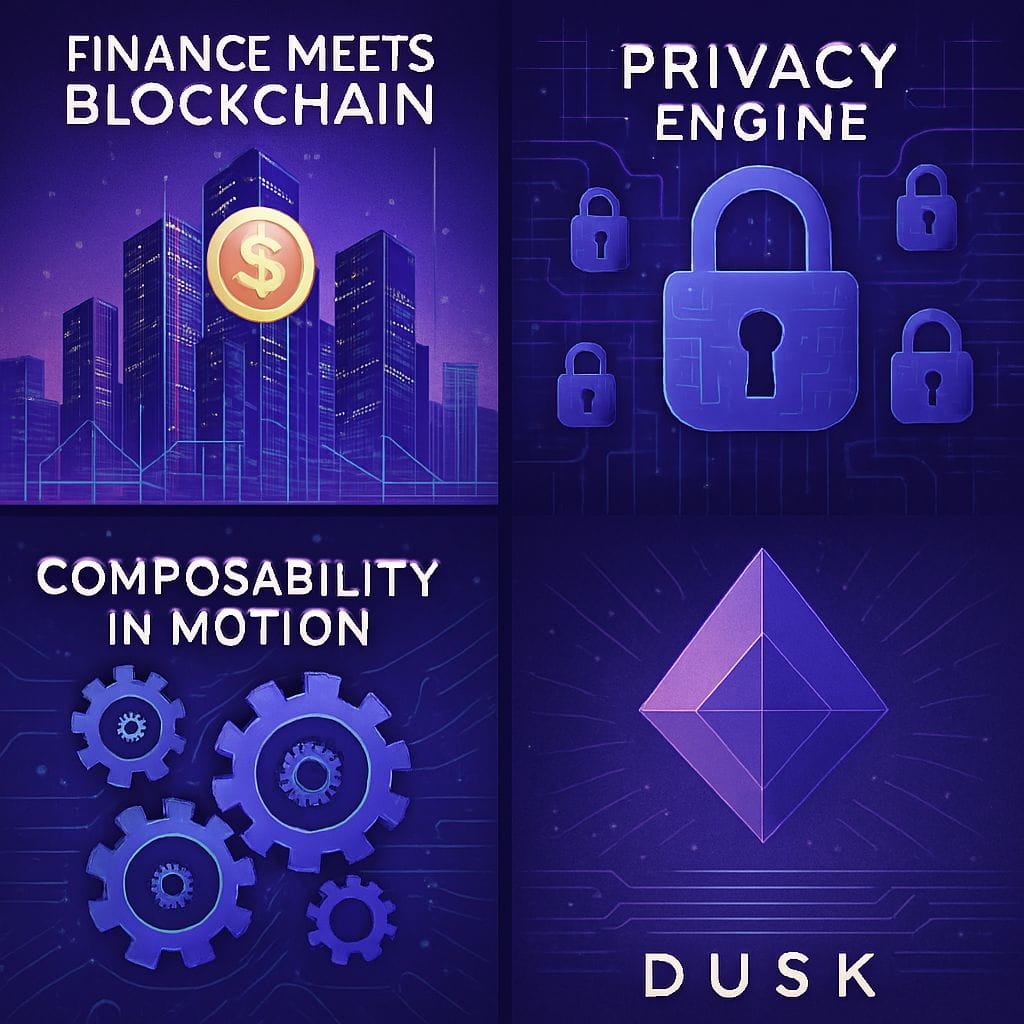
Hedger and privacy for the EVM layer
Privacy is one of the core reasons Dusk exists at all. A public ledger that exposes every balance and transaction is difficult to reconcile with competitive markets, confidential negotiations, or regulatory privacy obligations. Dusk addresses this with a purpose built privacy engine called Hedger.
Hedger is built for the EVM execution layer. Unlike older systems tailored for unspent transaction output models, it is designed to integrate directly with account based EVM semantics and familiar developer tooling. That makes it far easier for teams to adopt without rethinking every part of their architecture.
At a cryptographic level, Hedger combines several approaches. It uses homomorphic encryption to allow computations on encrypted values It uses zero knowledge proofs to demonstrate that operations are valid without revealing underlying data. It supports a hybrid model that lets assets move between different styles of accounting in a way that remains compatible with traditional financial systems.
The key result is that holdings, amounts, and balances can remain encrypted end to end while still being auditable when required. Transactions can be examined by authorized parties under clear rules without exposing information broadly. This dual objective of privacy and selective transparency lies at the heart of Dusk’s mission.
Hedger also focuses on practical performance. Its circuits are designed to support proof generation in common environments such as a user’s browser, with quick turnaround times. This enables applications to deliver a smooth experience without offloading all privacy work to heavy remote infrastructure.
Capabilities aimed at regulated markets
The features unlocked by Hedger are closely aligned with regulated markets.
It creates the conditions for obfuscated order books, where bids and offers can be shielded to prevent front running or information leakage while still allowing the matching engine to function correctly. This is attractive to institutional traders who need to protect their intent and exposure.
Transactions remain auditable by design. That means regulators auditors or designated oversight entities can verify flows when required but routine activity does not leak commercially sensitive information to the public This strikes a balance between the transparency of a public ledger and the discretion expected in financial markets
Confidential transfers protect users and institutions from broadcasting their balances or counterparties to the world At the same time, the protocol’s design keeps the system measurable and accountable, which is essential when dealing with regulated assets.
By tying these capabilities into the EVM environment and into protocol level licensing, Dusk turns privacy into a standard tool rather than a niche feature.
Strategic value and trade offs
Hedger represents a deliberate trade off. The EVM account model is not built for absolute anonymity in the same way as specialized privacy chains. However, it is widely adopted and battle tested, and it underpins most of today’s DeFi ecosystem.
Dusk chooses compatibility with this environment, then layers advanced cryptography and regulatory awareness on top. The result is full transactional privacy in everyday use, without cutting developers off from the tools, libraries, and patterns they already know.
Because Hedger is developed in house, the team can align performance, cryptographic primitives, and regulatory constraints in a coordinated way. This avoids the disconnect that can appear when privacy tools are simply plugged in as external libraries without deep integration.
What can be built on Dusk
Once these pieces are in place, the range of possible applications becomes broad. Some examples illustrate how the platform can be used, even without specific user stories.
Regulated digital securities can be issued natively on chain, complete with embedded compliance rules. Corporate actions, voting rights, and cap tables can be represented transparently while preserving sensitive details through privacy primitives.
Institutional DeFi protocols can enforce know your customer checks at the protocol level, separate public market signals from private positions and ensure that only eligible participants can access particular products This opens the door to credit markets structured products land liquidity venues that align with real world rules
Payment and settlement rails can support confidential transfers between institutions with delivery versus payment logic enforced by smart contracts This reduces settlement risk while protecting client flows from unnecessary exposure
Identity and access control use cases can treat verifiable credentials as first class citizens Access conditions can be encoded in smart contracts so compliance checks are enforced automatically rather than relying on manual back office processes
Brand principles and communication style
Beyond pure technology, Dusk pays attention to how it presents itself. Its brand guidelines emphasize clarity restraint and a focus on long term trust The visual language uses a limited, carefully chosen palette and a clean typographic system. The editorial voice favors plain, confident language over hype.
This is not a superficial detail. Regulated finance depends heavily on trust, comprehension, and auditability. A brand that avoids unnecessary visual noise and speculative language sends a clear signal about priorities. It also helps decision makers inside institutions explain Dusk to colleagues and supervisors who may not be deeply technical.
The guidelines also enforce consistent logo treatment, legible color contrast, and clear rules around imagery. These are the kinds of details that matter when documentation, interfaces, and investor materials need to survive legal review and internal compliance checks.
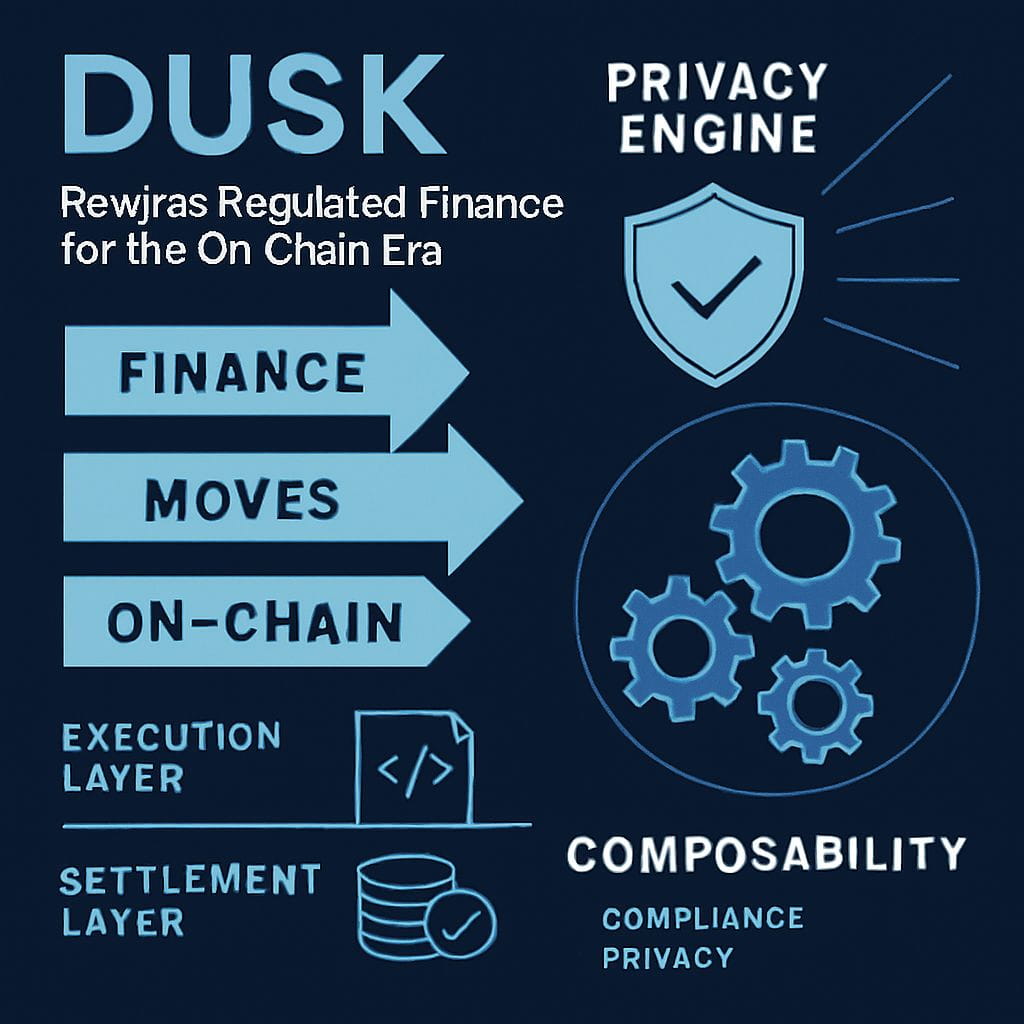
Why this matters now
Financial markets are moving gradually toward more transparent, programmable, and interoperable infrastructure. Yet the transition is constrained by privacy regulations legacy workflows and the need for predictable settlement
Public blockchains offered a vision of open access and composability but many of them struggled to accommodate the realities of licensed instruments and institutional constraints Private chains tried to solve this by limiting participation but often sacrificed the benefits of open networks
Dusk takes a third path. It is an open network designed from day one to host regulated activity. It brings together privacy, compliance, and composability at the protocol level and exposes them through an architecture that developers already understand.
That combination makes it a natural platform for the next generation of financial infrastructure. Markets can move on chain with confidence that rules are enforced, data is protected, and settlement is reliable. At the same time developers and users retain the freedom and flexibility that made public networks compelling in the first place
The role of the token and ecosystem growth
Within this environment, the native token $Dusk plays the role one would expect on a modern smart contract platform. It powers transactions, compensates validators, and anchors economic security. Because the network is aimed at real world instruments and institutional scale activity, the health and stability of this token become central to the system’s reliability.
