

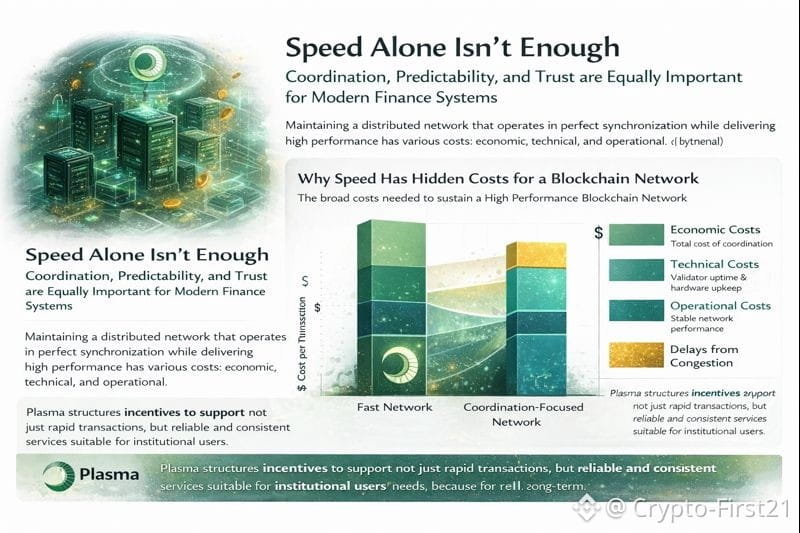
Plasma has realized through its innovation in design that simply having raw speed is not sufficient for modern financial systems, coordinating, predicting, and having trust have become equally important aspects of modern financial systems. By taking into consideration the total cost of maintaining a distributed network that can operate in perfect synchronization while also delivering high performance, Plasma's design is consistent with the belief that coordination, predictability and trust are as important as transaction speed. For every fast transaction, dozens and hundreds of independent machines have to agree on the same answer and agree on it almost instantaneously; coordinating that invisible process comes with costs, economic, technical, operational. thus, Plasma has been designed to manage those costs to ensure that as demand increases, Plasma can continue to service the needs of its users without compromising the viability of its service.
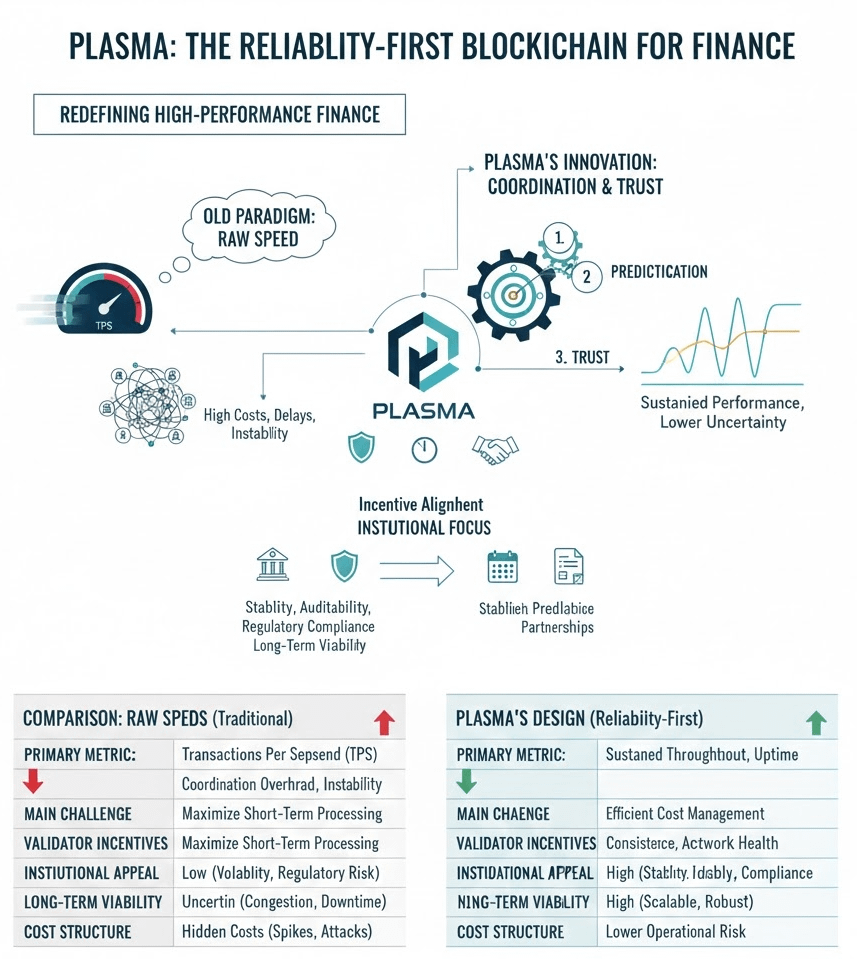
Many people often think that the amount of transactions per second indicates a blockchain's performance, but behind that number are several layers of complexity. For instance, validators need to be consistently online, maintain their hardware, maintain a stable network connection, and maintain a high level of security. Each of these layers adds to the overall cost of performing transactions and the costs associated with delays in transaction processing. Plasma's method of structuring incentives will reward participants for not only processing transactions rapidly, but for providing reliable and consistent services to users. This is a crucial consideration for institutional users' needs, because institutional users have less concern about short-term spikes in performance than they do about the long term predictability of performance. Regulatory concerns in the financial space dictate that even slight deviations in performance can create major downstream consequences for institutions.
Technically, Plasma aligns incentives for validators with network health to coordinate all transactions so they can be executed at the same time. Rather than motivating nodes to be energized for maximized performance over a brief period, Plasma provides contingent incentives to encourage sustained load, increased accuracy during transaction processes, and disciplined resource usage. Therefore, rather than having the hidden cost later on when there are congestion issues, downtime, or security attacks, the design of the network will lower operational uncertainty over time; thus, eliminating one of the largest barriers to using a decentralized system. With this type of network, it will be easier to model, audit, and incorporate as part of an existing financial workflow.
Recently published market data shows that, historically, when it comes to institutions adopting new technology, institutional adoption is typically based on reliability, not on novelty or exciting new technology. In practice, as networks become less reliable, they generally have slower early market growth followed by a greater retention period for residents. The evidence indicates that Plasma supports this argument by having the first cause of all transaction execution being defined as coordination and therefore being viewed as simply infrastructure. Consequently, coordination may appear to be a dull topic at first, but with greater transaction volumes and increased regulation, coordination has the potential to become the primary cost of doing business and thus is a future advantage for those systems that have mastered it at this point.
Personally, I appreciate this transition. After years of seeing projects pursue newspaper articles, working within the boundaries of reality seems like a much more realistic approach to developing projects. The longer I research financial infrastructure the clearer it becomes that boring reliability is far superior to flashy speed when talking about dollars and billions. The design of Plasma reflects this directive of taking a slow, steady, and meandering road to get to a point where decentralized systems can be as reliable as traditional systems and can become commonplace in our normal economic activity.

