

In the world of cryptocurrency, new projects are emerging one after another, but few directly target stablecoin infrastructure like @Plasma . #Plasma will launch on the mainnet by the end of 2025, quickly attracting market attention, especially with the price movements of its token XPL being nothing short of a thrilling roller coaster. From the initial frenzy at launch to the rational corrections seen today, this project not only tests investors' patience but also highlights the tremendous potential of the stablecoin sector. This article will analyze the essence of the Plasma project in conjunction with the historical price of XPL and look forward to its long-term prospects. As a platform focused on the global flow of funds, can Plasma become the ‘high-speed rail track’ of the stablecoin economy? Let’s break it down step by step.
The core of the Plasma project: reshaping the world of stablecoins
Plasma is not an ordinary blockchain project. From the beginning, it was positioned as a Layer 1 network dedicated to stablecoins, aiming to solve high fees, slow speeds, and complex user experience issues of traditional on-chain transfers. Imagine wanting to send money using USDT to a friend overseas, only to be tormented by Ethereum's gas fees and congestion. The emergence of Plasma is precisely to eliminate these pain points.
The project uses the PlasmaBFT consensus mechanism to achieve over 1000 TPS (transactions per second) and sub-second block times. This means transactions are almost completed instantly, eliminating long waits. More importantly, it is fully compatible with EVM (Ethereum Virtual Machine), allowing developers to seamlessly migrate applications without having to learn new tools from scratch. Plasma's killer feature is 'zero-fee USDT transfers': through the built-in Paymaster mechanism, the protocol layer automatically subsidizes the gas fees for USDT transactions, allowing users to send stablecoins for free without holding $XPL tokens. This is a revolutionary innovation for cross-border remittances, micropayments, and small merchants.
Behind Plasma is strong backing. Institutions such as Tether (the issuer of USDT), Bitfinex, DRW Venture Capital, Flow Traders, and Nomura participated in its financing. In 2025, the project raised $50 million through public offerings, reaching a valuation of $500 million. Upon the launch of the mainnet, it attracted $2 billion in deposits, with TVL (Total Value Locked) soaring to $6.35 billion at one point. This reflects the market's demand for stablecoin infrastructure—the global supply of stablecoins has exceeded $250 billion, with monthly transaction volumes reaching $2-3 trillion. Plasma's goal is to capture a portion of that market and become a strong competitor to TRON or Solana.
However, the project is not perfect. Its PoS (Proof of Stake) security model relies on the staking of $XPL tokens, while the inflation mechanism and unlocking plan have also raised controversy. The total supply is 10 billion XPL, of which 10% has been circulated through public offerings. Early investors achieved a 32-fold return at the peak, but this has also sown the seeds for subsequent price pressure.
XPL's price trend: Insights from peak to trough
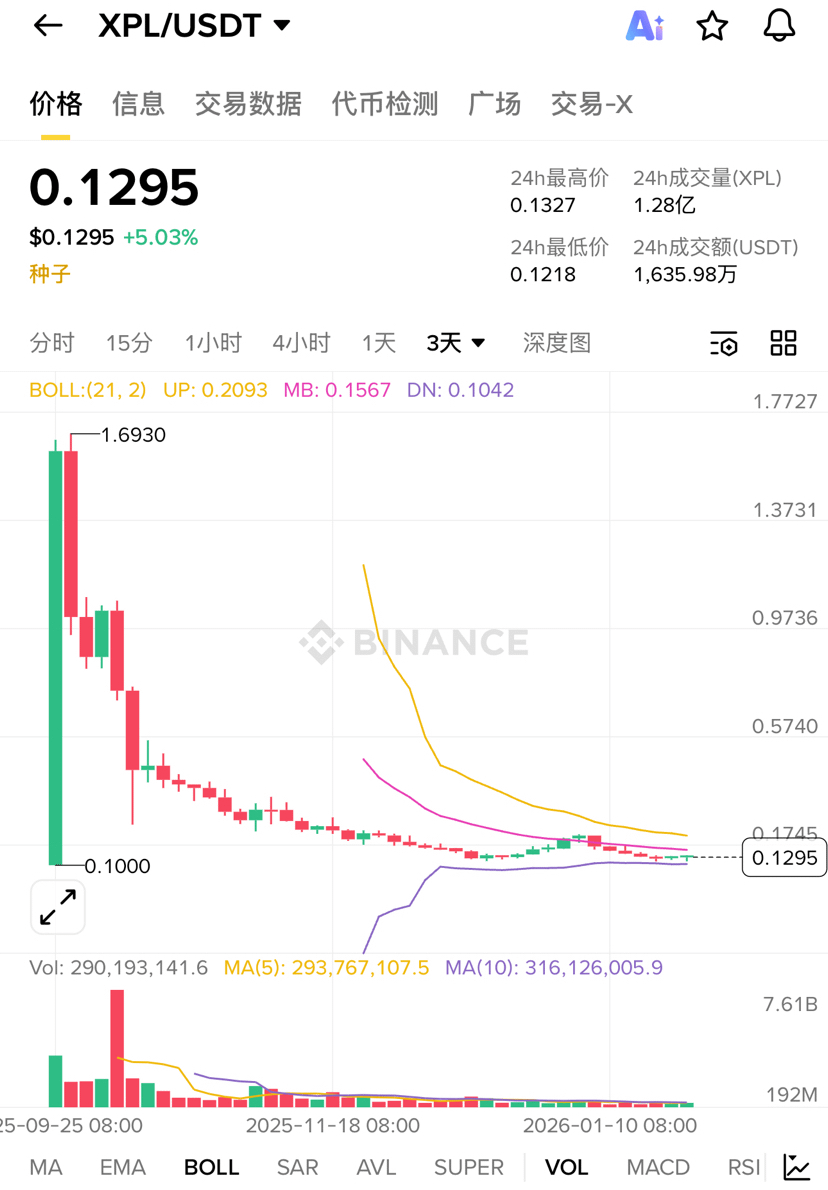
The XPL token was listed on exchanges such as Binance in September 2025, showing a bright performance on its first day. The presale price was about $0.05, but it quickly surged to a historical high (ATH) of $1.6 after listing. This wave of increase was due to a combination of market speculation and project endorsements. Tether officially announced a partnership with Plasma to promote seamless integration of USDT; several CEXs offered zero-fee transfer support; plus the narrative of the stablecoin supercycle made $XPL a hot topic. The explosive growth of early TVL—$2 billion on the first day—further pushed up the price, and the market cap once approached $2 billion.
But the good times did not last long. Six weeks after listing, the price began to adjust, dropping to around $0.5 by the end of 2025. Entering 2026, the adjustment intensified, and it currently hovers in the $0.12-0.13 range, down over 90% from ATH. Although the 24-hour increase fluctuates between 5-8%, the overall trend is downward. The market cap ranking has slipped to between 140-220, with a circulating supply of about 1.8-2.2 billion, and FDV (Fully Diluted Valuation) of about $1.29 billion. The trading volume remains at $60-80 million per day, indicating liquidity is acceptable but far below peak levels.
Why such dramatic fluctuations? First is the unlocking pressure. On January 27, 2026, 88.9 million XPL (worth about $11 million) entered the market, which is the monthly release from the ecological fund. The plan for the year includes unlocking about 3.55 billion tokens, including large shares for the team and investors (in September, 883 million team tokens and 833 million investor tokens were released at once), plus a 5% annual inflation rate, which will double the supply. This is equivalent to a 'flood' in the market, diluting the rights of existing holders.
Secondly, revenue and the token burn mechanism have not kept pace. Plasma's daily revenue is about $295,000, mainly from transaction fees, but this can only burn about 700 million XPL annually (at current prices). To offset selling pressure, revenue needs to grow more than fivefold. Currently, daily USDT transactions are only 40,000, and TVL has dropped from the peak of $6.35 billion to $3.26 billion, reflecting a slowdown in adoption. Macro factors also play a role: the overall crypto market adjusted in 2025, stablecoin growth was steady but did not meet expectations; competitors like TRON (market cap $32 billion) still dominate P2P transfers.
From the chart, XPL's price trend shows a typical 'pump-dump' pattern: a V-shaped surge after listing, followed by a stair-step decline, accompanied by slight rebounds. Over the past 90 days, the price has dropped from $0.65 (the peak after presale) to current levels, with a 7-day increase of only 1-3%. This reminds investors that the prices of crypto projects are often narrative-driven rather than based on immediate fundamentals. In the short term, XPL may fluctuate in the $0.10-0.15 range, depending on the next unlocking and market sentiment.
Opportunities and challenges coexist
As of January 27, 2026, the XPL price is about $0.125, with a 24-hour trading volume exceeding $80 million. The number of holders exceeds 20,000, with the staking feature already launched, offering a promotional reward of 150% APR, aimed at locking supply and enhancing governance. The project ecosystem includes cross-chain aggregators, DeFi tools, and multi-chain bridges, supporting seamless transfers of stablecoins like USDT and USDC.
The advantages are obvious: Plasma fills the gap for a stablecoin-exclusive chain. Traditional chains like Ethereum, while powerful, are not optimized for payments; TRON, while cheap, has many security risks. Plasma's Bitcoin security anchoring (part of the nodes rely on BTC) and institutional-level encryption make it suitable for enterprises and large transfers. In the future, if it achieves millions of daily transactions, revenues will skyrocket, and the token burn mechanism can effectively combat inflation.
However, the challenges cannot be ignored. Selling pressure is the biggest risk: if supply doubles without corresponding demand, prices will be further depressed. Adoption relies on partnerships—although there is Tether support, more wallets, CEXs, and merchant integrations are needed. DeFi applications are under development, but they need to have stronger utility for holding XPL to attract long-term holders. Regulatory uncertainty also lurks: the stablecoin sector is facing global scrutiny, and Plasma's zero-fee model may touch anti-money laundering regulations.
From an investor's perspective, XPL's current valuation (market cap of $230-280 million) is 'cheap' relative to its potential. The Tether ecosystem is valued at $500 billion, and if Plasma captures 3-5% of that market, its market cap could exceed $6 billion (currently only 1/20 of that). But this will take time: within 1-2 years, prices are unlikely to rebound significantly unless major events occur, such as staking locking 40-50% of supply or a DeFi explosion.
Potential stocks in the stablecoin revolution
Looking to the future, Plasma's outlook is optimistic but needs caution. In the short term (2026), unlocking pressure will dominate, and prices may maintain a low-level fluctuation. Investors are advised to focus on key milestones: reactions after the large unlocking in September; staking participation rates; daily transactions breaking 100,000; new partners like financial institutions joining. If revenues double and token burn can offset inflation, prices may rebound to $0.5.
In the medium term (2027-2028), if the project achieves 'neobank UX' (bank-level user experience), it will become the standard for stablecoin payments. The global remittance market is worth trillions of dollars, and Plasma's instant, low-cost advantages can eat into traditional systems. Combining with Web3 trends, such as RWA (real-world assets) and cross-border payments, XPL could evolve from a 'loyalty token' to a necessity. In an optimistic scenario, the market cap could break into the top 25, with prices exceeding $3.5.
In the long run, Plasma represents the transition of stablecoins from 'storage' to 'liquidity'. If successful, it will reshape global finance: frictionless P2P transfers, instant merchant settlements, and inclusive finance for developing countries. But the risks are: if adoption lags, the project may fade from view; competition intensifies (like emerging L1 chains); or macro bear markets drag it down.
Overall, Plasma is not a short-term speculative target, but a medium to long-term bet. Although the price trend of XPL is tortuous, it reflects the project's transition from hype to value. Investors should DYOR (Do Your Own Research) and diversify risks. The crypto world is rapidly changing, but projects like Plasma that focus on pain points often stand out in the tide. In the future, if the stablecoin economy explodes, Plasma will be a big winner—provided it can survive the current 'winter'.
(This article is based on publicly available market data and project dynamics, for reference only, not investment advice.)$XPL

