

The term privacy is often associated with the idea of hiding all information on a blockchain or making it completely private from all but the intended recipients; however, Dusk believes that privacy can be approached in a different way. The company believes that privacy can be made flexible, contextual, and applicable for the real world systems that are currently being developed using blockchains and other digital identity technologies.
Dusk has therefore created its permissioned visibility solution, whereby data is kept hidden by default, but can subsequently be displayed in order to comply with established rules, regulations, or trust relationships. Put simply, this means that users can demonstrate the validity of their transactions, availability of funds or goods, without exposing any unnecessary sensitive, confidential, personal information regarding the details of the transaction to anyone. The ability to do this allows for more options for auditing, compliance, and accountability to exist. This is particularly important to financial institutions, which require both confidential and regulatory clarity while operating within a regulatory framework.
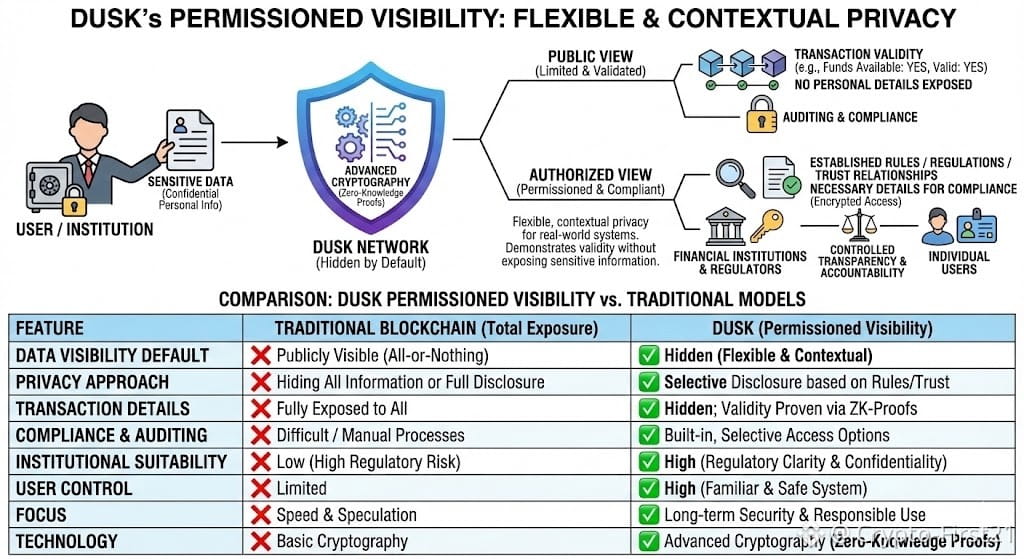
By creating a structure for permissioned visibility, Dusk token aligns the economic incentives surrounding responsible use of blockchain with the overall design of this system. Consequently, instead of focusing on speed and speculation, Dusk will incentivise long term network security and fair participation for all users through its design elements. With the permissioned visibility structure, advanced cryptography, in particular, zero knowledge proofs, is utilised to allow for the verification of transactions, while simultaneously protecting sensitive information regarding the underlying transaction.
For financial institutions that utilise Dusk's permissioned visibility structure, this allows these institutions to be able to move, settle, and maintain records of their assets without transmitting private information publicly. In addition, this model allows individual users to have a system that is both familiar and safe with respect to personal privacy, whilst also providing the requisite degree of decentralisation.
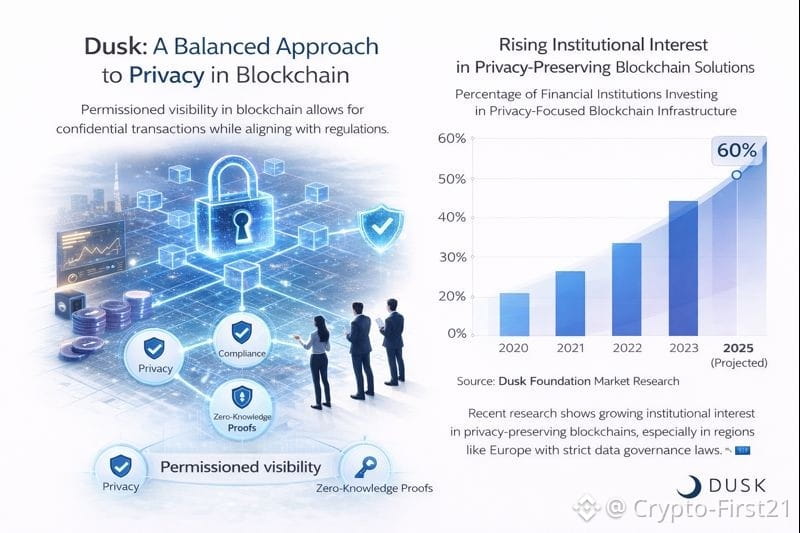
Recent research indicates that there has been an increasing level of institutional interest in the development of privacy preserving digital infrastructures across geographical locations where there are substantial data governance laws, i.e. Europe. Financial companies, like banks and asset managers, have been experimenting with creating infrastructures that allow for controlled transparency, which is a major shift away from total exposure of data. The design choices made by Dusk align with what will be happening within this industry for a long time; therefore, Dusk is positioned very well for success in this type of environment. There tends to be a slow and thoughtful adoption of technologies in environments which contain trust based relationships, but once trust has been established there is an ongoing and sustainable growth pattern.
Personally, I think the design philosophy of a balanced DPI will continue to be well-positioned for success. Humans behave this way, we do not agree to share everything with others, and we need the openness that occurs from having a shared responsibility or a trusted relationship. Therefore, creating a system that has both of these concepts, trust and openness, feels more natural. This may also explain why this potential for success is greater than a system which requires total open sharing of each individual's data.
