
When I first looked closely at Plasma, what struck me wasn’t speed or throughput numbers. It was how little the network seemed to care about being noticed. That sounds strange in crypto, where attention often feels like the product. But Plasma feels designed for something quieter. Repetition. The same action, done correctly, thousands of times a day.
Payments expose weaknesses faster than almost any other use case. If a transaction feels slow, uncertain, or expensive, users notice immediately. Plasma starts by reducing that tension. Sub-second finality means the transaction doesn’t linger in a pending state. The money is either there or it isn’t. That clarity matters more than raw speed because it changes trust at the moment of exchange.
Underneath that experience is Plasma’s decision to center the network around stablecoins, especially USDT. In 2024, stablecoins processed roughly 11 trillion dollars in transfers. That volume didn’t come from hype cycles. It came from people moving value because they needed to. Plasma treats that behavior as the baseline, not the edge case.
Gasless USDT transfers are an extension of that thinking. On the surface, it feels like convenience. Underneath, it removes volatility from a place where volatility causes friction. Users don’t need to think about holding XPL just to send dollars. Developers don’t need to explain gas mechanics to non-crypto users. The system absorbs complexity so the transaction feels ordinary.
That ordinariness creates space for real-world use. Remittances depend on predictability. Merchants depend on settlement speed. A payment system that settles in under a second changes how risk is perceived at checkout. Funds feel earned, not promised. That distinction is subtle, but it shapes behavior.
Plasma’s EVM compatibility supports this goal quietly. By allowing Solidity-based contracts through the Reth client, Plasma avoids forcing developers into unfamiliar environments. That lowers experimentation costs. Teams can test payment logic, escrow flows, or settlement automation without rebuilding their entire stack. Familiar tools reduce hesitation, which increases adoption over time.
Security choices reinforce the same philosophy. Plasma’s Bitcoin-aligned security model isn’t about chasing maximal decentralization narratives. It’s about anchoring trust to a system that has protected hundreds of billions of dollars over many years. Bitcoin’s security budget is measured in billions annually. Tapping into that foundation adds weight beneath Plasma’s faster execution layer.
$XPL sits at the center of these mechanics, but it doesn’t demand attention. It pays for execution, aligns validators, and governs upgrades. Its role is structural, not performative. That design choice reduces speculative pressure on everyday usage. The token exists to support the network, not overshadow it.
There are real challenges ahead. Gasless systems must remain economically sustainable. Sub-second finality must hold under stress. Regulatory pressure around stablecoins continues to evolve. Plasma doesn’t pretend these risks don’t exist. Instead, it builds around them, accepting constraints where needed.
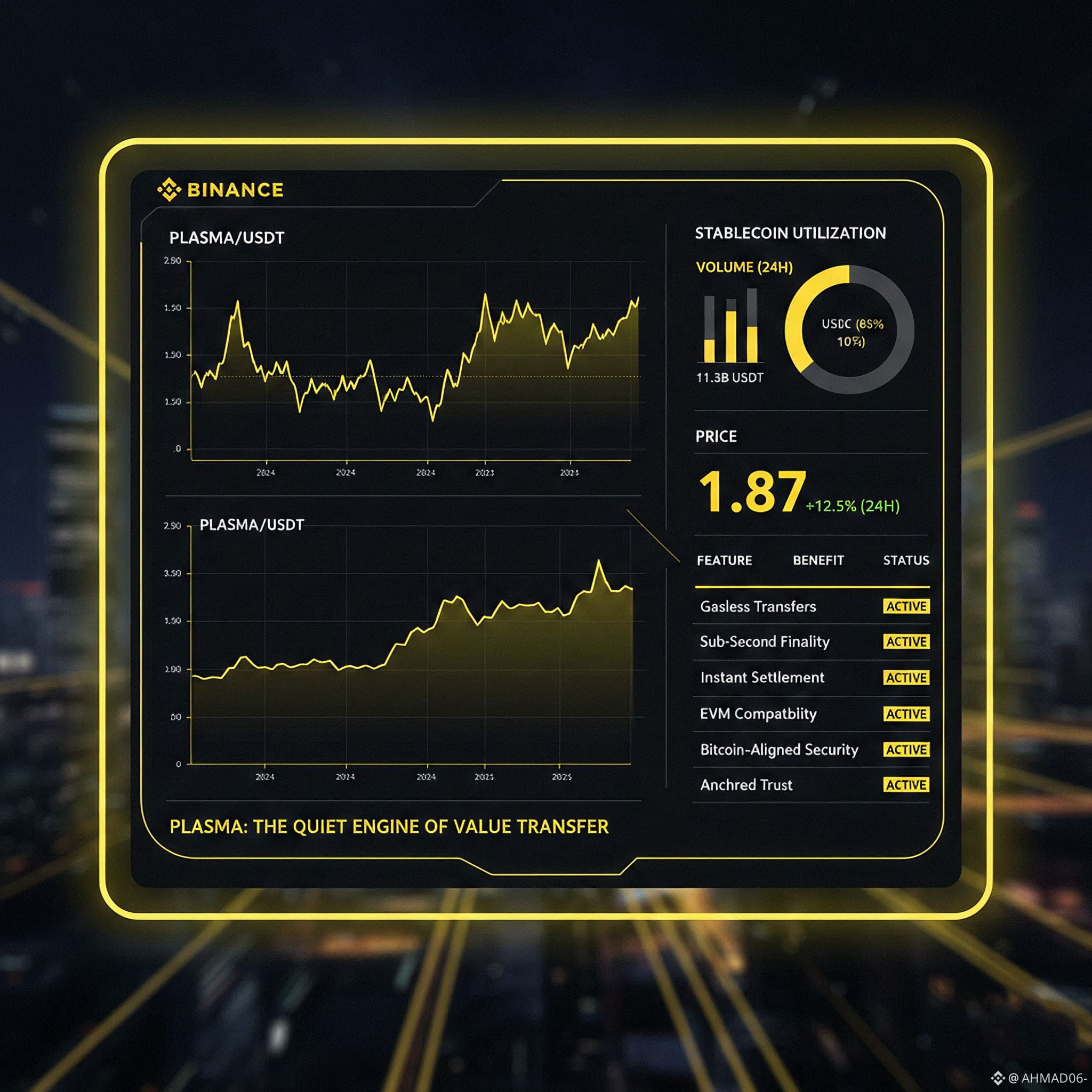
Looking at the broader market, Plasma reflects a shift that’s easy to miss. Blockchains are slowly dividing between those that optimize for narrative cycles and those that optimize for reliability. One type moves fast in headlines. The other moves steadily in infrastructure.
Moral:
If Plasma succeeds, it won’t be because it shouted the loudest. It will be because the system kept working when no one was watching.

