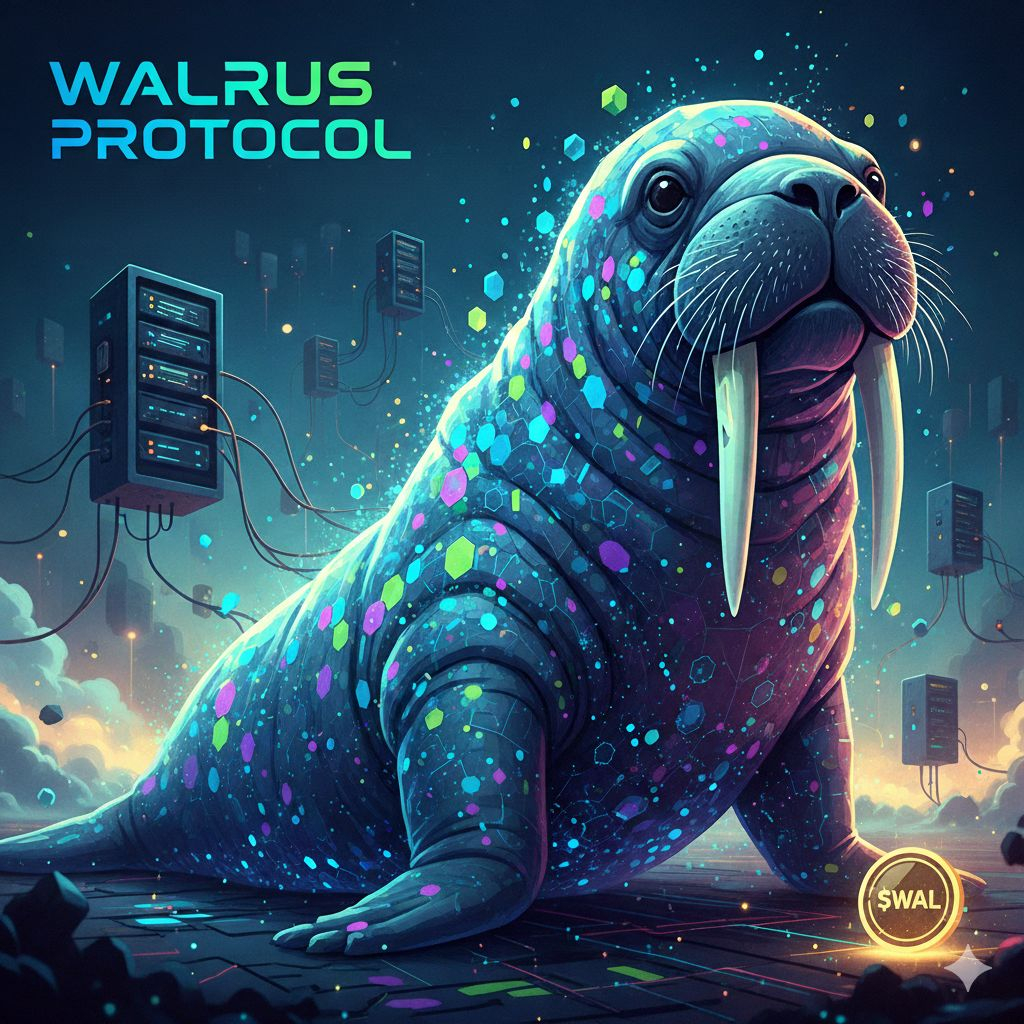
Many people talk about decentralization, but the truth is uncomfortable: most projects still rely on traditional cloud providers to store their data. If the central server of one of these large corporations goes down, the "decentralized project" goes down with it.
This is where the @Walrus 🦭/acc comes in to change the game. I have studied their proposal, and what I found was far beyond the hype.
The Magic of Erasure Coding
Different from conventional storage, Walrus uses a technique called erasure coding. Instead of just copying the file, it fragments it into smart pieces distributed across the network.
Extreme Resilience: You don't need all fragments to recover your data. Even if some nodes go offline, your file remains intact and accessible.
Cost Efficiency: Less space waste than traditional replication, making large-scale storage viable for the Web3 economy.
Where does this change your life?
Eternal NFTs: No more disappearing metadata or broken links. With Walrus, art and code live where they should: in a truly distributed infrastructure.
Media and Social: Imagine social networks where your history and photos do not belong to a single entity, but to a resilient and open protocol.
The role of the token $WAL
The token is not just speculation; it is the fuel. It incentivizes storage providers to keep the network fast and secure. It is pure infrastructure supporting the ecosystem sustainably.
💬 What do you think?
The infrastructure is the silent foundation that defines who survives in the next cycle. Is decentralized storage the "missing link" to total digital sovereignty?
Comment down below: do you prioritize security or convenience in storing your data? 👇