

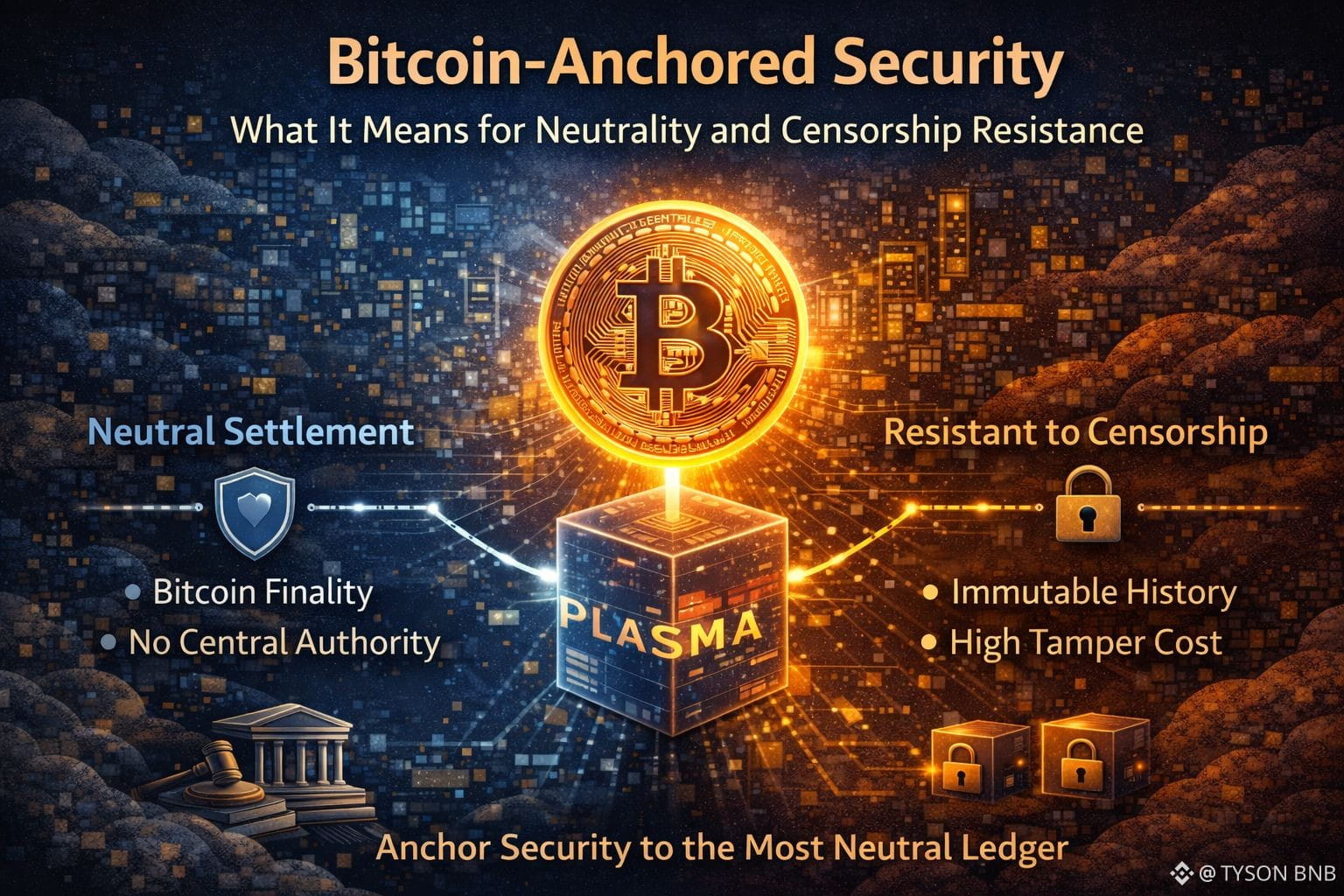
 Neutrality is easy to promise and hard to maintain. Most blockchains claim to be neutral infrastructure, yet their security models quietly introduce points of influence: validator cartels, governance politics, token incentives, or regulatory pressure concentrated on a small group of operators. Over time, these pressures shape what gets included, delayed, or quietly ignored. This is where the idea of Bitcoin-anchored security enters the conversation, not as a buzzword, but as a design choice with real consequences for censorship resistance. For Plasma, anchoring security to Bitcoin is less about borrowing reputation and more about outsourcing final authority to the most politically neutral ledger that exists today.
Bitcoin’s role in this architecture is not about execution or programmability. It is about settlement finality and historical immutability. Bitcoin is slow, conservative, and intentionally resistant to rapid change. Those qualities frustrate application developers, but they make Bitcoin uniquely valuable as a security anchor. When a system ties its state commitments or checkpoints to Bitcoin, it inherits Bitcoin’s social and economic gravity. Rewriting history becomes prohibitively expensive, not just computationally, but politically. Any attempt to censor or manipulate anchored data would require influencing Bitcoin itself, a task orders of magnitude harder than pressuring a smaller validator set or governance council.
Plasma's attention to Bitcoin, anchored security is because of the company's fundamental mission: to offer neutral stablecoin settlement. Stablecoins are at a bit of an uncomfortable crossroads between decentralized (open) networks and the influence of power structures in the real world. They are used worldwide, quite often crossing borders and jurisdictions, and therefore, they draw scrutiny, inevitably. In such a scenario, neutrality is not merely a philosophical choice; it is, in fact, a necessity for survival. If settlement infrastructure can be easily influenced, it becomes an extension of whoever holds leverage over validators or token governance. Anchoring to Bitcoin is a way of externalizing that leverage to a system that has no issuer, no foundation, and no steering committee.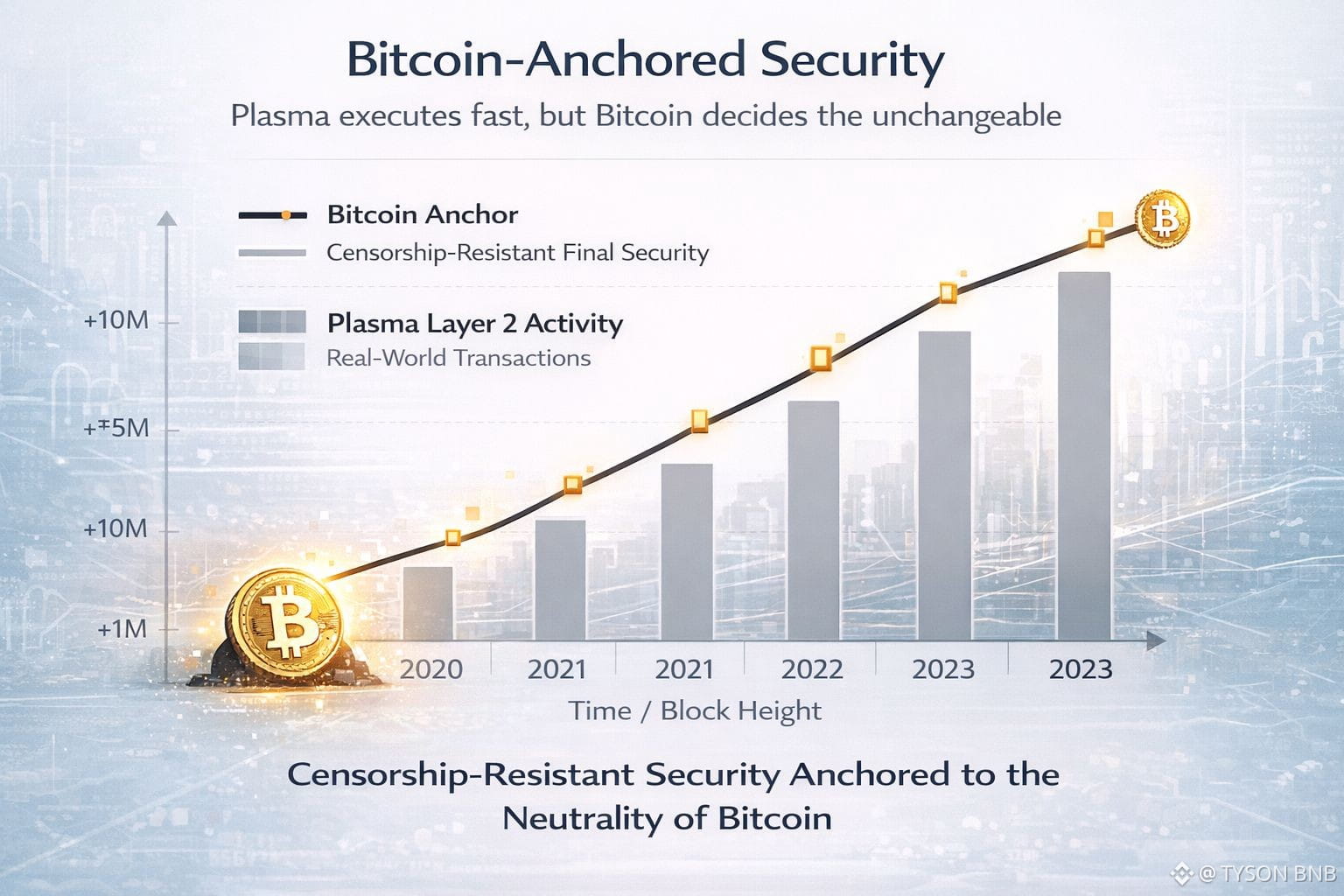
This anchoring changes the threat model. Instead of asking “who controls the validators today,” the question becomes “can anyone realistically coerce Bitcoin to rewrite or censor history?” The answer, based on over a decade of adversarial testing, is effectively no. Bitcoin’s security is not just hashpower; it is the diversity of its miners, the inertia of its protocol, and the lack of centralized choke points. By tying settlement assurances to this base, Plasma reduces the number of actors who could plausibly interfere with transaction finality.
Neutrality also emerges from predictability. Systems anchored to rapidly evolving governance structures can shift rules under pressure. Parameters change, validators rotate, incentives are tweaked. Bitcoin’s refusal to evolve quickly becomes an advantage here. When Plasma anchors security to Bitcoin, it anchors to rules that are painfully hard to change. This rigidity creates a stable reference point for neutrality. Users and institutions do not need to trust Plasma’s future governance promises; they can observe Bitcoin’s past behavior and draw their own conclusions.
Censorship resistance, in this context, is not about dramatic confrontations. It is about quiet reliability. A network that can be censored easily does not need overt attacks; subtle delays, selective inclusion, or policy-driven throttling are enough. Bitcoin-anchored security raises the cost of such subtle manipulation. Even if a middle layer tries to filter the activity, the anchor makes a permanent record of the divergence that cannot be changed. This openness is a deterrent. Censorship is made to be seen, proven, and it harms one's reputation.
There is also an important psychological effect. When users know that settlement is ultimately anchored to Bitcoin, trust shifts away from personalities and organizations toward mathematics and history. This does not eliminate trust entirely, but it relocates it. Instead of trusting operators to behave well, users trust that misbehavior cannot be hidden. In financial systems, this distinction matters. It is easier to trust constraints than intentions.
For Plasma, which focuses on stablecoin settlement rather than speculative execution, this model fits naturally. Typically, stablecoin users do not mind less rapid feature upgrades but they do care more about the guarantee that their transactions will not be arbitrarily blocked or reversed. Anchoring to Bitcoin provides a form of constitutional backing. It does not guarantee inclusion in every moment, but it guarantees that exclusion cannot be rewritten out of existence. That guarantee is subtle, but powerful.
Critically, Bitcoin-anchored security does not mean outsourcing everything to Bitcoin. Plasma has its own chain, in which it decides the block size, gas limit, and the way the UX can be delivered. The anchor is about finality, not control. This separation preserves flexibility while hardening the core. Plasma can evolve its operational layer without constantly renegotiating its neutrality assumptions, because the anchor remains unchanged.
There is a broader implication here for blockchain design. Many networks attempt to achieve neutrality internally, through decentralization metrics or governance safeguards. These efforts are valuable but fragile. Internal neutrality can erode over time as incentives concentrate. External anchoring offers a complementary approach: rather than perfecting neutrality inside a system, tie the system’s critical guarantees to something already proven to resist capture. Bitcoin, by accident or design, has become that reference point.
Some critics argue that anchoring to Bitcoin introduces dependency. In reality, it introduces asymmetry. Plasma depends on Bitcoin for security assurances, but Bitcoin does not depend on Plasma. This one-way dependency is precisely what makes the anchor credible. There is no incentive for Bitcoin to adapt to Plasma’s needs, and that indifference is a feature. Neutrality is strongest when the anchor has no reason to care.
Viewed through this lens, Bitcoin-anchored security is less about technical integration and more about political architecture. It is a way of choosing which power structures a system aligns with. By linking itself to Bitcoin, Plasma is basically associating its identity with a network whose main achievement is neither speed nor expressiveness, but rather the ability to resist influence. In a time when financial infrastructure is more and more coming under the influence of geopolitical factors, this is a significant decision.
Ultimately, neutrality and censorship resistance are not achieved by slogans. They emerge from constraints that make interference impractical rather than merely discouraged. Bitcoin-anchored security provides such a constraint. It does not promise perfection, but it narrows the space for abuse. For a stablecoin-focused network like Plasma, operating at the crossroads of open finance and real-world regulation, that narrowing may be the difference between infrastructure that merely exists and infrastructure that can be trusted to endure.