
Hello, dear readers, I am Uncle.
In the past two days, Binance has launched trading pairs for Tesla, gold, silver, and others, and the market discussion is very high. This is indeed a milestone, representing that mainstream exchanges also recognize the trend of traditional assets being brought on-chain. However, Uncle has observed a phenomenon: many readers look at Binance's massive trading volume and wonder, 'Since Binance is fast and convenient, why should I still spend effort researching @Dusk this growing public chain? Is DUSK really more reliable than Binance?'
This is a very professional question. Today, we won't discuss vague visions; Uncle is going to take everyone down to the bottom to dissect the life-and-death differences between 'trading certificates' and 'native production rights' in extreme situations.
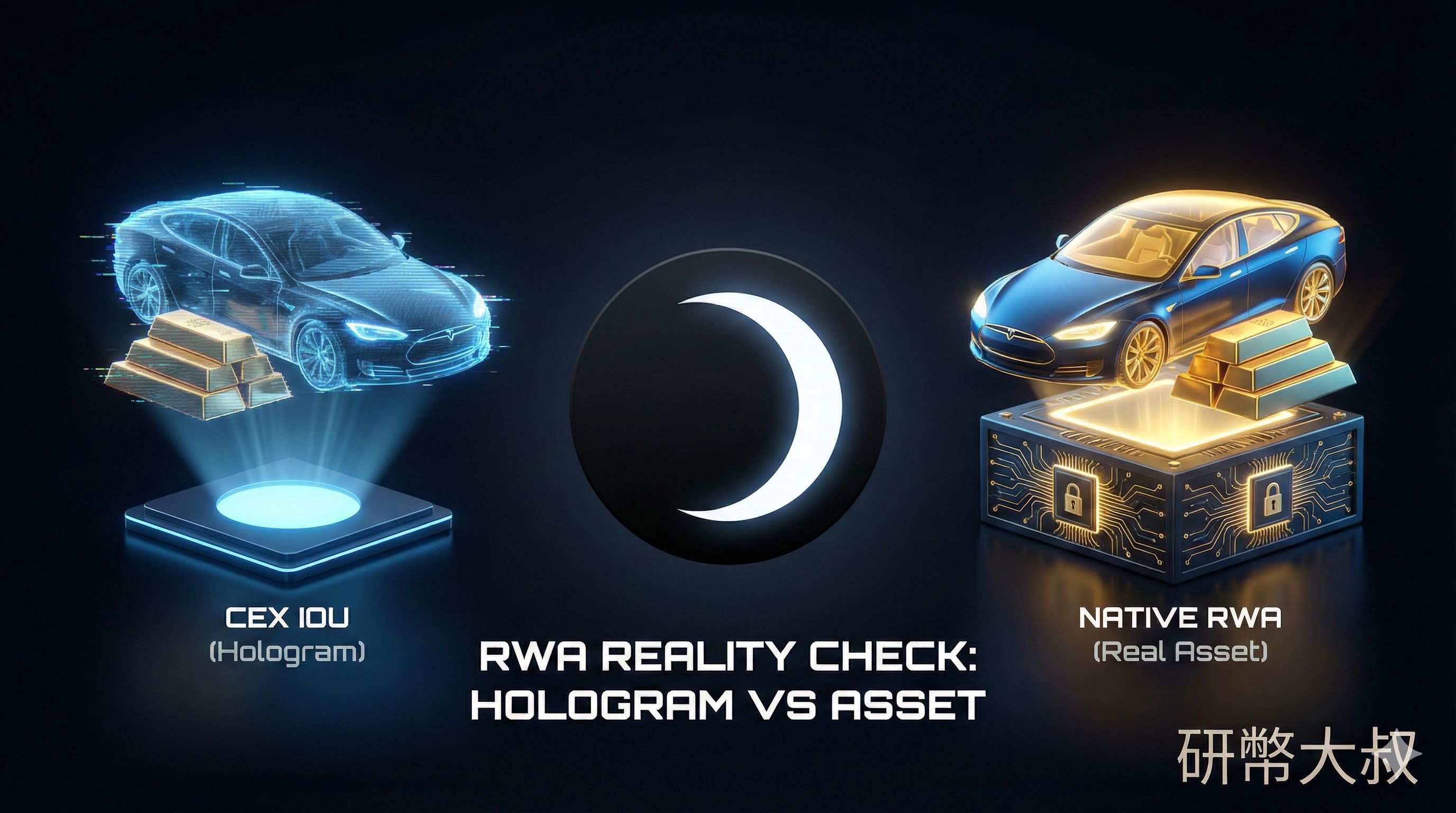
1. What you buy on Binance is a 'receipt', while what you hold on Dusk is 'digital ownership'.
First, we need to clarify what assets you actually have.
Buying Tesla on Binance means you are purchasing a form of 'tokenized certificate'. In simple terms, Binance has found a third-party custodian to hold the actual stocks and then issues 1:1 tokens on its own ledger.
Risk concerns: This highly relies on 'centralized credit', specifically Binance's credit. What you are buying is Binance's promise to you, not the stock itself. If there are issues with the custodian involved or if there are discrepancies in the exchange's internal ledger, your tokens will face the risk of 'depegging'. In extreme market volatility, you may find that the token price you hold does not match the actual US stock price, which is known as 'credit discount'.
The native logic of Dusk: DUSK follows 'native issuance'. The assets at the moment of issuance are directly coded onto the blockchain and are legally protected under EU MiCA regulations. On Dusk, Tokens are property certificates, and there is no need for 'secondary transfer' or 'centralized guarantees' through exchanges. The assets in your wallet have the same legal standing as physical stocks.
2. Regarding 'price divergence': The race between shadow and reality.
One of the most concerning questions for readers: If the prices on Binance and Dusk differ from the actual stock price, what should we do? Let's continue to see.
The divergence of Binance comes from a 'closed environment':
The price of Binance tokens reflects 'supply and demand within the platform'. If Binance users collectively panic sell, even if Tesla's US stock is rising, the token price on Binance could drop below the issue price. It's like buying meal vouchers at an amusement park; the price is determined by the park and may not align with outside prices. This is called 'shadow pricing', and the divergence often arises because you cannot easily 'withdraw' assets from the park.
The divergence of Dusk comes from 'liquidity costs':
As an emerging public chain, Dusk's initial trading activity will certainly not match that of Binance, which may lead to larger buy-sell spreads. However, the divergence of Dusk has a 'cure', which is the core topic we will discuss next: redemption and arbitrage.
3. Deep arbitrage logic: Why is the 'redemption mechanism' the lifeline of RWA?
This is the key point Uncle wants to share with everyone: If a price divergence occurs, can you earn back money through arbitrage?
Limitations of Binance:
Most tokenized assets on centralized exchanges are 'one-way'. You can buy and sell within the platform, but it's very difficult to actually 'withdraw' the tokens, convert them into real Tesla stocks, and sell them in the US stock market. This involves extremely complex cross-border laws and broker connections. If you cannot 'redeem in kind', then when a price discount occurs, arbitrageurs will not be able to step in to level the price difference, and you can only watch as your assets depeg.
Regulatory advantages of Dusk:
Because Dusk complies with EU MiCA regulations from the ground up and issues through regulated platforms like NPEX, it must support 'two-way redemption' by design.
This means: if Tesla on Dusk is cheaper than the actual US stock by 2% due to inactive trading, professional arbitrageurs will rush in like sharks.
1. Buy low: Purchase undervalued Tesla Tokens on Dusk.
2. Legal redemption: Use regulatory-compliant procedures to convert Tokens back into real assets or equivalent fiat currency (for example, through $EURQ).
3. High-priced selling: Sell at market price in traditional financial markets to earn that 2% risk-free price difference.
This process will repeat until the price of Dusk fully aligns with the actual stock price. This is why, despite Dusk having a smaller trading volume, its price possesses 'legally stable' characteristics.
4. Conclusion: Do you want convenience or sovereignty?
The Tesla trading offered by Binance packages traditional assets into 'tokens' for easier buying and selling, while DUSK is reconstructing financial infrastructure to truly return assets to 'personal ownership'.
Uncle's musings: If you just want to play short-term, the convenience of Binance is irreplaceable. But if you are looking for long-term allocation of large assets and hope that your assets still have legal protection and the ability for 'hard redemption' during market crises, then the DUSK system that integrates regulations into code is the long-term game you truly need to understand.
$DUSK #dusk #RWA #Binance #Tesla #MiCA
