

Crypto loves feature lists. Faster blocks. New VMs. More apps. Better wallets. But regulated finance does not adopt tools that way. It adopts what fits the calendar. The calendar is the real boss. Month-end close. Quarterly reports. Annual audits. Routine checks from risk and compliance teams. If a system makes those cycles harder, it gets cut. It does not matter how clever the tech sounds.
That is why reporting cycles decide adoption more than features.
A fund can trade all day, but it must explain itself later. A broker can route orders, but it must keep records. An issuer can raise money, but it must prove ownership rules were followed. These are not “nice to have” tasks. They are survival tasks. They decide whether an asset can be offered, held, and settled at scale.
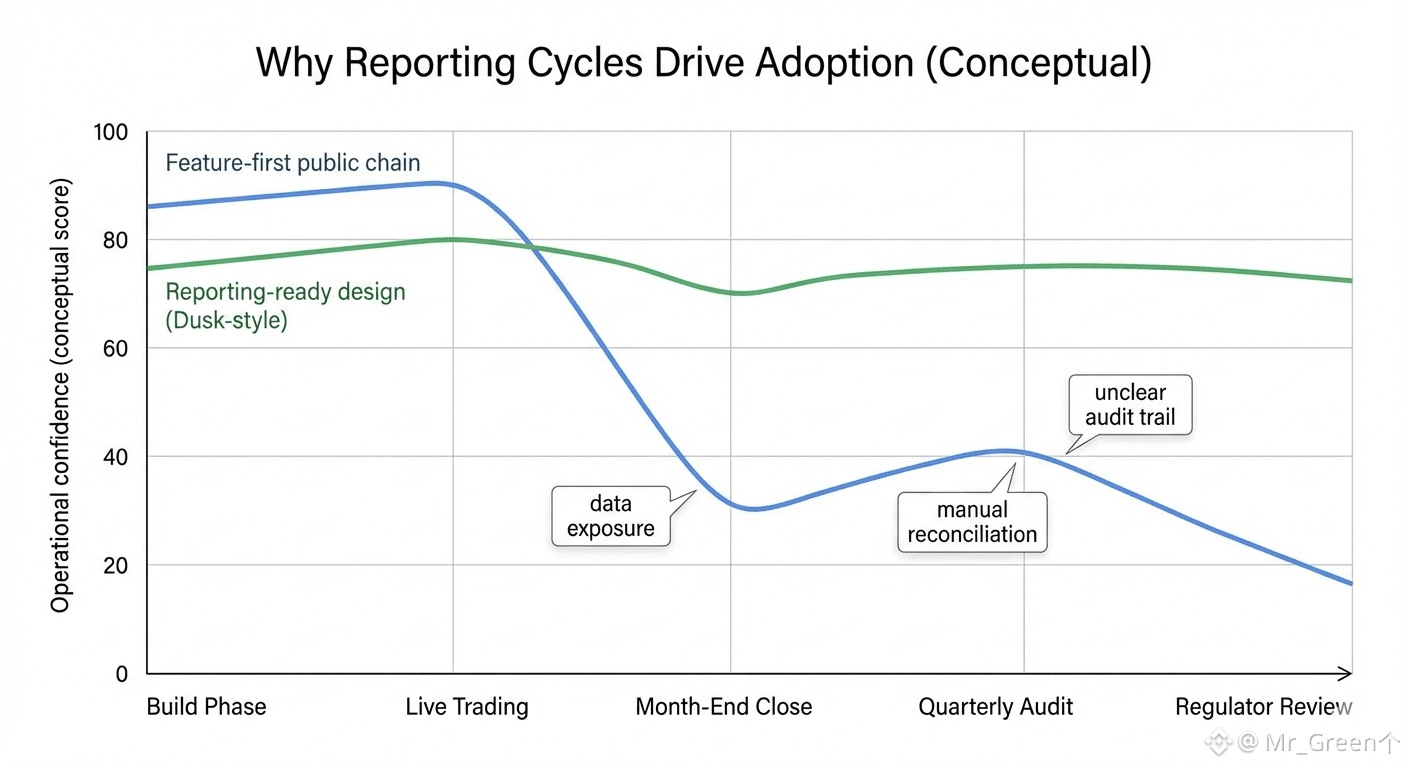
Now look at what breaks on most public chains. Public chains are loud by default. Balances are readable. Transfers show sender, receiver, and amount. That level of exposure creates problems in two directions at once. It creates privacy harm for lawful users. It also creates compliance risk, because teams start adding patches at the edges. They hide flows with off-chain steps. They gate access with a front end. They monitor wallets after the fact. That kind of setup falls apart during real audits.
When auditors arrive, they do not want vibes. They want a clean trail.
Dusk’s pitch makes more sense when you view it through that lens. Dusk’s docs describe a chain built for financial apps where privacy is built in, but transparency is still possible when required. It is not trying to make every action public. It is trying to make every action explainable to the right party. That is selective disclosure in plain language.
Selective disclosure matters because reporting is not public theater. It is controlled access. A regulator does not need your entire on-chain life. An auditor does not need everyone’s data. They need specific answers to specific questions. Who was eligible. Which rules applied. Whether transfers violated restrictions. Whether balances were sufficient at settlement. Whether the system can prove it.
Dusk’s dual transaction approach fits this reality. Dusk describes Moonlight as the public lane and Phoenix as the shielded lane. Moonlight is useful when openness is part of the workflow. Phoenix is useful when privacy is normal market hygiene. The point is choice. Finance uses both kinds of flows every day. Dusk tries to make both native, on the same settlement layer.
This becomes even more practical when you think about reporting windows. During a reporting window, some data must surface. Not always to the public. Often to an internal team, an auditor, or a venue. Dusk’s framing is that you can keep transfers confidential, while still having a path to reveal what is required. That is why “privacy plus audit” is a real design goal, not a slogan.
The reporting test also shows up in execution layers.
Many builders live in the EVM world. Tooling is familiar. Contracts are common. But EVM apps on public chains usually inherit public exposure. That is where DuskEVM and Hedger fit the reporting story. Dusk describes Hedger as a privacy engine for the EVM layer, using zero-knowledge proofs and homomorphic encryption. The goal is to support confidential activity on EVM while staying audit-ready.
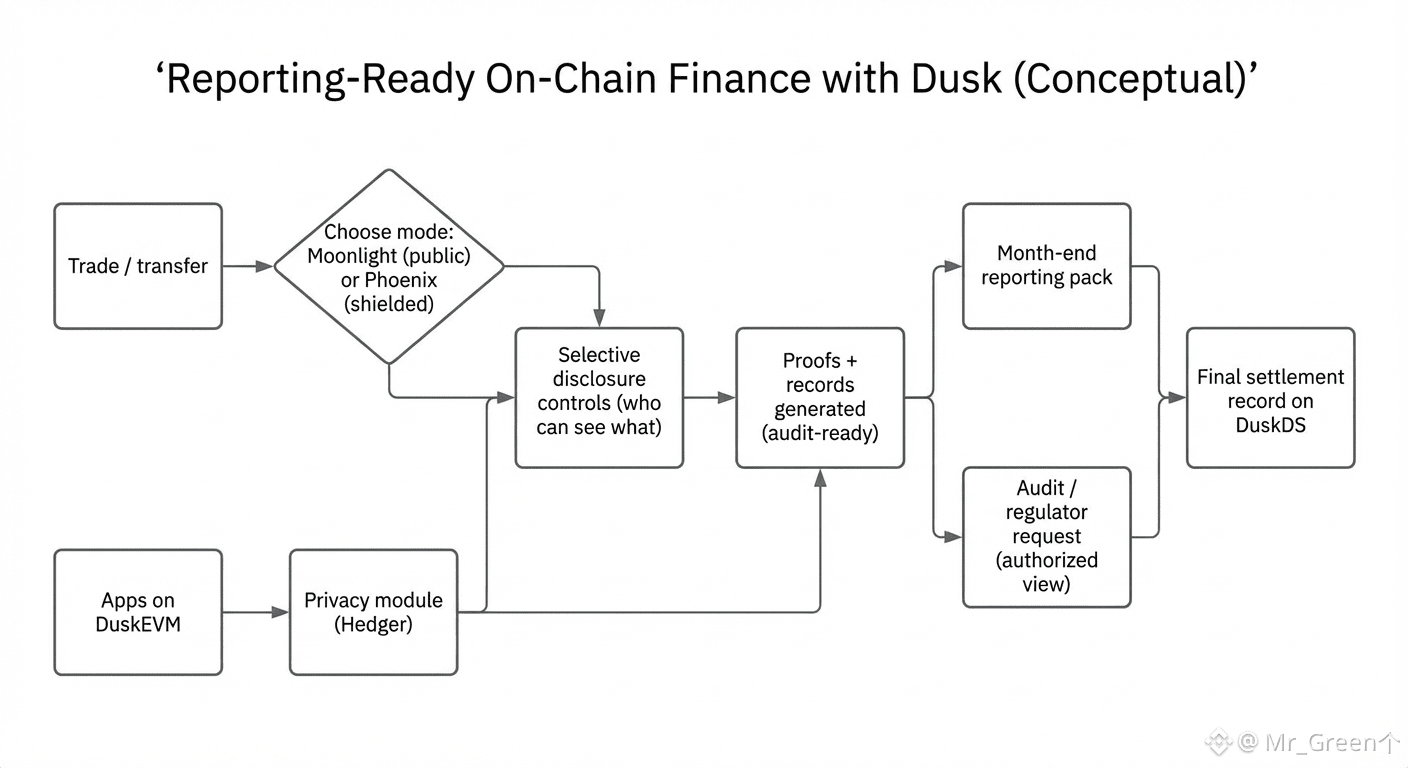
In reporting terms, that means something simple. You can run app logic without dumping sensitive values into public logs. You can still produce proof that the rules were followed. Then, when a real request arrives, you have a controlled way to show what must be shown.
This is also why Dusk’s partnership choices matter more than social hype.
Dusk’s public updates describe a partnership with NPEX that ties into regulated market structure. Dusk also frames this partnership as bringing a suite of licenses into the plan, including MTF, Broker, and ECSP, with DLT-TSS described as forthcoming. Those acronyms matter because they live inside reporting culture. Licensed venues survive by passing reviews. They build systems around record keeping, controls, and oversight.
That is the world where “reporting cycles” are not a metaphor. They are deadlines.
Dusk Trade is the clearest example of Dusk putting itself in that world. Public posts and Dusk channels describe the Dusk Trade waitlist as open, and describe it as a regulated RWA trading platform built with NPEX. They also highlight EU compliance posture, KYC/AML readiness, and GDPR-aware handling. Whatever happens next, the intent is clear. Dusk is trying to ship a product that will be judged by compliance teams, not just traders.
This is why reporting decides adoption. A chain can have great features and still fail the reporting test. If the system cannot produce clean records, real firms cannot touch it. If the system forces full public exposure, real firms cannot trade without leaking strategy. If the system hides everything with no audit path, real firms cannot defend themselves later.
Dusk is trying to avoid all three traps at once. It anchors settlement on DuskDS. It supports both public and shielded transfers. It frames privacy as compatible with oversight through selective disclosure. It adds an EVM path for builders who already have habits. It adds a privacy engine for EVM so confidential workflows can still be proven.
That is a reporting-first design, even when it sounds like pure crypto tech. So if you want a clean way to judge Dusk, use the calendar test. Ask how it behaves when the quarter ends. Ask what a compliance officer can verify. Ask what an auditor can reproduce. Ask what a venue can report without exposing users.
Features get attention. Reporting cycles decide who is allowed to stay.
