

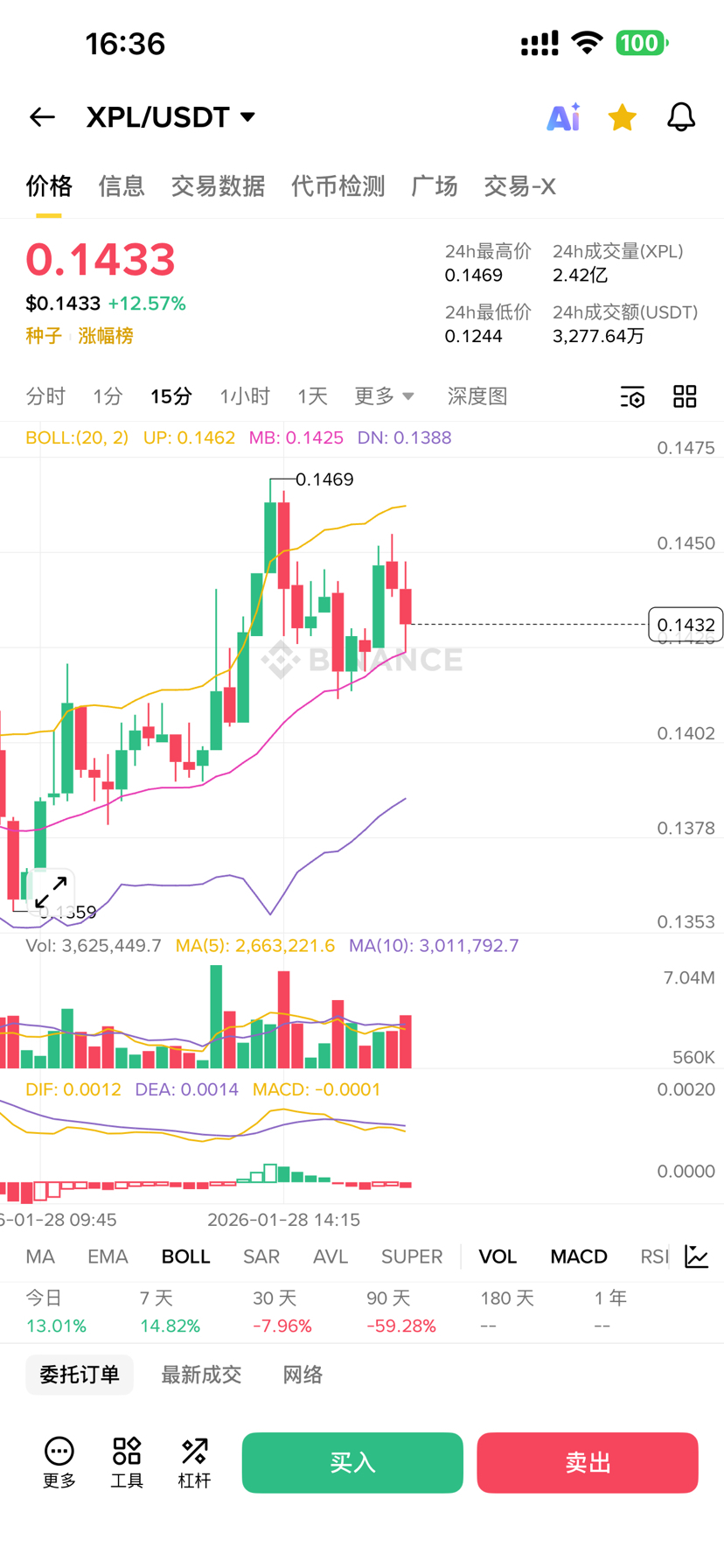
When I saw that steep, almost vertical green K-line on the screen, I was taken aback. Yesterday, XPL was like a dead calm, languishing around $0.12 without any vitality. But today, it surged from a low of $0.124 to a high of $0.1469 within 24 hours, exceeding a 12% increase. Such a level of volatility, appearing in an asset that has been in a long-term downtrend, cannot simply be summarized by the words 'it has risen.' This feels more like a long-overdue technical resistance, a psychological battle between bulls and bears centered around key price points, and the battlefield map is that scarred K-line chart.
Price itself is a history book filled with stories.
To understand why it rose today, we must first look at why it fell before and where it fell to. The history of XPL is a typical narrative of 'high-profile listing, long bottom-seeking'. Its historical highest price reached $1.68, compared to today’s price, which has erased more than 90% of its market value. Such a decline is not uncommon in the cryptocurrency field but is enough to destroy the faith of most early holders. From January 2025 to January 2026, its price fell from $1.3 to the range of $0.15, with an annual decline of 87.82%.
But the key point is that the price does not fall straight down but will look for certain positions to 'rest'. These positions are what technical analysis refers to as support and resistance levels. I reviewed recent data and found that around $0.12, the price seems to have encountered some kind of 'invisible support'. For example, on January 19, the price dropped to a low of $0.113 but was quickly pulled back; in the following trading days, multiple attempts to drop near $0.12 were unsuccessful. This area has gradually formed a technical 'support platform'.
This rebound was directly initiated from the lower edge of this platform ($0.124). From a technical game perspective, this can be interpreted as: after several attempts to break through the key support of $0.12, the shorts found that the selling pressure below was exhausted and could not continue to push prices lower. Once the selling pressure weakens, even a very small buying force can drive prices to rebound relatively sharply. This is why assets that have dropped significantly often seem to have a strong rebound in the early stages — because their price spring has been compressed too tightly.
Market memories and the specter of cycles.
In the crypto market, we often talk about 'cycles'. The bear market seems bottomless, but the bull market is always born out of despair. XPL's current situation reminds me of many past assets. It has gone through a brutal process of de-bubbling, with its circulating market value falling from a high point. But at the same time, some subtle changes are occurring.
The most direct change is in trading volume. Despite the low price, we see that the recent daily trading volume is not small, often maintaining at several million dollars. This indicates that even in the low-price zone, funds are still continuously exchanging chips. Who is selling? Perhaps it is the last batch of stop-loss orders that can no longer hold on, or it may be the early unlocked chips. Who is buying? It could be left-side traders who believe 'the price has included all the bad news', or it may be new funds attracted by recent fundamental changes.
Here we must mention a potential risk point, which is the sword of Damocles hanging over many investors: token unlocking. Some analyses point out that a large-scale unlocking may occur in July 2026. This clear expectation of future supply increase is one of the core factors suppressing the price's medium to long-term performance. The current rebound is happening under the shadow of this long-term bearish expectation. This makes its nature more complex: it could be a game of expectations 'before the bad news lands', or it could be purely a technical rebound.
Market language: not just a numbers game.
Setting aside the cold charts, the market itself is also telling emotions. Today’s rise is accompanied by a significant increase in volume, which is a positive short-term signal, indicating that real money is buying in, rather than just a 'volume-less rise' caused by shorts covering. Additionally, while some other altcoins (like AUCTION) have seen significant declines, XPL has managed to strengthen against the trend, showing that its capital flow is beginning to exhibit a degree of independence.
Where does this independence come from? I believe it partly stems from the unique positioning of its project being re-evaluated by the market. When the overall market is weak, capital becomes pickier, searching for those that have 'fallen out of value' and whose stories are not yet told. Plasma's focus on the 'dedicated chain' story for stablecoin settlement, along with the recent integration with platforms like NEAR Intents, may provide it with a glimmer of distinction from other purely conceptual altcoins.
A simple logic: having fallen a lot is itself a reason for a rise.
Finally, I want to share an observation that may not be so technical but is very fundamental: in capital markets, having fallen a lot is itself the biggest premise for good news. When the pessimistic expectations of an asset are infinitely amplified and the price falls to the dust, any small positive change can be magnified exponentially. It’s like a spring that has been pressed to its limit; it just needs a little pressure release to bounce back.
What does it mean for XPL to drop from $1.68 to $0.12? It means that all the doubts about excessive financing, valuation bubbles, and slow ecological progress have largely been factored into the price. Those who dare to hold or buy at this price level are either those who choose to 'lie flat' after being deeply trapped or extremely high-risk seekers who believe its core value is severely underestimated. The market's selling pressure will phase out at such a position.
Therefore, today’s rebound can be viewed as a fierce collision of long and short forces at a critical psychological threshold. It does not necessarily represent a complete trend reversal — a reversal requires more solid fundamental support and a longer time for bottom formation. But it clearly sends a signal: in this price range, the market's attitude is shifting from 'one-sided selling' to 'long-short divergence', and divergence is always the starting point for price fluctuations and opportunities.
For observers, the most important insight from this rebound may not be 'whether to chase', but it reminds us that even in seemingly dead markets, the undercurrents of capital have never ceased to surge. Every inch of price movement is a complex mapping of countless individual decisions and collective psychology.
The price that has fallen to the dust is like a spring that has been compressed to its limit; a rebound only needs a reason to release the force.
The market is not trading the truth of the present but trading the consensus and divergence of future expectations. When the last pessimist begins to hesitate, the first glimmer of light in price is often lit.
Beyond the rebound: insights into the ecological 'connector' value behind XPL's rise.
When the price chart of $XPL suddenly 'comes alive', pulling out more than a 12% increase in 24 hours, many people's first reaction is: a rebound from an oversold condition, a technical bounce. This explanation is certainly correct, but it may only see the ripples on the surface. As a researcher continuously tracking Layer1 ecosystem development, I tend to dive underwater to see what dark currents are pushing the ripples. I found that this fluctuation may be closely related to a seemingly low-key but actually far-reaching technical integration — the integration of Plasma with NEAR Intents. This is not just adding a cross-chain bridge, but more like connecting a focused 'engine' to the entire 'intercontinental highway network'.
'Dedicated chain' paradox: performance and solitude.
To understand the significance of this integration, we must return to Plasma's original intention. Since its inception, it has claimed not to be another 'universal public chain', but a 'dedicated highway' tailored for stablecoin settlement. This positioning is very smart, directly addressing the pain points of high transfer fees and slow speeds for stablecoins on universal chains. It theoretically achieves a zero Gas fee experience for users through a mechanism similar to Paymaster, which is fatal attraction for merchants and ordinary users.
However, the term 'dedicated' brings with it a huge challenge: ecological isolation. A highway, no matter how fast and cost-effective, if it can only connect a few towns, its value is also limited. Developers, users, and funds are naturally inclined to gather in ecologies that are prosperous with many choices, such as 'super cities' like Ethereum, Solana, and their Layer2s. Previously, although Plasma chain had accumulated tens of billions in stablecoin assets, the value capture and application scenarios of its native token XPL have always been limited by this relatively closed garden. Its value needs to be 'used' and more importantly, 'taken out'.
NEAR Intents: the 'universal key' breaking the garden walls.
The emergence and integration of NEAR Intents precisely address this pain point. It is not a simple cross-chain bridge but a cross-chain liquidity protocol based on 'intents'. You can think of it as a top-level, intelligent 'international airport transfer system'. Users no longer need to worry about complex cross-chain operations; they just need to express the intent of 'I want to exchange asset X on chain A for asset Y on chain B', and the 'solver' network behind the system will automatically find the optimal path to complete the exchange.
On January 23 this year, Plasma officially announced the integration of NEAR Intents. This means that Plasma's native token XPL and its core asset USDT0 are instantly connected to a vast liquidity network covering over 25 mainstream blockchains and containing more than 125 kinds of assets. For ordinary users, they can now seamlessly exchange ETH on Ethereum, ARB on Arbitrum, or MATIC on Polygon directly for XPL or USDT0 on Plasma chain, a process that may only require one click.
The real demand revealed by the data: the migration wave of stablecoins.
The most clever part of this integration is its perfect resonance with Plasma's core mission. Data shows that in cross-chain transactions processed by NEAR Intents, as much as 39% of the transaction volume involves Tether (USDT). This indicates that in the current crypto world, cross-chain liquidity for stablecoins is one of the highest frequency and most rigid demands.
Imagine this scenario: a trader who has taken profits in the Ethereum DeFi ecosystem holds a large amount of USDT. He may want to transfer some assets to a chain with lower fees and faster speeds for savings or payments. In the past, he would have needed to go through centralized exchanges or use complex cross-chain bridges. Now, through NEAR Intents, he can one-click exchange USDT on ETH for USDT0 on Plasma chain (or directly exchange for XPL), and then deposit it into a digital banking application like Plasma One to enjoy the advertised high returns. This path has become unprecedentedly smooth.
For Plasma, this not only introduces external liquidity but also transforms its most proficient 'stablecoin settlement' service into a public product that is easily accessible to the entire network. It has transitioned from a closed 'dedicated road' to an open 'stablecoin settlement hub'.
From 'value islands' to 'value hubs': the subtle shift in XPL's role.
This change may subtly impact the economic model and value narrative of the XPL token. Previously, the value support of XPL was relatively inward: staking security and network governance. Now, with Plasma becoming an important node in cross-chain liquidity through NEAR Intents, XPL begins to acquire an outward and connective value.
It is somewhat similar to a 'pass card' or 'service area equity' on a highway. When this road becomes an indispensable part of the busy road network, the potential demand and use value of this 'pass card' will naturally rise. More assets flowing into the Plasma ecosystem, whether to enjoy zero-fee transfers or to use its DeFi or digital banking services, will increase the demand for network resources, ultimately benefiting XPL holders through fees, staking demands, and other forms.
Short-term enthusiasm and long-term narrative 🤔
Of course, we must remain clear-headed. The sustainability of a price rebound brought about by a technical integration needs the test of time. The market may have prematurely speculated on this good news, but the true value accumulation depends on the actual amount of funds flowing in post-integration, the trading frequency generated, and whether new and interesting application scenarios can emerge.
At the same time, we must not forget other fundamental factors, such as the future token unlocking plan mentioned earlier, which will continue to exert pressure on the market supply side. The benefits of technology and ecology require sufficiently strong buying to offset these structural selling pressures.
But in any case, this integration with NEAR Intents adds a crucial new chapter to Plasma's story. It is no longer just a technical story about 'how good the performance is and how low the fees are', but has upgraded to a narrative about 'how wide the connections are and how vibrant the ecology is'.
In the crypto world, isolation brings security but also stagnation; connection comes with risks but also nurtures prosperity. Plasma is proactively choosing to embrace the latter. This price increase may be the market casting its first temporary vote of trust for this strategic choice. The face value will fluctuate, but the strategic direction itself is worth savoring for anyone concerned about the implementation of blockchain applications.
The best technology does not build the highest walls but opens the widest doors. NEAR Intents is exactly the door to the entire crypto world that Plasma has pushed open.
When a chain chooses to connect, its token transforms from 'fuel' to 'passport', with its value depending on how many places it can take you.
The short-term ups and downs of the market are a voting machine, while long-term value is a weighing machine. The weight of the integration is slowly being added. #Plasma @Plasma $XPL
🔔ps: Dear ones, I’ll stop here for today. The above only represents my personal opinion and does not constitute any investment advice. Some data and information are sourced from the internet; if there are errors, please contact me for timely correction. Thank you 🥹


