

Imagine a world where your data isn’t trapped inside a company’s servers, where no one can shut you down, spy on what you store, or suddenly hike up prices because they feel like it. Now imagine a network that doesn’t just store your files but protects them, hides them, spreads them across hundreds of independent nodes, and still brings them back instantly whenever you need them. That world sounds almost impossible in the age of Big Tech monopolies, but that’s exactly the world Walrus is building, and it is doing it with a calm confidence that feels like watching a giant quietly rise from deep waters. Walrus, built on the powerful Sui blockchain, has become one of the most exciting and whispered-about names in decentralized storage and privacy-focused blockchain technology. And unlike most projects that talk big but deliver small, Walrus is actually shipping real technology that works at scale.
What makes Walrus different is its entire philosophy. Instead of treating storage as just a place to dump files, Walrus treats data like a living, programmable digital asset. You don’t simply upload something; you embed it into a decentralized web where it becomes unstoppable and censorship-proof. Through their clever use of erasure coding, Walrus breaks files into hundreds of pieces and spreads them across a global network of independent storage providers. Even if several nodes go offline, the file can still be rebuilt instantly from the remaining fragments. This approach makes Walrus not only extremely durable but also incredibly cheap compared to traditional blockchain storage, which is usually painfully expensive. For developers, creators, businesses, and anyone who wants control over their digital life, this is a breakthrough that can change everything.
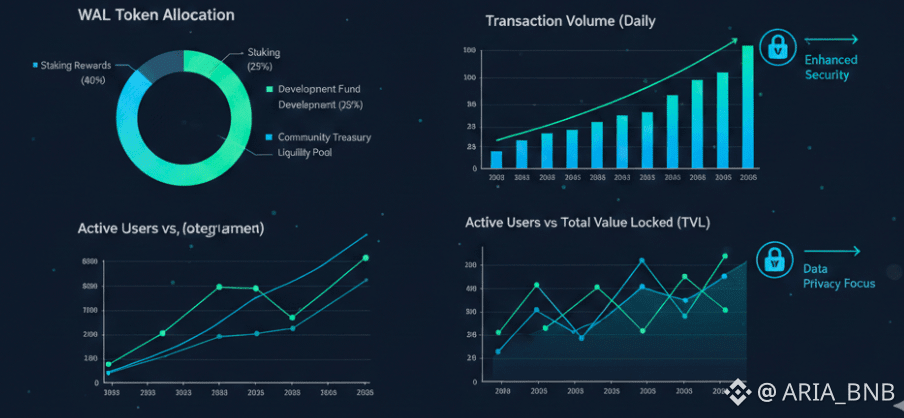
The WAL token plays a central role in this new world. It’s the fuel, the reward, the governance voice, and the economic heart of the Walrus ecosystem. By holding WAL, users can stake, participate in governance, pay for storage, or support validators and storage nodes that keep the network alive. There is something satisfying about the simplicity of it: if you believe in decentralized data, you support the system, and the system supports you back. The token distribution also tilts heavily toward the community, making sure Walrus is driven not by a small elite group but by the same people who use it and depend on it.
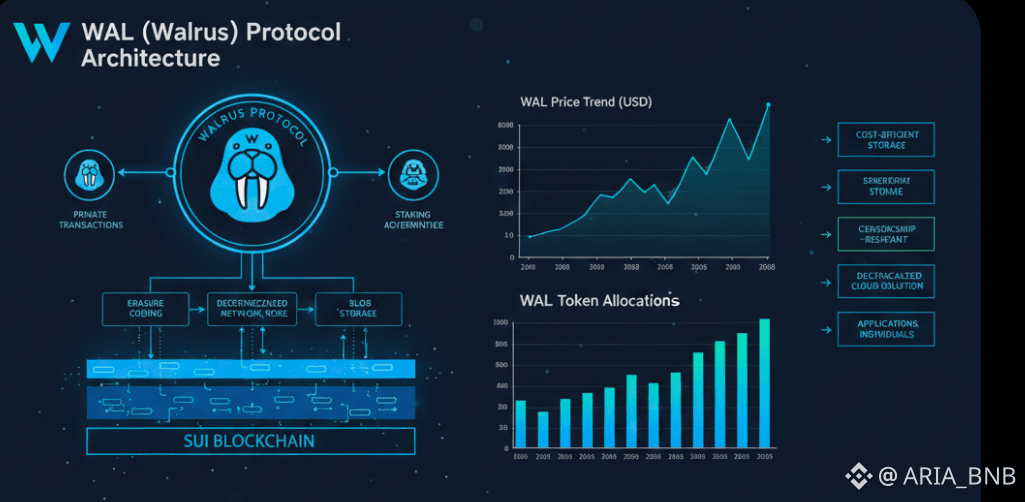
But what truly electrifies people about Walrus is what can be built on top of it. Large AI dataset repositories, immutable archives, unstoppable websites, secure enterprise backups, high-quality video platforms, decentralized gaming assets, collaborative tools, censorship-resistant apps—everything that requires big data and reliability finally has a home that isn’t controlled by someone’s corporate server. Developers are already exploring Walrus for hosting AI model weights, game assets, and massive datasets that would cost a fortune anywhere else. Sui’s fast and scalable blockchain structure gives Walrus an instant advantage, letting developers link smart contracts with stored data without friction. This transforms storage from a passive service into an active, programmable layer of Web3.
The buzz around Walrus has grown fast since the project gathered huge institutional backing and launched its testnet and mainnet. Major investors, builders, and crypto communities are watching it like a sleeping giant, because the moment large Web3 apps and enterprises begin locking their data into Walrus, the entire ecosystem could take off. It feels similar to the early days of Arweave or Filecoin, but with the advantage of fresh architecture, modern cryptography, and a much more efficient and cost-effective storage engine. Walrus sits at the perfect intersection of necessity and innovation. Everyone needs data storage. Everyone needs privacy. Everyone needs decentralization. And Walrus is quietly stitching all three into a seamless experience that feels natural, simple, and powerful.
There is also a feeling that Walrus arrived at the perfect time. AI models are exploding in size, game studios are moving into Web3, creators are fighting censorship, and decentralized apps need reliable, fast data solutions. Traditional centralized storage systems are struggling with trust issues, outages, and increasing costs. In contrast, Walrus is offering a system where data lives forever, controlled by no one, maintained by everyone, and accessible from anywhere. It’s not just an innovation; it’s a rebellion against the old internet. The more people understand this shift, the more they realize Walrus isn’t just a tool, it’s a movement
What stands out the most is how human the entire idea feels. Walrus isn’t trying to reinvent life or build unrealistic metaverses. It is solving a real, painful problem that everyone experiences daily: where do I safely store my data, and who do I trust with it? The answer Walrus gives is simple: trust the network, trust cryptography, trust mathematics, trust decentralization. Not a company, not a CEO, not a server farm. Just pure, reliable technology designed for people who want control over their digital lives.
As the ecosystem grows and more dApps, companies, and creators start building on Walrus, it wouldn’t be surprising if Walrus becomes the backbone of Web3’s storage economy. Its combination of efficiency, privacy, resilience, and programmability makes it one of the most promising and thrilling projects rising today. And what’s even more exciting is that this is only the beginning. Walrus is still young, still expanding, still gaining momentum, and still carving deeper into the foundations of decentralized infrastructure.
Watching Walrus evolve feels like witnessing the birth of a new era for digital storage—one where users finally take back control, one where data becomes truly free, and one where a quiet giant from the depths of the blockchain emerges to reshape the future

