

Dusk ia a L1 regulated, privacy-conscious, and operationally reliable finance. Founded in 2018, Dusk has matured beyond privacy gimmicks, focusing instead on robust, auditable infrastructure that aligns with the stringent demands of regulated markets. Its technologies, including DuskDS, Succinct Attestation, and DuskEVM, are designed for institutions that require deterministic block finality, uptime guarantees, and compatibility with existing financial tooling.
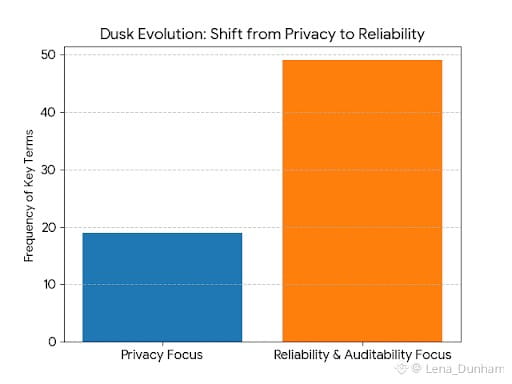
From Privacy to Reliability: The Evolution of Dusk
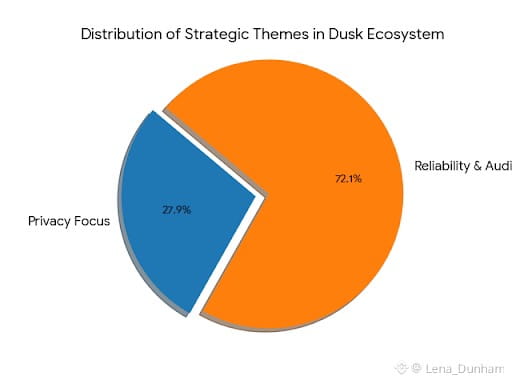
Dusk originally positioned itself as a privacy-focused blockchain, emphasizing confidential transactions and secure financial data handling. While privacy remains a core design principle, the team realized that regulated markets prioritize predictability, reliability, and auditability. Financial institutions and enterprise users are less concerned about being on the bleeding edge of DeFi experimentation and more focused on compliance, operational uptime, and risk mitigation.
This strategic pivot has enabled Dusk to target institutional-grade applications. Its architecture balances privacy with transparency, giving auditors and regulators the ability to verify compliance without exposing sensitive operational data.
Key Technologies Driving Dusk’s Reliability
1. DuskDS: Deterministic Block Finality
At the heart of Dusk’s reliability is DuskDS (Dusk Distributed System). This module ensures deterministic block finality, meaning transactions are confirmed in a predictable manner without the risk of forks or probabilistic settlement. Unlike typical blockchains, where validators’ metadata can leak sensitive information or expose the network to timing attacks, DuskDS uses advanced protocols to mask validator identities while maintaining security and consensus integrity.
This deterministic approach is crucial for regulated financial applications, where audit trails must be reliable, and transaction settlement cannot be subject to probabilistic delays or uncertainty. The network can handle high-value transfers, tokenized assets, and compliance-focused DeFi activities without compromising operational security.
2. Succinct Attestation: Privacy with Auditability
Privacy in Dusk is not an afterthought. Succinct Attestation allows validators to prove transaction validity and data integrity without revealing the underlying metadata. This ensures that financial activities remain compliant with KYC/AML requirements while preserving user confidentiality.
The technology works by generating compact cryptographic proofs, enabling efficient verification of transactions without exposing sensitive operational details. Institutions can confidently integrate Dusk into their workflows, knowing that regulatory reporting and auditing requirements are seamlessly supported.
3. Soft Slashing and Uptime Insurance
Traditional blockchain slashing mechanisms penalize validators harshly for downtime or misbehavior, sometimes scrubbing their entire stake. Dusk introduces soft slashing, which provides uptime insurance without forcing participants to lose capital. This economic model encourages consistent validator performance while reducing financial risk, making the network more resilient to unexpected downtime or operational hiccups.
Soft slashing effectively aligns incentives between validators and institutions, ensuring that the network remains highly available even during routine maintenance or unforeseen disruptions.
4. DuskEVM: Interoperability with Existing Tooling
Interoperability is critical for adoption. Dusk’s EVM-compatible environment (DuskEVM) allows developers to reuse existing Ethereum tooling — from smart contracts to developer frameworks — while benefiting from Dusk’s privacy, reliability, and regulatory features.
This design lowers the barrier to entry for enterprise applications, DeFi protocols, and tokenized asset platforms, allowing them to deploy robust solutions without rewriting contracts or learning a new ecosystem from scratch.
Target Use Cases for Dusk
Dusk is designed for applications where consistency, auditability, and regulated compliance matter:
Institutional DeFi: Banks and fintech companies can deploy tokenized financial instruments while adhering to compliance standards.
Digital Securities and Tokenized Assets: Security token offerings (STOs) and real-world asset tokenization benefit from deterministic settlement and audit-ready infrastructure.
Payment Systems: Stablecoin and cross-border payment solutions can leverage Dusk for secure, predictable transaction finality.
Compliance-Focused Applications: Any blockchain solution that interacts with KYC, AML, or regulatory reporting requirements can rely on Dusk’s privacy-preserving auditability.
Dusk’s Approach to Operational Reliability
Unlike many blockchains chasing high-speed DeFi or flashy NFT use cases, Dusk prioritizes operational reliability:
Predictable Block Times: Deterministic consensus ensures that blocks are finalized within expected timeframes, reducing network uncertainty.
Validator Uptime Guarantees: Soft slashing enforces high validator reliability without harsh financial penalties.
Resilient Network Architecture: The system tolerates faults and malicious actors while maintaining availability for critical financial applications.
Audit-Ready Design: Succinct attestation allows auditors to verify activity without exposing sensitive operational or user data.
This philosophy transforms Dusk from a niche privacy blockchain into a trusted infrastructure layer for regulated financial markets.
Ecosystem and Adoption
As of 2026, Dusk has been making strides in enterprise adoption:
Partnerships with regulated financial entities for STO and tokenized asset deployments.
Integration with compliance tooling to enable audit-ready financial applications.
Support for institutional DeFi protocols, where reliability is more valuable than transaction throughput.
While Dusk is not competing in the DeFi speed race, it focuses on practical deployments that can survive audits, downtime, and everyday operational realities.
Market Position and Binance Context
Dusk (DSK) has gained traction on exchanges like Binance, reflecting growing institutional interest. Trading pairs such as DSK/USDT and DSK/BUSD provide liquidity while allowing retail and institutional users to participate in its ecosystem. Unlike speculative DeFi tokens, Dusk’s appeal comes from real-world utility, auditability, and reliability, making it attractive to investors looking for long-term infrastructure plays rather than short-term hype.
Binance’s recent coverage of Dusk highlights its focus on compliance-ready, regulated blockchain infrastructure, positioning it uniquely among Layer 1 chains competing primarily on throughput or yield generation.
Why Dusk Stands Out
In a market crowded with privacy-focused, DeFi-centric, or NFT-hyped chains, Dusk differentiates itself in several ways:
Privacy without Hype: It maintains confidentiality through Succinct Attestation while focusing on practical utility.
Deterministic Reliability: DuskDS ensures that block finality is predictable — a critical feature for regulated financial operations.
Validator-Friendly Economics: Soft slashing encourages uptime and reliability without penalizing capital unnecessarily.
Interoperability with Ethereum Ecosystem: DuskEVM allows institutions to leverage familiar tooling, easing integration.
Compliance-First Approach: Every aspect of the chain — from smart contracts to attestation — is designed with audits, regulators, and risk mitigation in mind.
Future Outlook
Looking ahead, Dusk is poised to:
Expand adoption among regulated financial institutions seeking blockchain solutions.
Support tokenized assets that require both privacy and auditability.
Integrate with cross-chain DeFi platforms using DuskEVM.
Develop enterprise-grade applications in payments, digital securities, and compliance services.
The chain is not about speed or flashy DeFi trends; it’s about being the backbone that financial applications can trust.
Conclusion
Dusk represents a mature, regulated, and reliable approach to blockchain infrastructure. By focusing on deterministic consensus, privacy-preserving attestation, soft slashing for uptime insurance, and EVM compatibility, it provides a platform where finance can operate reliably even on dull days, audits, or unforeseen network stress.
While many Layer 1 projects chase hype or user numbers, Dusk is proving that long-term operational reliability, regulatory alignment, and predictable block finality are the keys to sustainable blockchain adoption — especially in institutional and regulated markets.
In 2026, Dusk is no longer just a privacy experiment. It is a practical, audit-ready blockchain for the financial world — a platform where institutions can deploy, operate, and scale with confidence, transparency, and resilience.
