
I’ve been watching the Layer-1 space long enough to know how this usually goes: everyone fights over speed, everyone posts TPS screenshots, and then real adoption still gets stuck on the same boring bottlenecks—data, UX, and trust.
@Vanarchain feels like it’s deliberately choosing a different battlefield. Instead of treating AI as a “feature,” it’s positioning itself as a full AI-native infrastructure stack—where the chain isn’t just executing instructions, it’s built to understand context and retain it over time. That’s the whole point of Vanar’s 5-layer architecture (Vanar Chain → Neutron → Kayon → Axon → Flows).
1) The real pivot: from programmable apps to systems that can remember
Most blockchains still treat data as an external dependency. You store something “somewhere else,” then anchor a hash on-chain and call it decentralization. In practice, that creates an ownership illusion: you own the pointer… not the asset.
Vanar’s Neutron layer is basically an attempt to break that pattern by making data compressible enough to live on-chain and structured enough to be queried like knowledge. The official framing is direct: files and conversations become “Seeds”—compressed, queryable objects that can be stored on-chain or kept local depending on how you want to manage privacy and permanence.
2) Neutron “Seeds” are more than storage — they’re executable knowledge
Here’s the part that actually caught my attention: Neutron doesn’t just claim “compression.” It claims intelligent compression—semantic + heuristic + algorithmic layers—compressing 25MB into 50KB (and describing this as an operational ~500:1 ratio).
That matters because it changes what can be native on-chain:
A PDF isn’t just “uploaded,” it becomes something you can query.
Receipts can be indexed and analyzed.
Documents can trigger logic, initiate smart contracts, or serve as agent input (their “executable file logic” angle).
So the story shifts from “we stored your file” to “your file can now participate in computation.” That’s a different category.
3) Kayon: the “reasoning layer” (and why it’s not just a chatbot wrapper)
Vanar’s architecture explicitly separates memory (Neutron) from reasoning (Kayon). The goal is that once data becomes Seeds, a reasoning engine can read them and act on them.
One line on Vanar’s own Neutron page is especially telling: it says #Vanar has embedded an AI directly into validator nodes, framing it as “onchain AI execution.”
If they execute this well, it’s a quiet but serious shift: instead of AI living off-chain (where you have to trust a provider), you get a path toward reasoning that’s closer to the settlement layer—more verifiable, more composable, and harder to “rug” via hidden backend logic.
4) The underestimated update: Vanar is hiring for payments rails, not just narratives
A lot of chains say “payments” when they really mean “a wallet UI.”
Vanar’s recent move that stood out to me is the appointment of Saiprasad Raut as Head of Payments Infrastructure—with coverage emphasizing experience across major payments networks and crypto strategy roles, and tying the hire to “intelligent/agentic payments,” stablecoin settlement, and tokenized value systems.
Whether you love the “agentic finance” phrasing or not, this is the kind of hire you make when you’re trying to connect to real payment realities (compliance, integration, settlement constraints)—not just ship another meme-feature.
5) Where $VANRY fits: utility first, then speculation

For me, the cleanest way to understand $VANRY is: it’s the fuel and the security glue for everything above it.
 Vanry own documentation frames $VANRY as:
Gas / transaction fees
Staking (dPOS)
Validator incentives + block rewards
A core role across the app ecosystem
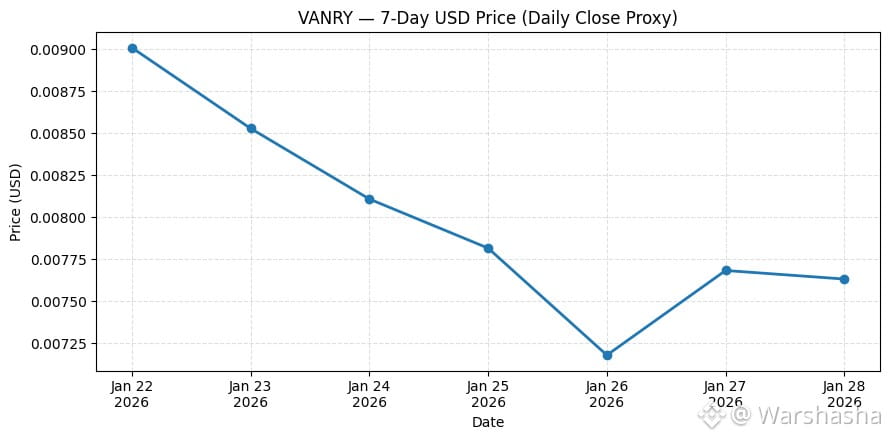
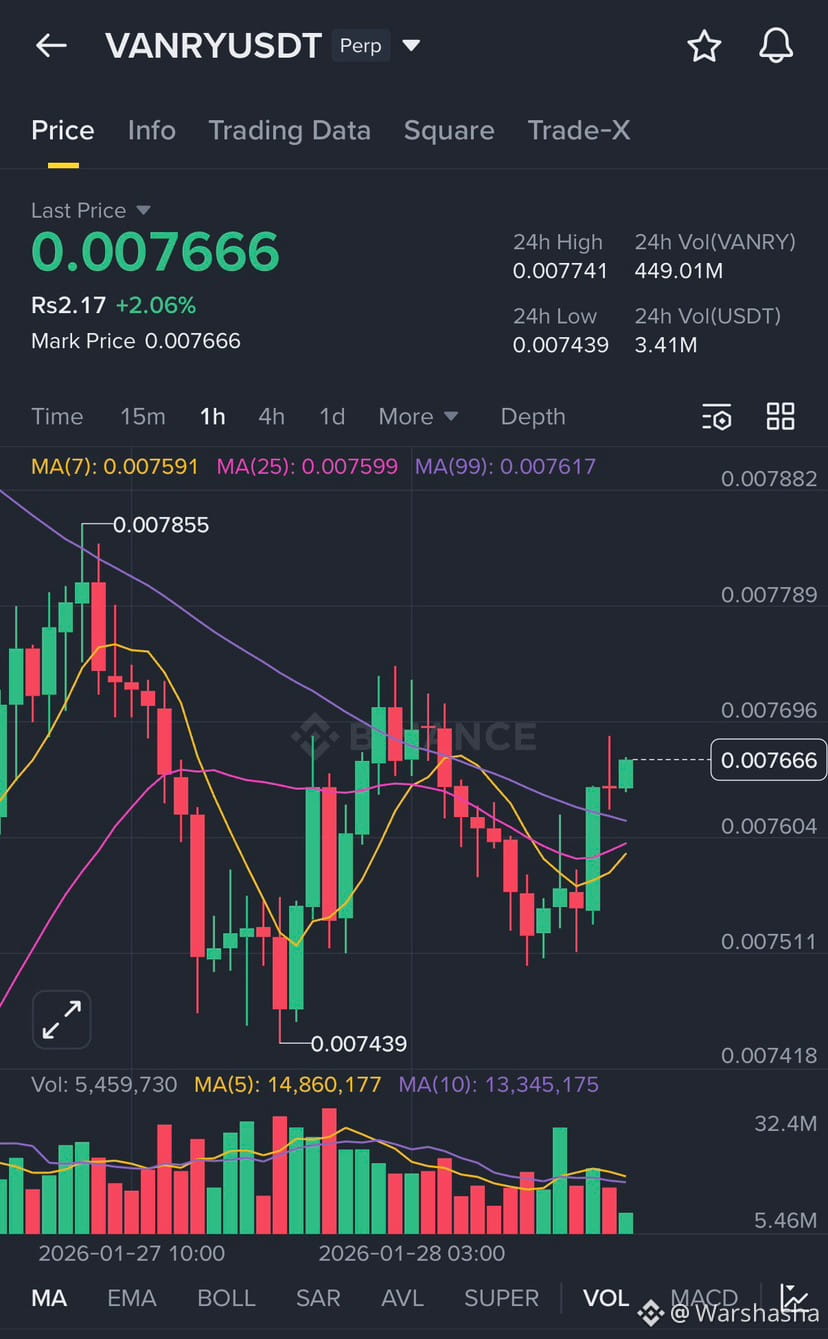
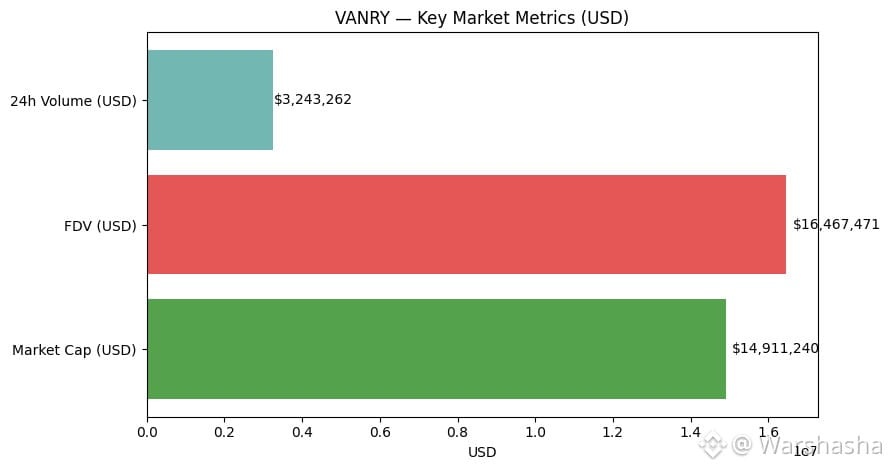
And when you look at the numbers right now (as of January 28, 2026), market trackers show:
Price around $0.0076
Market cap and FDV in the ~$15M–$16M range
That mismatch in supply reporting is normal in crypto (different methodologies), but for serious investors it’s a reminder: always sanity-check supply, emissions, and bridge/wrapped supply when you’re building a thesis.
6) What I’m watching next (because this is where “infrastructure” becomes real)
The most interesting thing about Vanar’s stack is that two layers are still labeled “coming soon” on the official architecture: Axon (intelligent automation) and Flows (industry applications).
So my 2026 checklist is simple:
Do Seeds become a real developer primitive (used by teams other than Vanar)?
Do we get clear, production-grade privacy controls for what’s stored on-chain vs locally (especially for enterprise docs)?
Do payments initiatives turn into integrations, not just announcements?
Do Axon/Flows ship in a way that feels like “agent workflows” and “industry rails,” not marketing pages?
If those boxes start getting checked, #Vanar won’t need loud hype cycles. It’ll become like infrastructure always becomes: quietly unavoidable.