
A few months back, I was putting on a small position in a tokenized bond product. Nothing aggressive. Just a test allocation to see how real-world assets actually behave on-chain once you get past the marketing. What stopped me wasn’t fees or latency both were fine but how exposed everything felt the moment the transaction hit the chain. Wallet balance, transfer size, timing… all of it was just sitting there, ready for anyone with a block explorer to piece together. I’ve spent years rotating through infrastructure and privacy-focused projects, and that moment summed up a quiet problem I’ve run into again and again: privacy is usually an add-on, not a foundation. Even when the tooling looks mature, the risk of information leakage makes you hesitate, recheck steps, and ultimately size down positions that should’ve been routine.
That hesitation reflects a broader flaw across most blockchain designs. Transparency is treated as a default good, which works fine for memes, collectibles, or casual swaps. But once you cross into anything resembling real finance, that openness becomes friction. Transaction histories expose strategies. Balances reveal intent. Counterparties become inferable. For individuals, it’s uncomfortable. For institutions, it’s a non-starter. Developers feel the same tension when trying to build compliant products how do you satisfy audit requirements without broadcasting sensitive details to the world? The usual workaround is layering mixers or privacy tools on top, but those introduce new costs, slower settlements, and more points of failure. Instead of solving the problem, they turn privacy into a fragile bolt-on that breaks under load, keeping adoption boxed into niche circles rather than pulling in regulated capital.
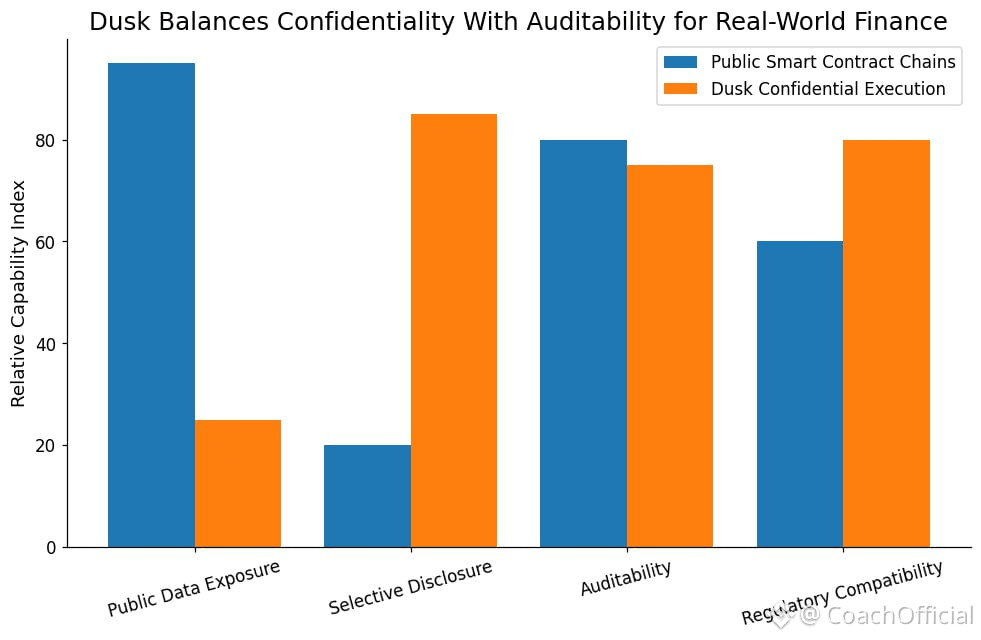
I keep coming back to the same mental image. It’s like handling cash in a glass-walled bank. Everything technically works, but every movement is visible. Even legitimate activity feels awkward when discretion disappears. You don’t want secrecy you want control over who sees what, and when.
That’s where Dusk’s design philosophy stands out. Rather than treating privacy as an optional feature, it’s built directly into how the chain executes. The network takes a conservative stance: it prioritizes confidentiality and verifiability over chasing raw throughput or flashy narratives. Smart contracts run using zero-knowledge proofs by default, hiding inputs while still proving correctness. At the same time, it avoids the full anonymity models that scare regulators away. Instead, it supports selective disclosure and on-chain attestations, so auditors can verify compliance without needing full data access. In practice, this means applications like private lending, tokenized securities, or regulated payments can settle directly on the base layer, without bouncing across privacy sidechains or off-chain systems. Since the January 2026 mainnet launch, integrations like the Quantoz partnership have shown how MiCA-compliant EURQ transfers can use these privacy primitives while keeping user details shielded.
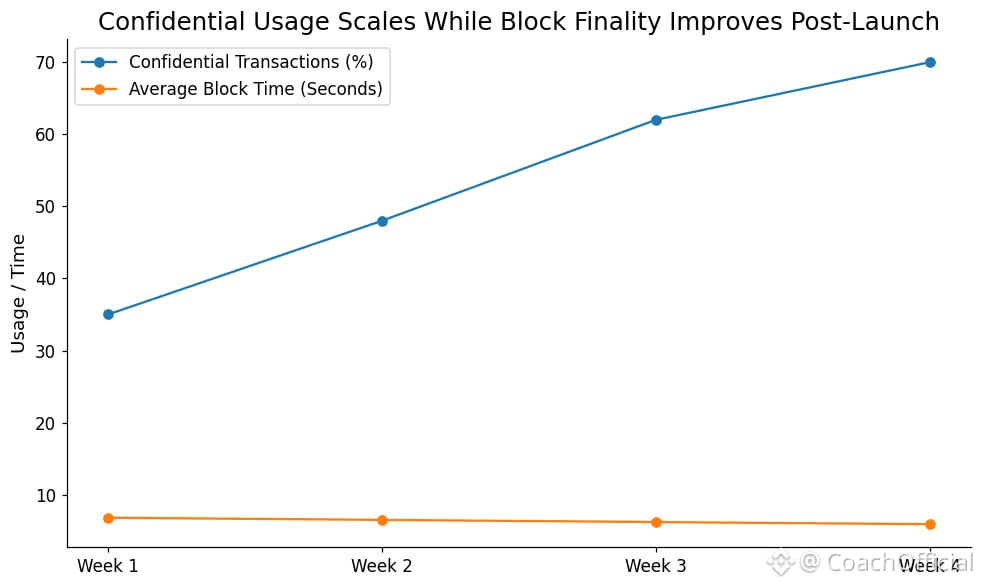
Under the hood, a few architectural choices matter a lot. The Rusk VM is central. Contracts are compiled into zero-knowledge circuits, meaning execution happens privately and only a proof is published to the chain. The result confirms the computation was valid, but the underlying data never becomes public state. That’s not theoretical you can see it in current block data, where confidential transactions make up a large share of early network activity. On the consensus side, @Dusk uses a segmented Byzantine Fault Tolerance model that breaks validation into phases, delivering practical block times around five to seven seconds post-launch. Leader selection uses blind bids, which reduces predictability and attack surface compared to more transparent proposer systems.
The $DUSK token itself plays a straightforward role. It’s used for fees, scaled by how complex the underlying proofs are, with a portion burned to dampen inflation. Staking is handled through blind commitments, so validator selection doesn’t broadcast stake sizes ahead of time, reinforcing privacy even at the consensus layer. Rewards flow from emissions and fees, with liquid staking via Sozu currently holding around 26.6 million DUSK. Settlement finality is backed by these staked amounts, and governance happens through stake-weighted proposals, including recent votes around DuskEVM and EVM-compatible confidential contracts. Emissions started high but taper over time, with roughly 40% of circulating supply about 207 million DUSK currently staked, anchoring security.
From a market standpoint, the network sits in a modest zone. Around a $70-plus million market cap, daily volumes in the mid-20 million range, and enough liquidity to move without extreme slippage. The Chainlink integration in January helped deepen venues like #Dusk Trade, but this isn’t a hype-driven market yet.
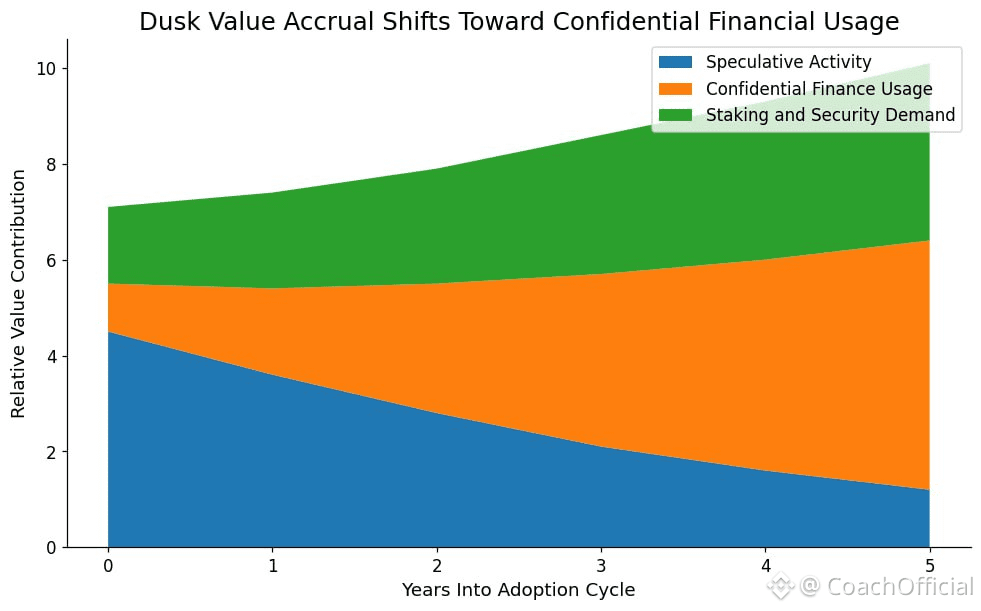
Short-term price action tends to follow the usual crypto rhythm. The mainnet launch and early partnerships drove a sharp rally, followed by a fast correction once momentum cooled. I’ve traded enough of these cycles to know how that goes. Long-term, though, the real question isn’t price it’s whether usage becomes habitual. If confidential RWAs, corporate actions, and compliant financial flows keep settling on-chain without friction, value accrues quietly through fees and staking, not speculation. That’s how infrastructure earns relevance.
There are real risks. Privacy-focused competitors like Aztec or Secret Network benefit from larger developer ecosystems. Regulatory interpretation under MiCA could evolve in ways that pressure selective-disclosure models. And there are technical edge cases to consider. A surge in confidential contract execution say during a major EURQ issuance or RWA event could overload ZK proof generation, backing up the Rusk VM and pushing block times beyond targets. In finance, even short delays can cascade into liquidity stress.
In the end, privacy-first infrastructure doesn’t win loudly. It wins slowly, when the second transaction feels easier than the first, and discretion becomes invisible instead of fragile. Whether Dusk reaches that point won’t be decided by launches or announcements, but by repeated, uneventful use the kind that only shows up once the system is trusted enough to fade into the background.
@Dusk