

Some blockchain projects shout. Others posture. A few chase whatever trend happens to be hot that week. Dusk does none of that. It moves quietly, deliberately, almost stubbornly focused on one thing: building financial infrastructure that actually works in the real world. And that quiet focus is exactly why it might end up changing everything.
From the outside, Dusk doesn’t look like a revolution. No flashy memes. No endless hype cycles. But beneath the surface, it’s laying the groundwork for something far bigger than most people realize. A financial system where privacy, regulation, and real-world assets don’t clash, but coexist.
Dusk began in 2018, long before “tokenized stocks” and “regulated DeFi” became buzzwords. Back then, crypto culture revolved around radical transparency and public-by-default everything. Wallets were open books. Transactions were visible to anyone with a block explorer. That openness was celebrated as freedom.
The Dusk founders saw the flaw immediately.
Banks would never accept that model. Governments wouldn’t either. Large institutions cannot operate in a world where sensitive financial data is permanently exposed. Balance sheets, settlements, corporate actions, and compliance processes require discretion. Laws demand oversight without chaos. Most blockchains simply weren’t built for that reality.
So Dusk went in a different direction.
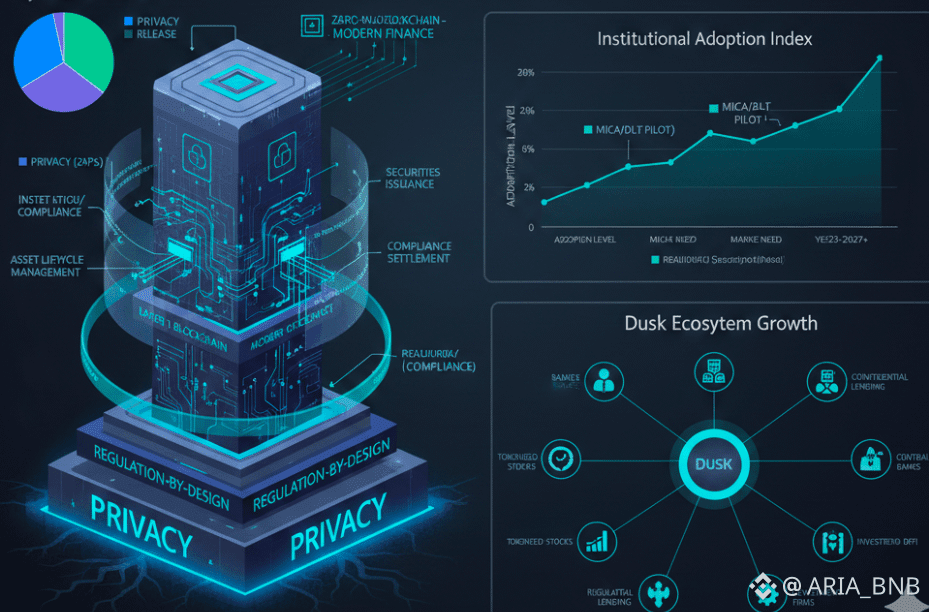
Instead of treating privacy as an optional feature, it made it foundational. Instead of bolting regulation on later, it designed compliance into the protocol itself. The result is a system where regulators can audit activity without violating user privacy, where institutions can transact without broadcasting every detail, and where everyday users aren’t forced to live under constant surveillance.
The engine behind this is zero-knowledge cryptography. Not as a gimmick. Not as a buzzword. As the backbone of the entire network. Dusk doesn’t just use ZK proofs, it builds an entire financial environment around them.
Over time, that vision matured into a full Layer 1 blockchain purpose-built for modern finance. It isn’t trying to replace every chain. It’s aiming directly at the systems that power global markets today. Securities issuance. Settlement. Compliance. Asset lifecycle management. All of it, rebuilt on-chain.
Picture stocks issued instantly instead of through layers of intermediaries. Bonds settling in seconds rather than days. Compliance checks enforced automatically by code. Regulators granted visibility without breaching confidentiality. That’s not marketing fluff. That’s the core design.
What makes this especially interesting is timing
Governments are tightening their grip on crypto. Institutions are actively searching for blockchain solutions that don’t break the law by design. In Europe, frameworks like MiCA and the DLT Pilot Regime have set clear boundaries. Many chains are scrambling to adapt. Dusk doesn’t need to. It was built for this moment from day one.
The past year has been pivotal. Mainnet went live, officially launching a privacy-preserving, regulation-ready blockchain. Then came DuskEVM, which quietly removed one of the biggest adoption barriers. Developers can now build Ethereum-style smart contracts while benefiting from confidential transactions and built-in compliance.
That opens the door to an entirely new class of applications. Private lending markets. Confidential AMMs. Tokenized company shares. All operating under enforceable rules, with sensitive data protected by default. This isn’t theoretical anymore. It’s running.
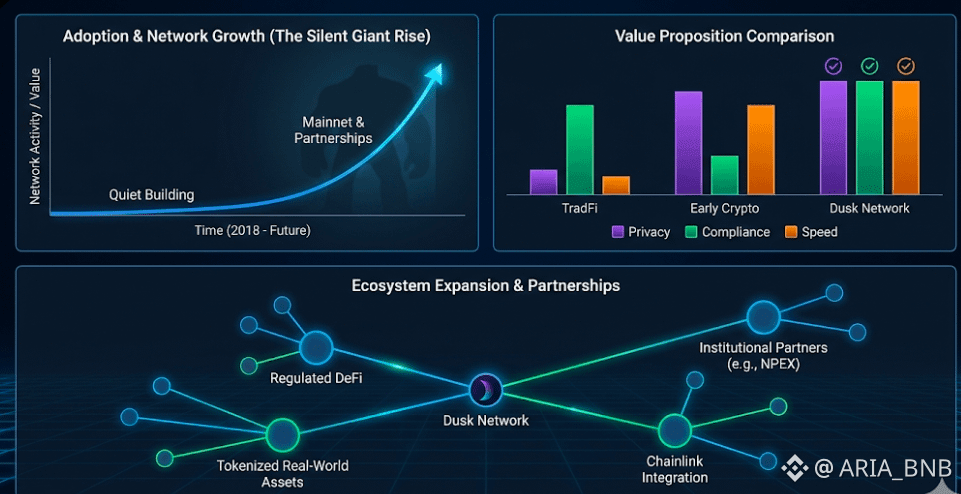
Partnerships have reinforced that momentum. Collaborations with Chainlink and regulated European exchange NPEX pushed Dusk into serious territory. Real stocks. Real data. On-chain. Legally compliant. This isn’t a crypto experiment. It’s infrastructure being assembled in plain sight.
What makes Dusk compelling isn’t just the tech. It’s the positioning.
Privacy. Compliance. Auditability. Speed. These aren’t optional features for institutional finance. They’re non-negotiable. Dusk shows that you don’t have to sacrifice decentralization or user freedom to meet those standards. You just have to design for reality instead of ideology.
Most blockchains were built for an open playground. Dusk was built for the real world, with real rules and real consequences. That difference matters.
Watching Dusk evolve feels less like watching a startup and more like watching infrastructure come online. Quiet. Methodical. Easy to overlook. Until one day, it’s everywhere.
Years from now, people may look back and realize this was the turning point. The moment blockchain stopped fighting finance and started fitting into it. When real-world assets became more than a talking point. When institutions, regulators, and users finally found common ground on decentralized rails.
Dusk doesn’t need noise. It doesn’t need hype. It’s the silent giant. The shadow architect. And as this future takes shape, one thing grows clearer by the day: the next era of global finance may not just run on blockchain. It may run on Dusk
