
Azu is here! Brother, if you still regard "TPS" as the only KPI for blockchain, then you probably haven't truly treated stablecoins as "money". The essence of money has never been about flashy composability, but rather three things — predictable costs, certain settlements, and scalability. This is also why I want to talk about Plasma today: it’s not here to participate in the beauty pageant of "yet another L1", but wants to treat stablecoin payments as its main business and simply integrate "payment experience" into the network layer.
Recall your experience of transferring stablecoins: clearly just transferring USDT/USDC, but you first need to buy gas; the gas price fluctuates; when the network congests, the transfer gets stuck, fails, or even requires several retries. The most ridiculous part is — you just want to "move money from A to B", yet you are forced to learn a bunch of "on-chain survival skills". This isn't a money issue; it's that the underlying network doesn't fundamentally treat payments as a primary necessity.
What is the essence of stablecoin payments? It is not 'just another transfer', but rather combining the separate instructions (messages) + clearing & settlement from traditional finance into an atomic on-chain action: a single ledger update that completes both the instruction and the value delivery. For ordinary users, this means that cross-border, micropayments, and commercial collections can feel more like 'sending messages' instead of 'going through bank processes'. Plasma also clearly explains this logic in their outreach: stablecoin payments merge the originally fragmented steps into a single on-chain settlement.
Here comes the question: since stablecoins are 'money', why are they mostly parasitic on general-purpose chains today? The answer is quite realistic: general-purpose chains have too many things to take care of—contract computation, MEV, various complex interactions, ecological internal competition... Therefore, the payment experience is forced to become 'just supported on the side'. But stablecoin payments particularly dislike 'on the side': what they want is certainty, predictability, and scalable throughput, not treating the chain like a playground.
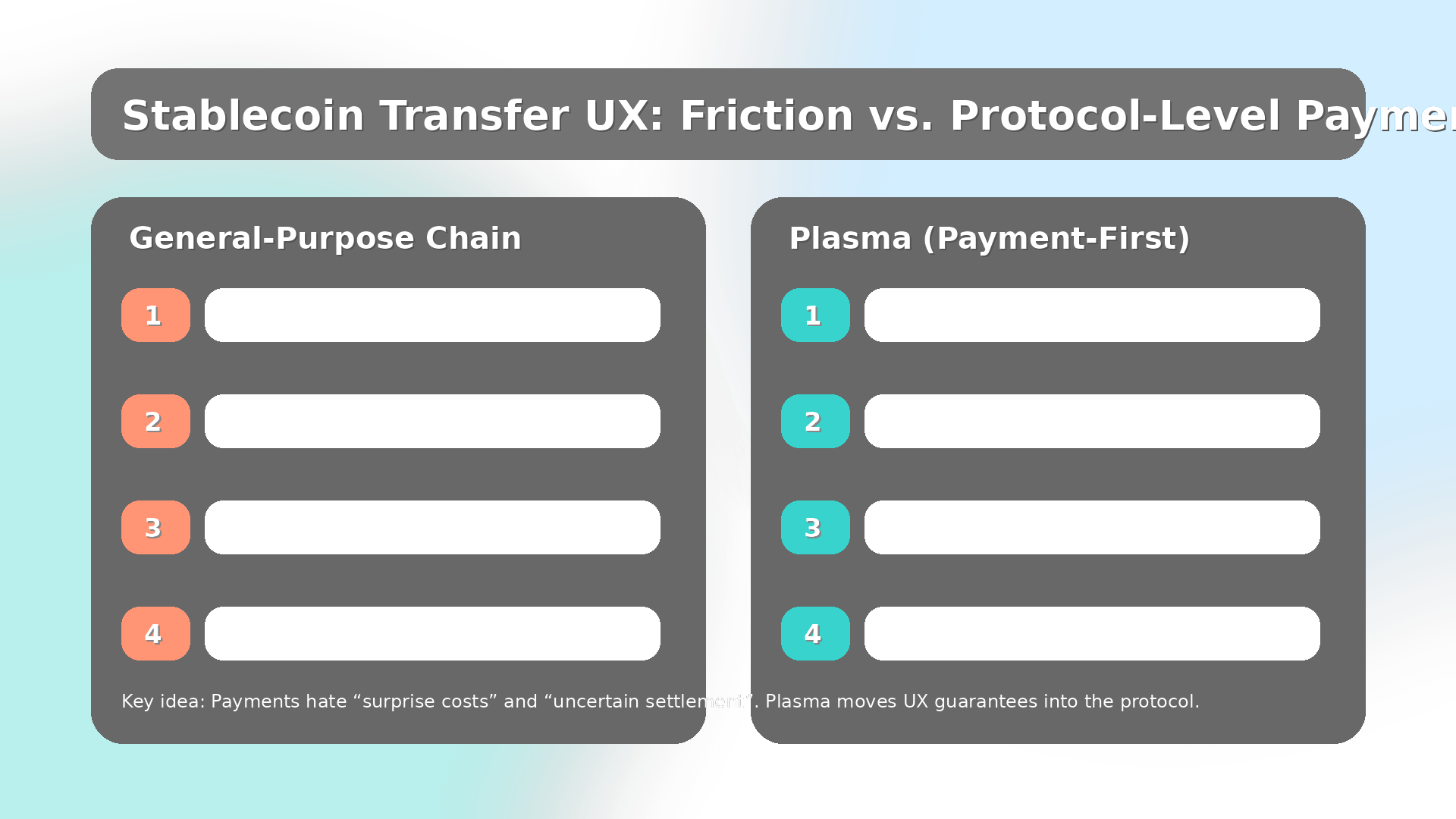
Plasma's attitude is quite firm: it directly defines itself in the official introduction as 'born for stablecoin payments', and emphasizes that it is not trying to be an all-purpose player for general computation, but instead building network-level capabilities around stablecoins: zero-fee USD₮, custom gas tokens, and 'confidential but compliant' private transactions. You can understand it as a straightforward statement: I first make 'the act of transferring money' as good as money, then discuss other matters.
What catches my eye the most is how it handles 'transaction fee friction'. Plasma explains it directly in the FAQ: the reason it can achieve zero fees for USD₮ transfers relies on the protocol layer's paymaster to 'cover the gas', allowing users to not hold the native token and not need to research rates for a regular transfer. The significance of this lies in the fact that it is not relying on a specific app to subsidize you, but instead turning the 'subsidy' into a public capability at the network layer—this is a qualitative change for payments.
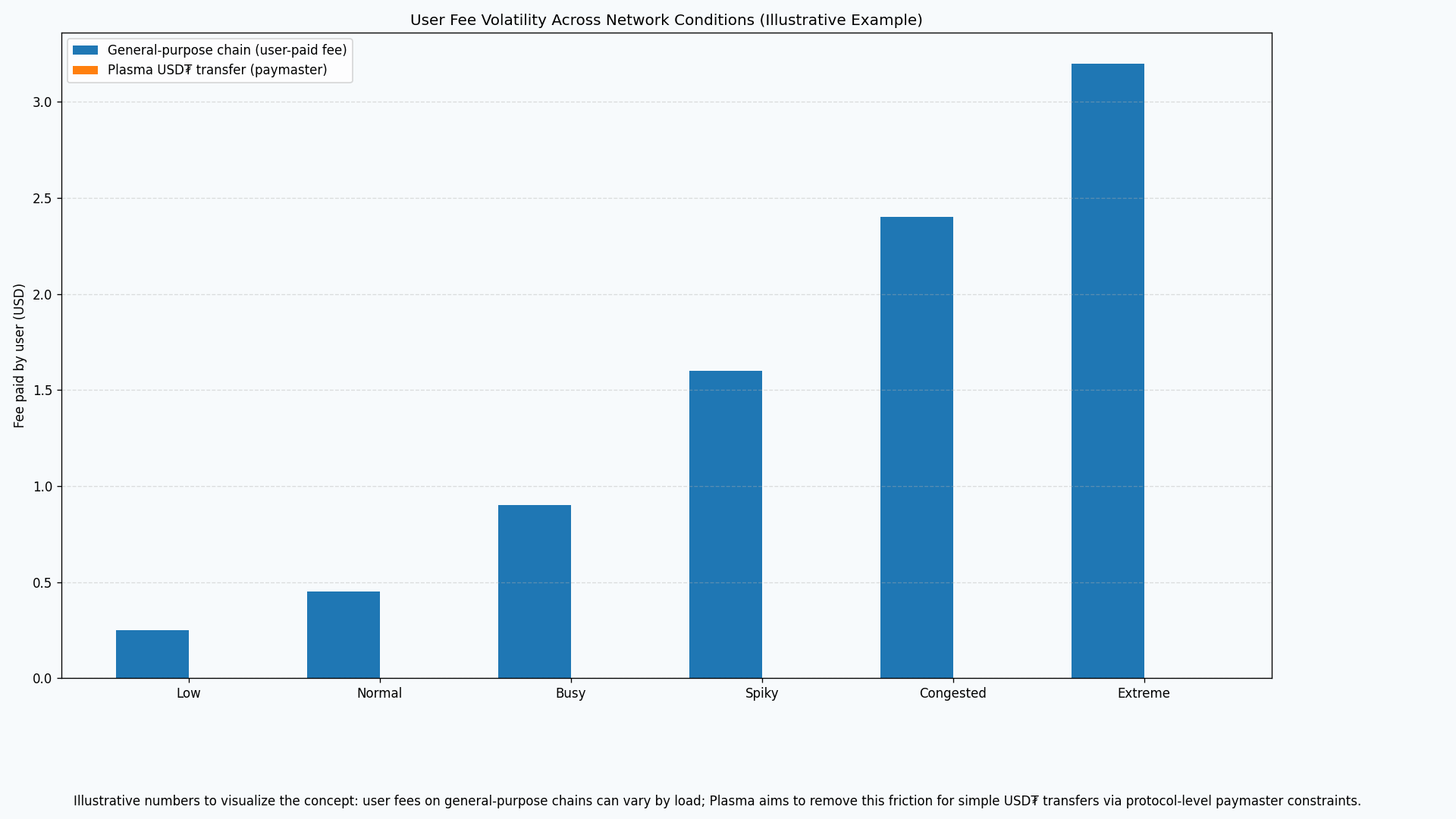
But I also have to complete my statement: a truly reliable 'zero-fee' will not be about indiscriminate spending. The Plasma documentation is very restrained: paymaster sponsorship is strictly limited in scope, only supporting transfers and transferFrom on USD₮ contracts, without supporting arbitrary calldata; at the same time, it introduces lightweight identity verification (such as zkEmail) and rate limiting to prevent abuse; gas funding comes from a pre-configured XPL allowance managed by the Plasma Foundation. I would give this design a high score because it acknowledges reality: payments need to be 'as smooth as utilities', but network security must also be 'as rigorous as the financial system'.
You might ask: what use does \u003cc-9/\u003e have? Will it become a 'decorative token'? Here we return to the core of the dedicated stablecoin chain: minimizing user friction does not equal erasing network economics. In the MiCA white paper you provided, the functions of XPL are clearly stated: it undertakes network security (validator staking participating in PlasmaBFT), transaction execution costs (contract deployment/computation, etc.), and future governance participation; it also mentions that the stablecoin characteristics of the network will support custom gas tokens in some cases. In other words, ordinary users making 'the most basic stablecoin transfers' can feel more like Web2 payments; while more complex on-chain activities still have clear fee and incentive structures—this is what is called 'an experience upgrade that can be realized in engineering'.
Let's talk about something you can't see, but will directly affect whether 'transfers feel like transfers': settlement certainty. The most dreaded thing for a payment system is not slowness, but uncertainty: you do not know when this money actually counts as 'arrived'. Plasma's architectural choice is also very clear: the official documentation defines PlasmaBFT as a pipelined, Rust-implemented version of Fast HotStuff, retaining the security of classic BFT while optimizing for faster submission paths and lower latency. You have also added many more 'compliance document-style' descriptions in your white paper: transaction broadcasting, block collection, 2/3 validator voting confirmation, and emphasizing 'near-instant finality' and the determinacy of Reth-based EVM execution. For ordinary users, you don't need to memorize these terms, but you will feel in experience: the arrival is more certain, retries for failures are less, and it's less likely to crash during peak periods.
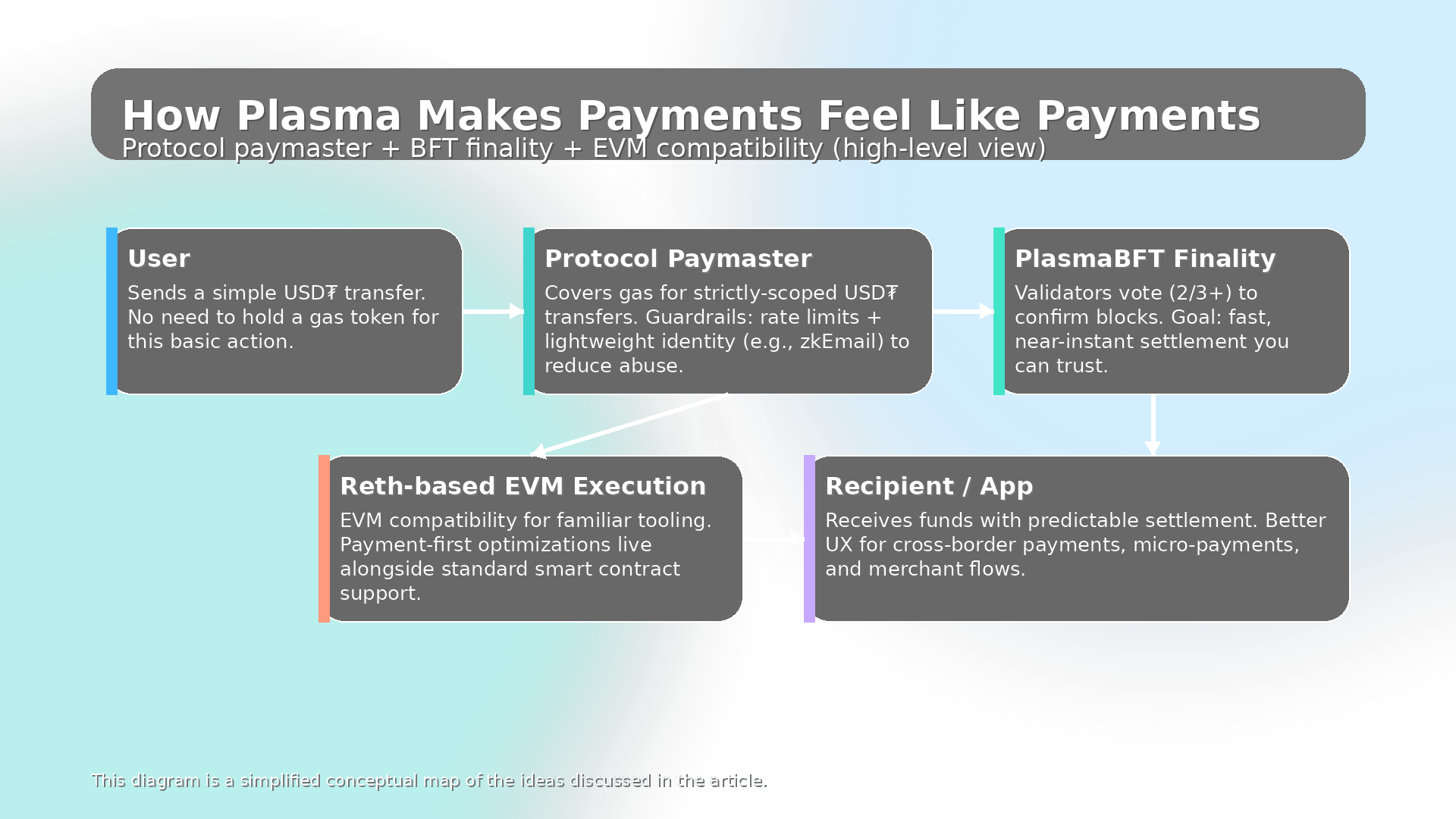
Moreover, Plasma does not exist to make developers 'relearn a whole new set of things'. It treats EVM compatibility as a fundamental capability and mentions in official articles about using Reth (Rust client) for execution layer combinations, aiming to bring over familiarity from the Ethereum ecosystem while optimizing performance and experience around stablecoin scenarios. The white paper also clearly states: Reth-based EVM executing contracts, together with PlasmaBFT, form the core of the network. You can understand this as: developers do not need to overhaul everything for 'making payments', but can migrate existing contracts/toolchains over and then add native stablecoin capabilities.
Plasma is not 'just another L1'; it is more like a stablecoin settlement engine. It takes the premise that 'stablecoins are the mainstream use case' seriously, rather than just as a marketing slogan: zero-fee USD₮ transfers are resolved through the protocol layer paymaster; users do not need to hold native coins first and can even cover costs using whitelisted assets (including stablecoins or BTC) via custom gas tokens; and then use BFT finality and EVM compatibility to support 'usability'.
From the perspective of ordinary users, what does this mean? It is not 'just another place to transfer USDT', but rather you may finally obtain an on-chain experience that is closer to real payments: no need to prepare gas for transfers, fees no longer feel like a lottery, settlement is more certain, and when scaling up, it will not crash just because of congestion. From the perspective of the entire industry, it is actually addressing a sharper question: when stablecoins are to move toward large-scale payments, do we really need a 'dedicated settlement layer'? Plasma's answer is: yes, and we should integrate key capabilities into the protocol rather than relying on application patches.
Finally, as per the usual practice, I want to ask you for genuine feedback: what is the most painful aspect for you when transferring stablecoins on-chain—transaction fees, having to buy gas, or the uncertainty of congestion failures/not arriving?
\u003cm-26/\u003e \u003cc-28/\u003e \u003ct-30/\u003e