

When I realise how fragile most digital data really is, I start questioning the systems we trust every day. Centralized servers promise speed and convenience, yet they quietly ask for surrender: control, ownership, and resilience. One outage, one breach, one policy change - and years of value can disappear. That realization is where the Walrus story begins, not as a product, but as a response to a structural flaw in how the internet stores truth.
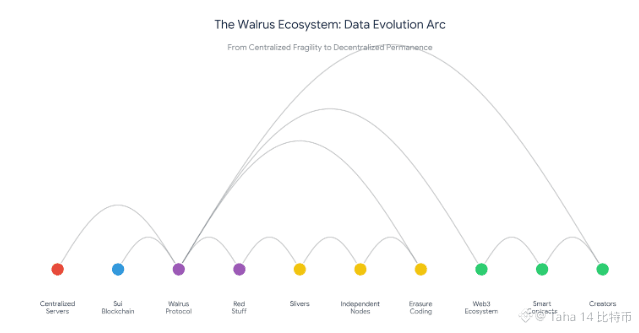
Walrus isn’t your typical cloud storage. It is built on the Sui blockchain, but its soul lies in a revolutionary encoding protocol known as "Red Stuff." Imagine taking a massive file and, instead of just making copies of it, you shatter it into a thousand unique shards called slivers. These slivers are then scattered across a global network of independent nodes. Because of advanced erasure coding, even if two-thirds of those nodes were to vanish overnight, the Walrus protocol could still reconstruct your original data with the precision of a master clockmaker. It is the ultimate insurance policy for the digital age, turning the chaos of a decentralized network into a fortress of reliability.
When data learns to stand on its own, power quietly shifts back to its creators.
The mechanics of Walrus go beyond simple security; they address the silent killer of Web3: cost. Traditional storage often demands a massive premium for the "luxury" of decentralization. Walrus flips the script. By utilizing XOR-based operations and a two-dimensional encoding system, it achieves massive resilience with a replication factor that rivals centralized giants like AWS or Google Cloud. It proves that we no longer have to choose between our values of decentralization and the reality of our budgets. We are finally entering an era where high-performance storage is no longer a luxury, but a fundamental right for every developer and creator.
Your data is no longer a ghost in a machine; it is a permanent echo in a decentralized canyon.
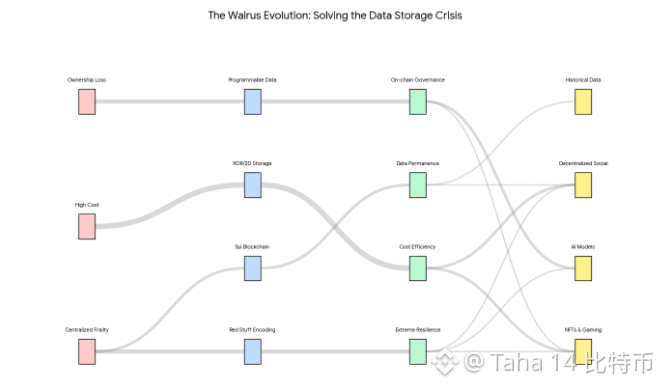
Most users may never interact with Walrus directly, yet they will rely on it every time they stream decentralized media, load on-chain assets, or query historical data. Like the ocean beneath a moving ship, Walrus supports motion without demanding attention.
From NFTs to gaming assets, from AI models to decentralized social platforms, Walrus provides a neutral data layer that does not discriminate by application or ideology. It does not ask who you are- only whether the rules are followed. This neutrality is what gives decentralized systems their long-term credibility.
As ecosystems mature, data permanence becomes more valuable than short-term speed. Walrus is built for that future, where applications are upgraded, teams change, markets shift - but data remains available, verifiable, and owned by those who created it.
The real power of Walrus is not just storing data - it’s setting data free.
Beyond the technical brilliance, Walrus introduces something revolutionary: programmable data. For the first time, data stored on-chain can be governed, accessed, and monetized through smart contracts, just like digital assets.
#Walrus

