
One of the quiet failures of many blockchains is isolation.
Chains launch with strong technical promises, but over time they become walled environments difficult to integrate, costly to migrate to, and disconnected from where users already are. #vanar Chain takes a different path. Its design philosophy assumes that no blockchain will exist alone, and that long-term relevance depends on interoperability and continuity.
From its core architecture to its token design, Vanar is built to integrate smoothly into the broader blockchain landscape rather than fragment it further.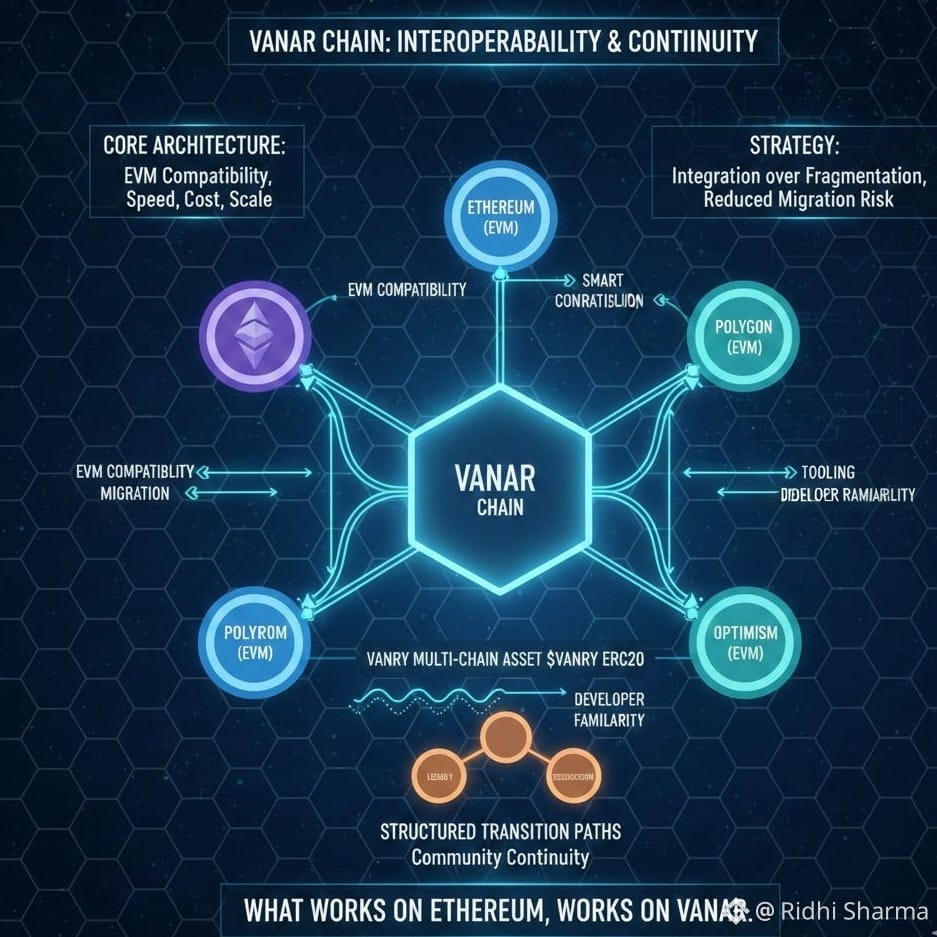
EVM Compatibility as a Strategic Decision
Vanar Chain is fully EVM-compatible, but this choice is not about convenience alone. It is a strategic acknowledgment of where liquidity, developers, and tooling already exist.
By using a battle-tested Ethereum client as its foundation, Vanar ensures that:
Existing smart contracts can migrate with minimal changes
Developers don’t need to learn new languages or frameworks
Tooling, audits, and infrastructure remain reusable
This dramatically lowers the cost of adoption. Instead of asking builders to start over, Vanar meets them where they already are.
Interoperability here is not theoretical it is practical.
“What Works on Ethereum, Works on Vanar”
#vanar ’s commitment to compatibility goes beyond execution. The protocol explicitly follows the principle that applications functional on Ethereum should behave consistently on Vanar.
This consistency reduces migration risk, one of the biggest blockers for serious projects. When behavior is predictable, teams can expand or transition without jeopardizing existing systems.
Vanar doesn’t position itself as a replacement chain. It positions itself as an extension layer optimized for speed, cost, and scale, while remaining familiar.
VANRY as a Multi-Chain Asset
$VANRY is not confined to a single environment. Alongside its native role on Vanar Chain, an ERC20-wrapped version enables interaction with Ethereum-based ecosystems.
This design allows:
Liquidity to flow across chains
Integration with existing DeFi infrastructure
Gradual adoption instead of forced migration
Rather than trapping value inside one network, Vanar allows value to move freely a key requirement for long-term relevance.
Interoperability Without Over-Engineering
Many projects chase interoperability through complex cross-chain architectures that introduce new attack surfaces. Vanar takes a more restrained approach.
By staying EVM-aligned and using established bridging standards, Vanar reduces complexity while still enabling cross-chain interaction. Innovation happens selectively, only where it improves reliability or scale.
This philosophy prioritizes durability over experimentation.
Continuity for Existing Communities
Vanar’s evolution from earlier ecosystems reflects a broader vision: continuity matters.
Instead of abandoning prior communities or token holders, Vanar provides structured transition paths that preserve value and participation. This reinforces trust and reduces the fragmentation that often plagues blockchain upgrades.
Networks grow stronger when they evolve responsibly.
A Network Designed for the Long Term
#vanar ’s interoperability strategy signals something important: it expects to be around.
Chains built only for short-term attention often isolate themselves. Chains built for longevity design for coexistence. Vanar’s architecture suggests it belongs firmly in the second category.
Its vision is not domination it is integration.
