

If you only encounter Vanar through the ticker VANRY, it’s easy to assume it’s “just another chain.” Vanar’s own positioning is different: it frames itself as an AI-native infrastructure stack, not only a blockchain, but an organized system of layers, products, and developer paths designed to take a builder from “deploy a contract” to “ship an intelligent, repeatable workflow.”
The simplest way to understand how Vanar is organized is to follow the same structure the ecosystem itself presents: Build → Products → Learn. You can see this navigation pattern across Vanar’s site, where “Build” groups the core stack (Vanar Chain, Neutron, Kayon, and roadmap layers), “Products” groups user-facing tools (like myNeutron and staking), and “Learn” collects ecosystem and education resources.
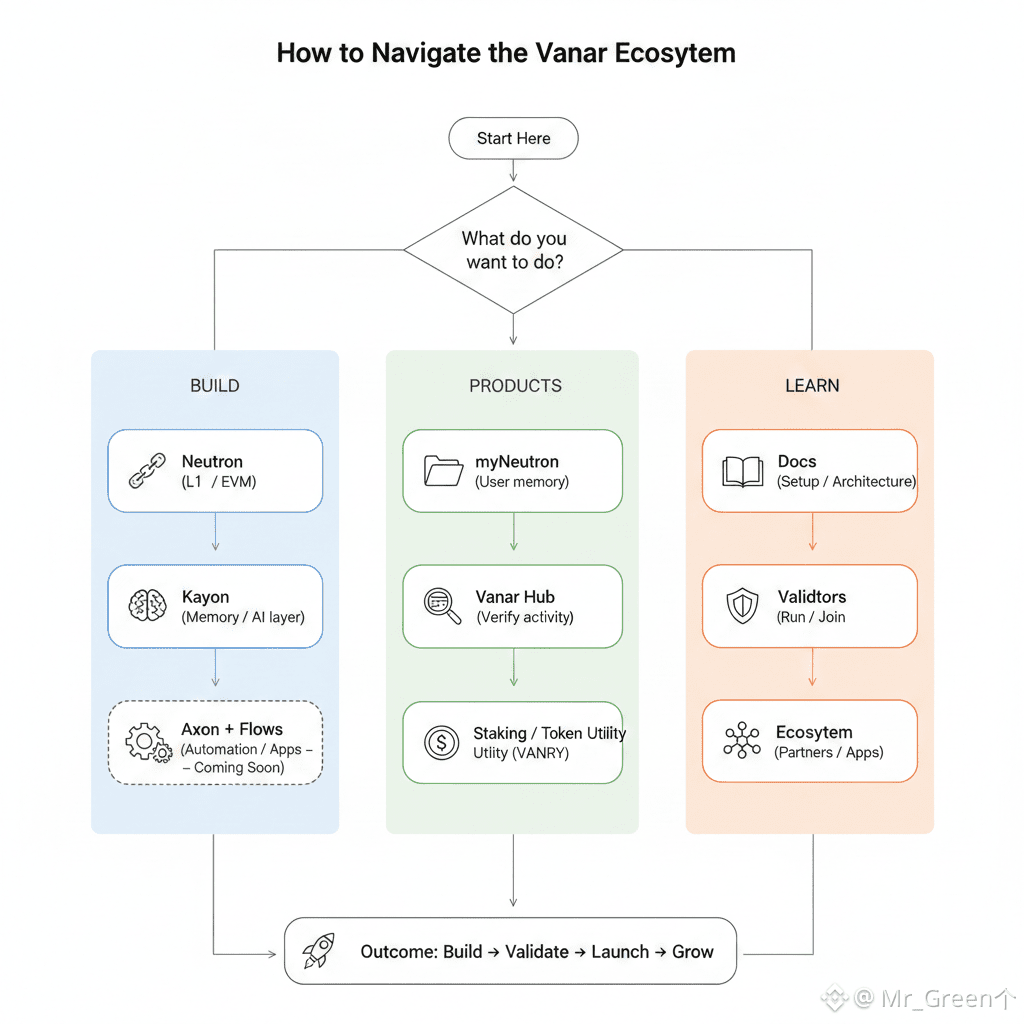
Build: The stack Vanar wants developers to build on
At the base is Vanar Chain, which Vanar describes as a modular L1 designed for AI agents, onchain finance, and tokenized real-world infrastructure, essentially the execution and settlement foundation of the system.
Vanar’s documentation emphasizes a few “infrastructure choices” that are especially relevant for application builders who care about predictable UX rather than purely crypto-native experimentation.
One is fixed fees. Instead of letting transaction costs swing wildly based on congestion and transaction type, Vanar documents a fixed fee model designed to keep costs stable and predictable for users and businesses. The docs go further by describing an update workflow where the protocol updates fees every 5 minutes based on the market value of the native gas token via a token price API. From a product standpoint, this is less about “cheap gas” and more about making costs budgetable—a key requirement for consumer onboarding and automated workflows.
Another is the chain’s operational model. Vanar documents its consensus as Proof of Authority governed by Proof of Reputation, and states that the Vanar Foundation initially runs validator nodes, onboarding external validators via a PoR mechanism. Whether a builder views that as a strength (operational clarity early) or a tradeoff (more centralization early), it’s an explicit part of how Vanar expects reliability and accountability to work while the ecosystem grows.
From a practical developer perspective, Vanar also makes “getting connected” straightforward: the official docs publish Vanar Mainnet settings including Chain ID 2040, RPC/WebSocket endpoints, currency symbol (VANRY), and the block explorer. That matters because adoption often starts with a boring truth: if wallets and tooling connect easily, developers ship faster.
Above the base chain, Vanar describes Neutron as the semantic memory layer. Neutron’s messaging is built around converting static data into AI-ready “knowledge” objects, something you can search, query, and use as context for actions rather than just storing files as dead references. This is one of Vanar’s defining ecosystem claims: AI doesn’t just need blockspace; it needs memory that can survive workflows and tool changes.
Then comes Kayon, presented as the reasoning layer, “natural language intelligence” intended to connect Neutron, blockchains, and enterprise backends. In the ecosystem’s own storytelling, Kayon is how “context” becomes “decisions,” and how decisions become workflows that feel usable to teams who don’t want to write custom scripts for everything.
Vanar also positions two higher layers: Axon and Flows, as part of the “Build” stack, with the site noting they’re coming soon. Whether you treat these as roadmap or near-term deliverables, the architecture framing is consistent: memory → reasoning → automation → industry workflows, all anchored to the chain. So when Vanar says “Build,” it’s not only “deploy contracts.” It’s an ecosystem attempt to make intelligent systems feel like a composable stack rather than a fragile set of off-chain integrations.
Products: What users can touch without reading a developer doc first
The second organizing layer is “Products”, the things meant to be used directly, not only built upon. Vanar’s navigation explicitly lists products such as myNeutron, Vanar Hub, Vanar Staking, the $VANRY token page, and the Vanar Explorer.
This matters because many chains struggle with a gap: they have infrastructure claims, but not enough user-facing surfaces where the ecosystem becomes real. Vanar tries to close that gap by pairing its stack narrative with product entry points.
The Vanar Explorer is one of the simplest “proof-of-life” products: it’s where activity becomes visible (blocks, transactions, addresses). The numbers move constantly, but the explorer itself is a key part of the product layer because it’s where users verify reality rather than relying on announcements.
The developer-facing pieces also feed into product experience. For example, Vanar’s fixed-fee positioning is echoed in its developer marketing (“low cost & high speed” and a fixed transaction price claim), which is essentially the ecosystem telling builders: you can design user journeys without fearing surprise execution costs.
In a mature AI-first ecosystem, the most important “product” might ultimately be the workflow layer itself: agents, automation, and payments that run repeatedly. Vanar’s public pages lean into PayFi and real-world infrastructure as the endgame for this stack.
Learn: How Vanar tries to turn a chain into a community
Finally there’s “Learn,” which is often underestimated, but it’s where ecosystems either become legible or remain confusing. Vanar explicitly groups learning destinations like Ecosystem, Validators, and Vanar Academy. That’s a practical signal that Vanar expects three kinds of people to be part of the system: builders shipping applications, operators securing or validating, and learners trying to orient themselves without drowning in technical complexity.
The documentation site is a major part of this “Learn” layer. It doesn’t just host setup instructions; it lays out how Vanar thinks about architecture: consensus, EVM compatibility paths, protocol customizations like fixed fees, and the overall structure of the chain.
On the ecosystem side, Vanar also maintains an Ecosystem/Partners area, which is where it frames collaborations and the broader network around the chain. Whether a reader treats partner pages as marketing or signal, it still plays a role in ecosystem organization: it’s where builders look to see “who else is here” before they commit time.
A practical way to “use” this map
If you’re reading Vanar as a builder, the ecosystem map can be turned into a simple workflow:
You start with Build if you want infrastructure, chain setup, docs, network parameters, and the core stack narrative.
You move to Products when you want something tangible to test or demonstrate, explorer verification, staking tools, and user-facing surfaces that make the chain feel real.
You stay close to Learn when you need the ecosystem to be explainable to teams, validators, academy content, and documentation that can align developers, operators, and stakeholders.
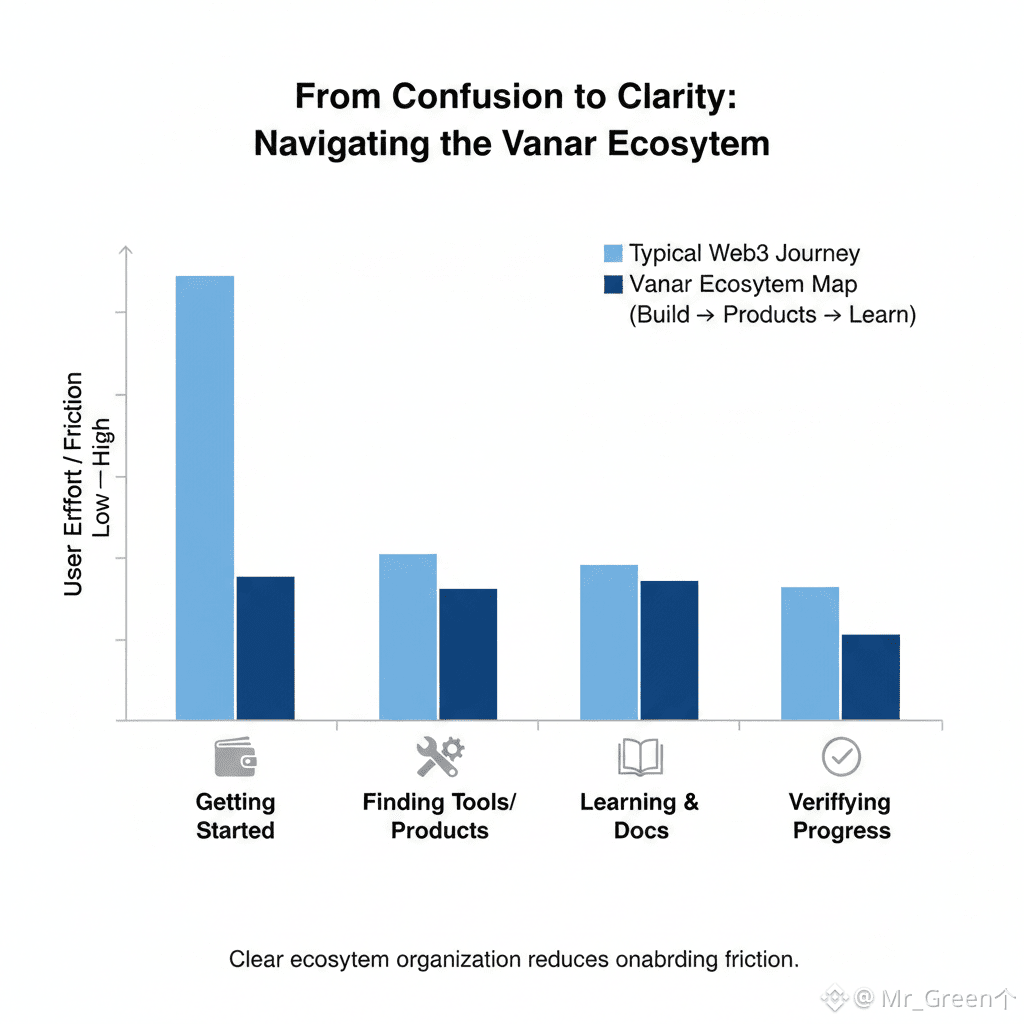
That “Build → Products → Learn” structure is what makes the Vanar ecosystem legible. It’s also what suggests Vanar is trying to compete on more than technology: it’s competing on organization, how quickly a new person can go from curiosity to competence, and from competence to shipping something real.