
One of the least discussed problems in decentralized systems is not where data is stored, but how data behaves over time.
Most systems treat data as timeless. A file is uploaded. It exists. Maybe it’s available. Maybe it’s not. Time is incidental. There is no clear relationship between when data is used, when it must be available, and who is responsible at each moment.
This creates a fundamental mismatch between data and real-world usage. Real systems operate on schedules. AI pipelines train at specific intervals. Media launches happen at defined times. Compliance windows are time-bound. But storage systems rarely reflect this reality.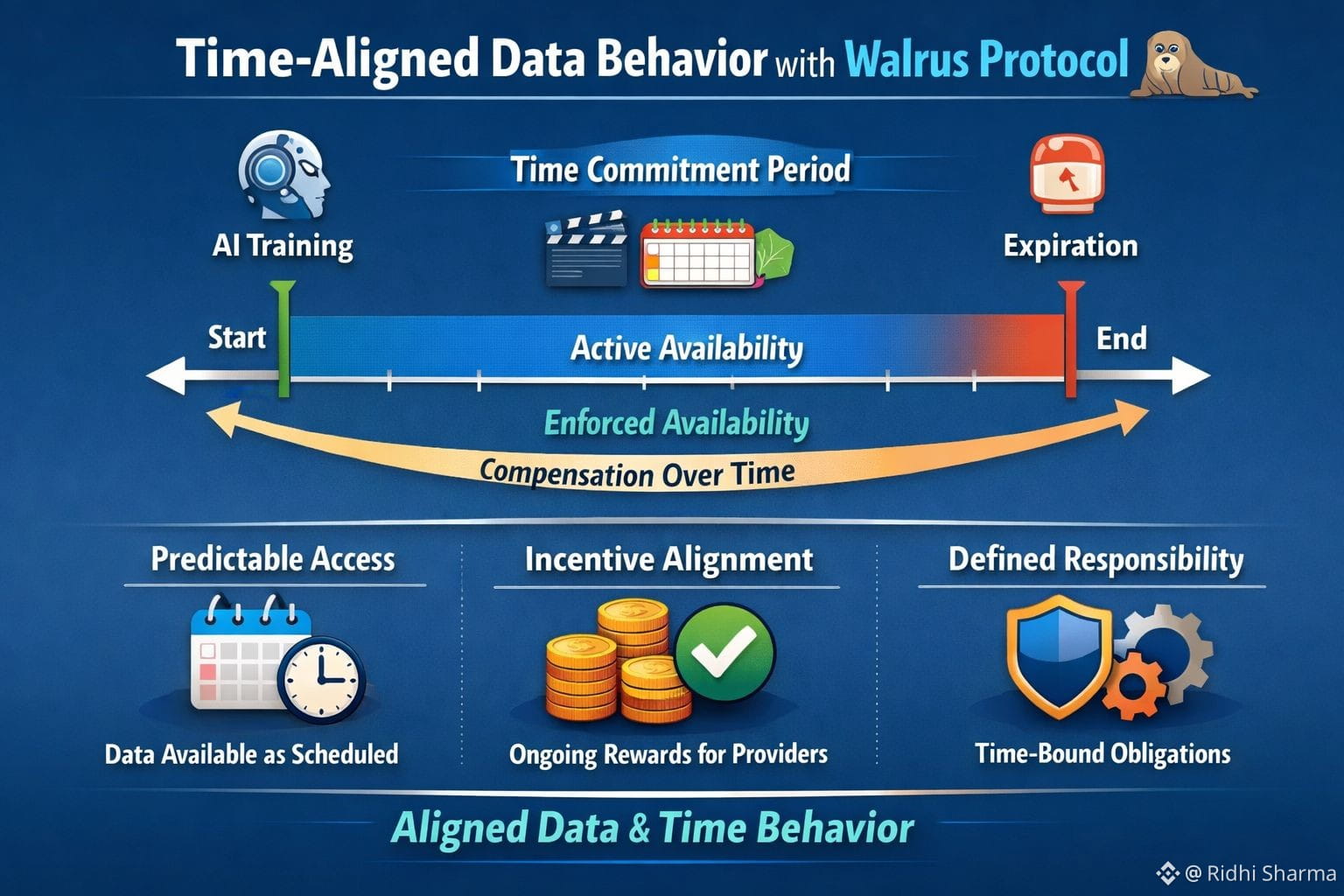
This is where #walrus Protocol introduces a quiet but important innovation: time-aligned data behavior.
#Walrus does not treat data as a static object that simply exists somewhere in the network. Instead, it treats data as a commitment that unfolds across time. When data is stored, the protocol defines how long it must be available, when availability is enforced, and how responsibility is distributed during that period.
This alignment between data and time has powerful consequences.
First, it makes system behavior predictable. Applications know not just that data exists, but that it will behave consistently during a defined window. This allows developers to design workflows that rely on timing rather than assumptions.
Second, it aligns incentives with reality. Storage providers are not rewarded upfront and forgotten. They are compensated as time passes, reinforcing continuous responsibility instead of one-time participation.
Third, it reduces ambiguity. Many decentralized failures happen quietly over time rather than instantly. Data availability erodes. Responsibility diffuses. Walrus prevents this by tying obligations to measurable time intervals.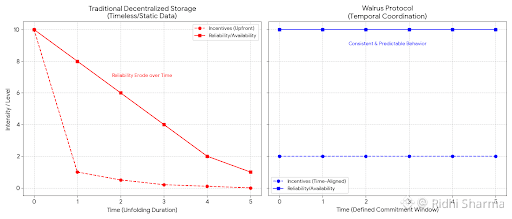
From a design standpoint, this turns Walrus into a temporal coordination layer. It synchronizes data usage, economic incentives, and network behavior along the same timeline. That synchronization is rare in decentralized infrastructure.
This is especially important for long-lived applications. AI models may rely on datasets months after creation. Media archives must remain available during specific licensing windows. Historical data must persist through governance cycles. Walrus makes these time-based requirements explicit rather than implicit.
Importantly, #walrus does not overreach. It does not promise infinite storage or eternal guarantees. Instead, it introduces clarity around duration. Data is not “forever” or “best effort.” It is available for this period, under these rules.
In my view, this is a sign of infrastructure maturity. Mature systems respect time. They define obligations, align incentives, and enforce behavior within clear temporal boundaries.
#walrus is not just storing data. It is teaching decentralized systems how to respect time and that may be one of its most enduring contributions.

