
In crypto, most attention is given to early ideas and long-term visions. Far less attention is paid to the transition phase the moment when a blockchain stops behaving like a concept and starts behaving like a system preparing for real economic responsibility. This is the phase where #Plasma currently sits, and it’s why I think the project deserves a fresh evaluation.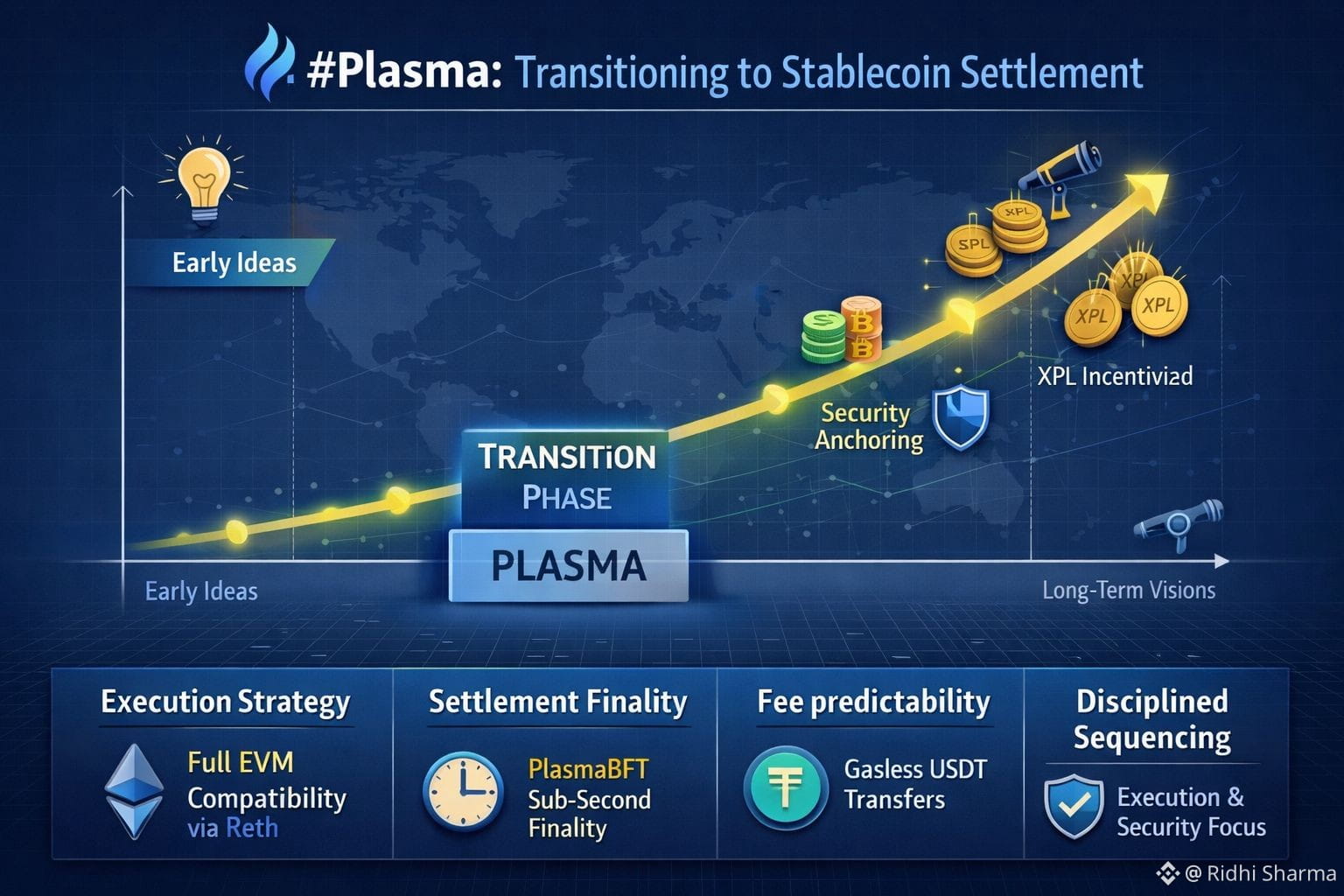
Rather than repeating what Plasma is, it’s more useful to look at what Plasma is doing now.
Stablecoins have already won the adoption race in crypto. That part of the story is settled. What remains unresolved is whether blockchain infrastructure is ready to handle stablecoins as a primary settlement mechanism rather than a secondary use case. Plasma’s recent positioning suggests that it is being built specifically for that responsibility.
Let’s start with execution.
#Plasma ’s full EVM compatibility via Reth is not just a technical choice it’s an execution strategy. Instead of asking developers and institutions to wait for new tooling or adapt to unfamiliar environments, Plasma aligns itself with what already works. This shortens the path from development to deployment and reduces operational risk.
That matters because settlement infrastructure cannot afford long feedback loops. Systems need to work predictably from day one.
Consensus design reinforces this readiness. PlasmaBFT’s sub-second finality doesn’t exist to win benchmarks; it exists to remove ambiguity. In settlement systems, ambiguity is expensive. Delayed finality introduces reconciliation overhead, compliance friction, and user uncertainty. Plasma’s approach eliminates those variables early.
The gas model fits this execution-first mindset as well. Gasless USDT transfers and stablecoin-first gas reduce dependency on volatile assets and simplify transaction flows. This is not about convenience it’s about ensuring that the cost structure matches the economic activity the chain expects to host.
As stablecoin settlement increases, fee predictability becomes operationally critical. Plasma treats this as a foundational requirement rather than an optional optimization.
Security anchoring to Bitcoin completes the execution picture. Instead of relying solely on internal assumptions, Plasma links its settlement assurances to an external, battle-tested network. This reduces long-term uncertainty and signals that the system is designed to operate under scrutiny, not just during growth phases.
Now let’s talk about XPL.
In many projects, the token narrative dominates early attention. With Plasma, $XPL appears deliberately understated. Its role is tied to validation, network participation, and security incentives. That positioning is consistent with a project focused on durability rather than rapid narrative cycles.
This matters because settlement networks fail when incentives drift. By tying XPL closely to operational roles, Plasma reduces the gap between token value and network health.
Another important signal in #Plasma ’s current phase is sequencing. Instead of aggressively expanding narratives or verticals, Plasma appears focused on aligning core components first: execution, finality, fee logic, and security. This sequencing suggests an understanding that trust is earned structurally, not rhetorically.
For users, this means fewer surprises. For developers, it means fewer assumptions. For institutions, it means fewer unknowns.
Educational exposure through platforms like Binance and Binance Square plays a complementary role here. At this stage, education isn’t about promotion it’s about setting correct expectations. When users understand what Plasma is optimized for, they evaluate it on the right criteria.
That benefits everyone. Users don’t expect features Plasma isn’t trying to deliver. Developers build with clarity. Institutions assess risk accurately.
What makes this phase compelling is that it’s quiet. Plasma isn’t trying to redefine crypto. It’s trying to prepare itself to carry real economic weight. That kind of preparation doesn’t always look exciting but it’s exactly what settlement infrastructure requires.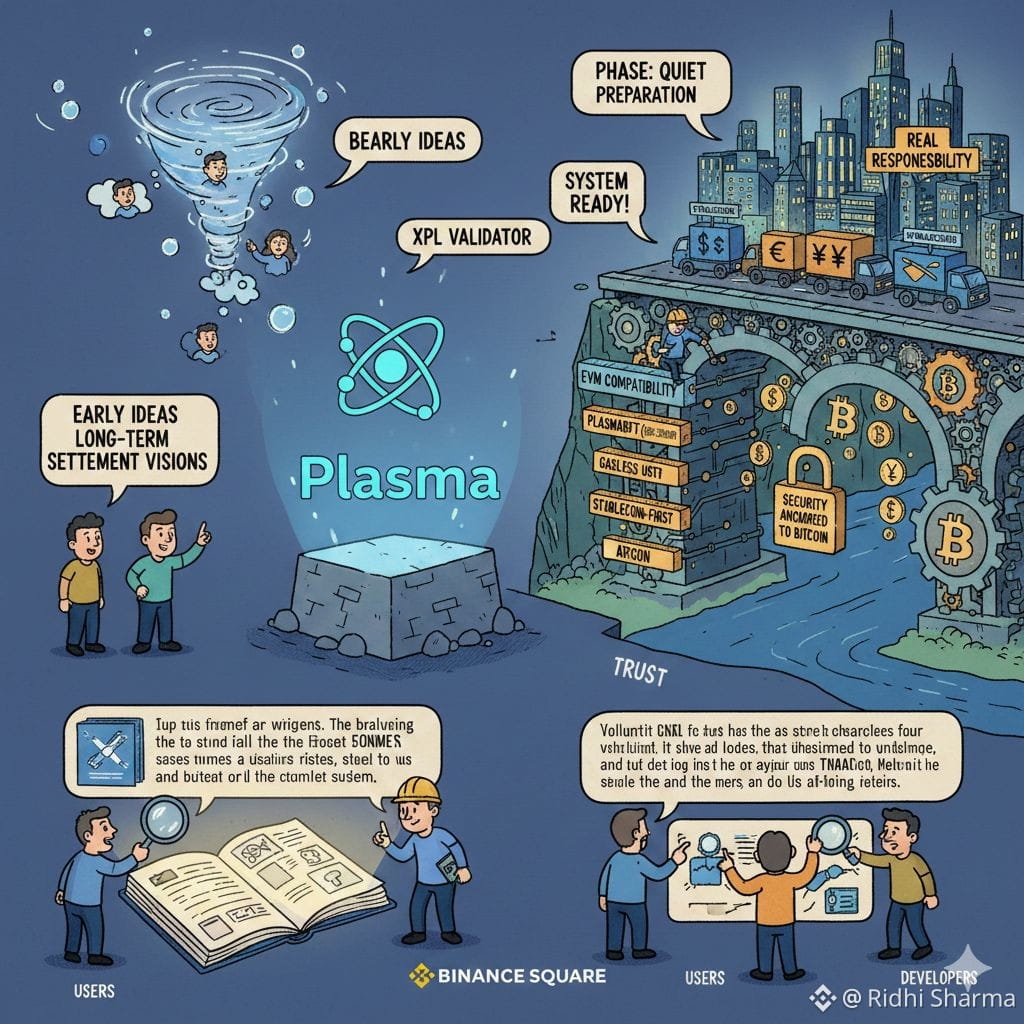
From my perspective, #Plasma ’s latest direction shows discipline. It prioritizes execution over expansion, alignment over acceleration, and readiness over reach. In a space where many projects rush visibility before stability, that restraint stands out.
And historically, the blockchains that last are the ones that take this phase seriously.

