

Walrus ($WAL ) is not just a DeFi token; it is a privacy-first, decentralized storage and transaction layer built on the Sui blockchain, designed to solve a critical problem: how to handle large data efficiently while keeping it verifiable, programmable, and censorship-resistant.
Traditional blockchains are excellent for computation and small on-chain state, but storing large files like game assets, AI models, or media is prohibitively expensive and slow. Walrus addresses this with programmable blob storage and erasure-coded distribution, creating a foundational layer for real-world Web3 applications.
Walrus works by splitting files into shards using RedStuff erasure coding, distributing them across many nodes, and allowing reconstruction even if some shards fail. Each blob is anchored on-chain via Sui objects, which record ownership, metadata, and expiry, giving developers programmable, secure access to large files without sacrificing decentralization.
This design ensures that developers and enterprises can build storage-intensive apps with blockchain guarantees, bridging the gap between Web2 performance and Web3 trust.
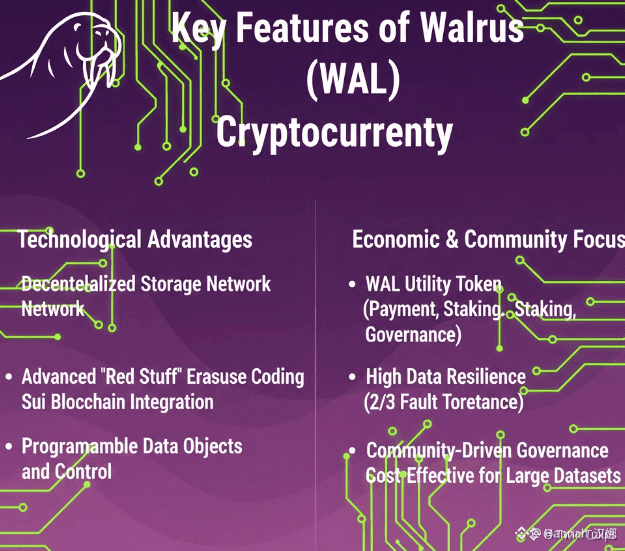
The protocol began as part of the Sui ecosystem and evolved through public testnets in 2024–2025, validating storage reliability, developer workflows, and staking economics. By March 2025, Walrus Mainnet launched, with over 100 decentralized storage nodes providing real storage, WAL token functionality, and staking governance.
Users could now store blobs, stake tokens, participate in governance, and interact with dApps in a privacy-preserving environment.
WAL token utility is structured and functional:
Storage Payments: Users pay WAL to store blobs, incentivizing node participation.
Staking and Delegation: Nodes stake WAL to join storage epochs; token holders can delegate and earn rewards.
Governance: WAL holders vote on protocol upgrades, pricing, and storage policies.
Incentive Alignment: Storage usage drives rewards, aligning token value with network activity.
Developer experience is central to the roadmap. Walrus offers CLIs and SDKs for JavaScript, Python, and more, enabling developers to integrate storage into apps without steep learning curves.
Storage can be accessed via HTTP/CDN, allowing hybrid Web2/Web3 deployment. Smart contracts on Sui can reference blobs directly, creating programmable, decentralized storage assets.
Real-world use cases illustrate Walrus’s structural edge:
NFT Metadata and Media: Large images, 3D assets, and dynamic art can be stored securely and retrieved on-demand.
Game Assets: Maps, avatars, and textures can be decentralized while remaining fast and reliable.
AI Data and Models: Datasets and model weights can be stored programmatically, enabling decentralized AI workflows.
Decentralized Web Hosting: Websites and apps can run fully decentralized, leveraging blockchain-verified storage.
Cross-Chain Availability: Storage proofs can serve multiple chains, enhancing interoperability.
The Walrus roadmap emphasizes expansion, performance, and ecosystem integration
Advanced Node Audits and Slashing: Ensures node reliability and uptime.
Developer Tooling Expansion: SDKs for mobile and web, lowering onboarding barriers.
Ecosystem Growth: GameFi, social apps, AI datasets, and media platforms are integrating storage.
Multi-Chain Integration: While anchored to Sui, Walrus aims to support Ethereum, Solana, and other chains.
Composability: Storage objects act as native assets within smart contracts, enabling programmable workflows.
Why Walrus matters today:
Capital is shifting from yield-focused DeFi to real utility infrastructure.
Web3 apps demand scalable, verifiable, programmable storage.
Users seek decentralized alternatives to centralized cloud storage.
Multi-chain interoperability is essential for modern dApps. Walrus occupies this intersection, providing cost-efficient, censorship-resistant storage that also integrates with smart contracts.
Edge over competitors:
RedStuff Erasure Coding: Lower replication cost without compromising reliability.
Programmable Storage: Storage can interact with smart contracts, unlike simple pinning solutions.
On-Chain Metadata & Gas Efficiency: Efficient Sui anchoring reduces storage costs.
Full Stack Integration: Wallets, SDKs, CLIs, and governance are all included.
Risks remain:
adoption depends on Sui ecosystem growth, storage demand, and node participation. Competition from Filecoin, Arweave, or centralized cloud providers could challenge traction. WAL token liquidity and economic alignment with storage demand are crucial for sustained network health.
Walrus’s impact goes beyond price action. It turns storage into a blockchain primitive, lowers cost barriers for developers, enables new classes of applications (gaming, AI, social platforms), and bridges Web2/Web3 adoption. It is foundational infrastructure for the next generation of decentralized applications.
In short, Walrus is a practical, programmable, and privacy-preserving storage layer that aligns incentives for users, developers, and node operators. Its roadmap focuses on real utility, adoption, and integration, making it a critical building block for the decentralized web.