



Walrus Protocol has become something I actually rely on every week in February 2026 — my own on-chain reputation archive. I got tired of my contributions being scattered: one DAO knows my votes, GitHub has my code commits, some forum tracks my helpful posts, but there’s no single, tamper-proof record that follows me around. Centralized platforms can shadow-ban you, delete history, or just vanish. Walrus lets me keep verifiable proof of everything I do in Web3 as immutable blobs I control.
I started small. Every time I do something meaningful — submit a proposal in a DAO, push a useful code commit, resolve a bug bounty, write a detailed forum answer, or complete a task in a community program — I save proof: screenshot of the transaction, Git commit hash, bounty completion link, or just a text summary. I bundle it with a timestamp and any relevant context, zip it if needed, encrypt sensitive parts with Seal (like private feedback), and upload as a blob through the dashboard. Red Stuff spreads it across nodes with 4–5x replication — my entire 2025–2026 contribution history (around 15 GB so far) costs me pennies per month. The stable USD pricing lock-in means I don’t stress about $WAL price swings.
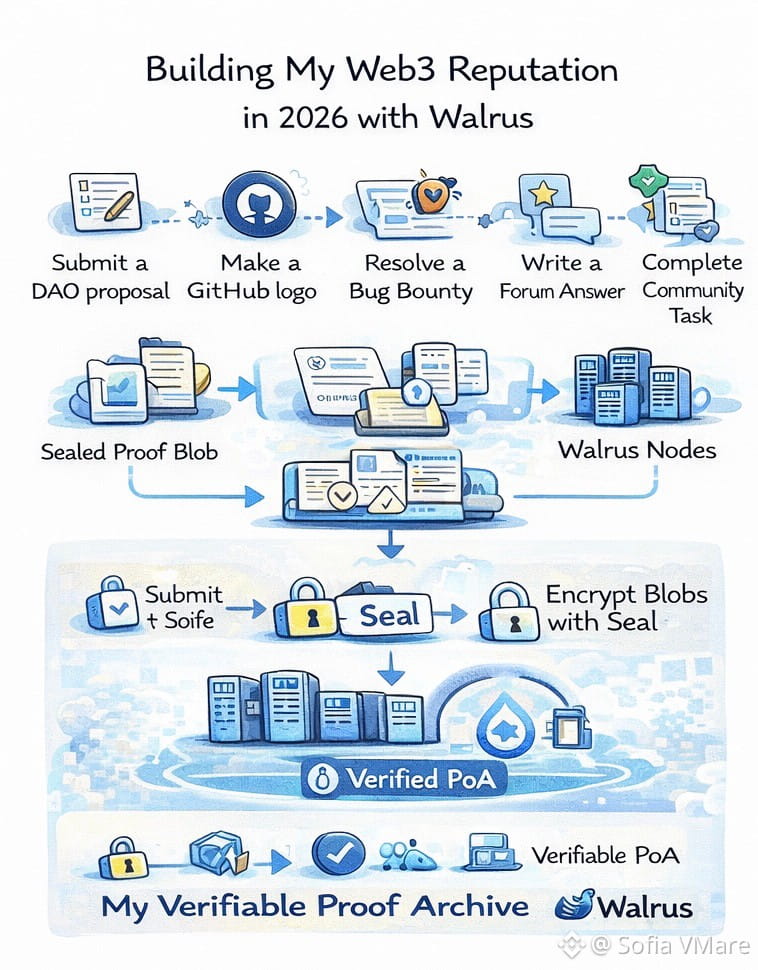
The PoA certificate on Sui is what makes it feel real. Each blob gets an on-chain receipt saying “this proof of contribution existed on February 3, 2026, and hasn’t been altered.” I can point to the blob ID and PoA when a new DAO asks “who are you?” — they verify instantly without trusting off-chain screenshots or my word. I can add new proofs thanks to versioning: January's commits remain as v1, while February's DAO votes as v2. Everything is still accessible and verifiable.
Secrecy is maintained by seal encryption. Before uploading, I encrypt client feedback from internal DAO conversations or freelance gigs; only I have the key. Upcoming zk-proofs will let me reveal aggregates like “92/100 reputation score from 150+ verified actions” without showing every detail — perfect when applying to a new community or pitching a collaboration.
I’ve already used it in practice. Last month a new DAO I joined asked for proof of past contributions — I shared my blob ID. They checked PoA, saw my voting history and code commits, and gave me higher initial voting weight. Another time I linked a blob to my freelance profile — a client verified my 4.8/5 average from past gigs without me sending screenshots (zk-proof showed the aggregate). It saved time and built instant trust.
For me in Web3, reputation is everything — but it’s always been fragmented and fragile. Walrus changes that. I pay tiny $WAL fees to store proofs, nodes stake $WAL to host them and earn rewards, and the whole system feels aligned. The Walrus Foundation RFP is funding tools like reputation SDKs and zk-proof templates, so it’s getting easier for non-devs like me to set up.
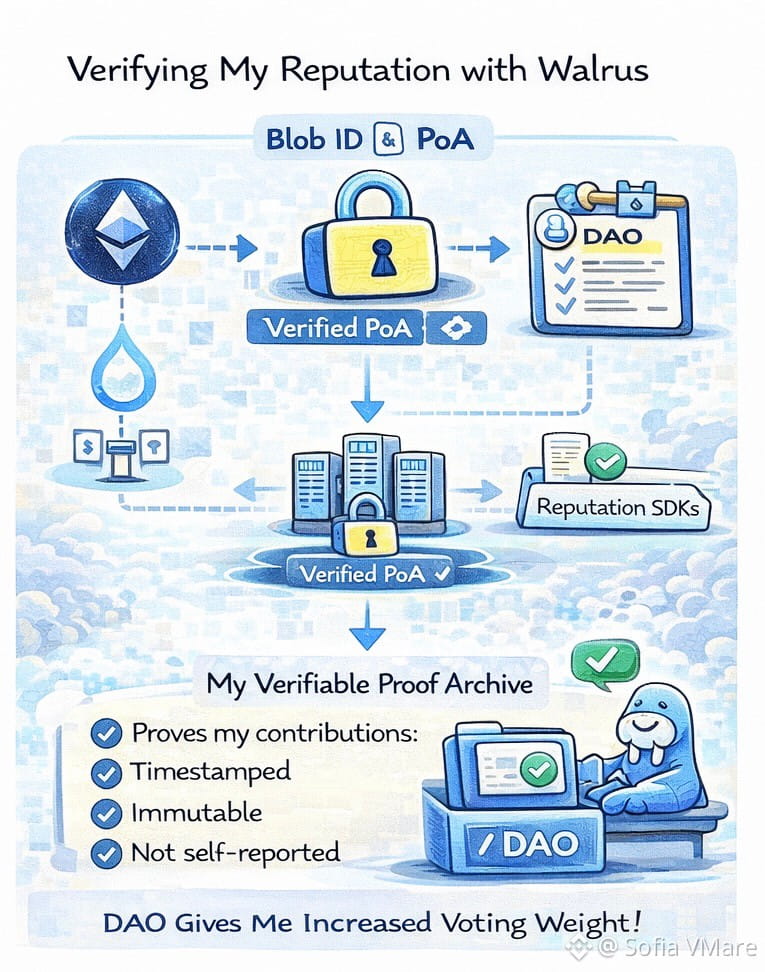
In a year full of sybil attacks and trust issues, having a personal, portable, verifiable reputation feels essential. Walrus isn’t the reputation app — it’s the storage and proof layer making it possible. If you’re active in DAOs, freelancing, or contributing anywhere in Web3 — try archiving one small proof: upload a screenshot of a recent contribution, save the blob ID, test verification. You’ll see how different it feels to have a permanent record that belongs to you, not a platform.
It’s not hype; it’s just working infrastructure that gives you control over your Web3 identity. Walrus is letting me build a reputation that follows me, one verifiable blob at a time.