


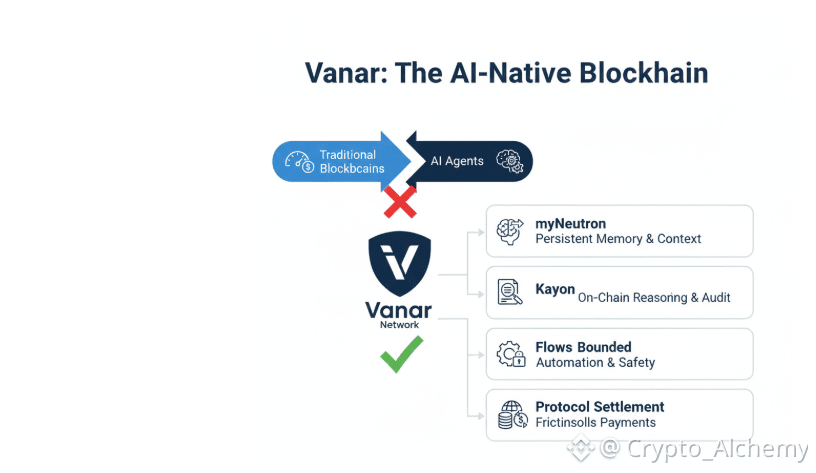
What happens when AI agents need to transact but blockchains only understand human wallet clicks? This incompatibility sits at the center of why blockchain AI projects generate hype but rarely deliver utility. Vanar confronted this mismatch directly by asking what intelligent systems actually require rather than what sounds impressive in marketing materials.
Traditional chains measure success through transactions per second. Faster processing. Higher throughput. Better benchmarks against competitors. These metrics matter when humans initiate every action manually. But AI agents operate differently. They need to remember previous interactions across sessions. They need to explain their reasoning when audited. They need to execute automatically within safe boundaries. They need to settle payments without manual wallet approvals.
Remove any single requirement and the entire AI use case collapses. An agent without memory cannot build on past learning. An agent without explainable reasoning cannot satisfy compliance requirements. An agent without bounded automation requires constant human supervision defeating the purpose of autonomy. An agent without payment settlement cannot participate in real economic activity.
Vanar built each capability as a live product rather than a roadmap promise. myNeutron provides persistent memory where AI systems maintain context across interactions. Your financial planning agent remembers your goals from previous conversations. Your gaming companion learns your preferences over time. Your business automation builds institutional knowledge rather than starting fresh every session.
Kayon delivers on chain reasoning with full audit trails. When an AI makes a decision the logic path records permanently. Enterprises can examine automated choices. Regulators can verify compliance. Users can understand why systems behaved as they did. This transparency layer transforms AI from black box mystery into accountable tooling suitable for serious deployment.
Flows enables bounded automation where agents act independently within predefined limits. Full autonomy creates unacceptable risk exposure. Pure manual control eliminates efficiency gains. The middle ground allows useful automation while humans retain meaningful oversight. This balance matches what enterprises actually need rather than what sounds revolutionary in theory.
Payment capability at the protocol level completes the stack. AI agents operating in real economies must settle transactions that satisfy regulatory frameworks globally. Bolting payments onto application layers creates friction that prevents agents from closing economic loops efficiently. Vanar treats settlement as foundational primitive available to every agent on the network.
The Base expansion demonstrates strategic clarity about where adoption happens. AI native capabilities trapped on isolated chains limit potential impact unnecessarily. Base brings established developers, existing liquidity, and proven user communities. Vanar brings AI readiness that Base lacks natively. The combination creates positioning neither achieves alone.
VGN and Virtua provide current proving grounds where these capabilities generate real usage today. Gaming and metaverse applications create transaction volume. Brand partnerships bring mainstream distribution. Actual users interacting with shipping products inform development priorities through behavior patterns rather than assumptions.
VANRY value accrual ties directly to this activity. As AI agents increasingly require memory, reasoning, automation, and settlement the demand for Vanar capabilities grows proportionally. This differs fundamentally from tokens dependent on narrative cycles or temporary incentive programs. Readiness creates sustained demand while hype creates temporary spikes.
