


The first report didn't mention money.
It came in as a gameplay complaint. Someone said an item "activated twice." No clip. No hash. Just a line that sounded defensive, like they were already preparing to lose the argument. On Vanar, that tone usually means the system did exactly what it was allowed to do.
Nothing forced a breath.
Once Vanar's wallet-less sessions ( Frictionless onboarding ) get smooth enough, players stop treating actions as commitments. They tap the way they tap in any normal loop... fast, casual, half-attentive. No pause. No ritual. No clean moment where intent has to step forward and announce itself. Gas abstraction kept the surface quiet. The session kept moving.
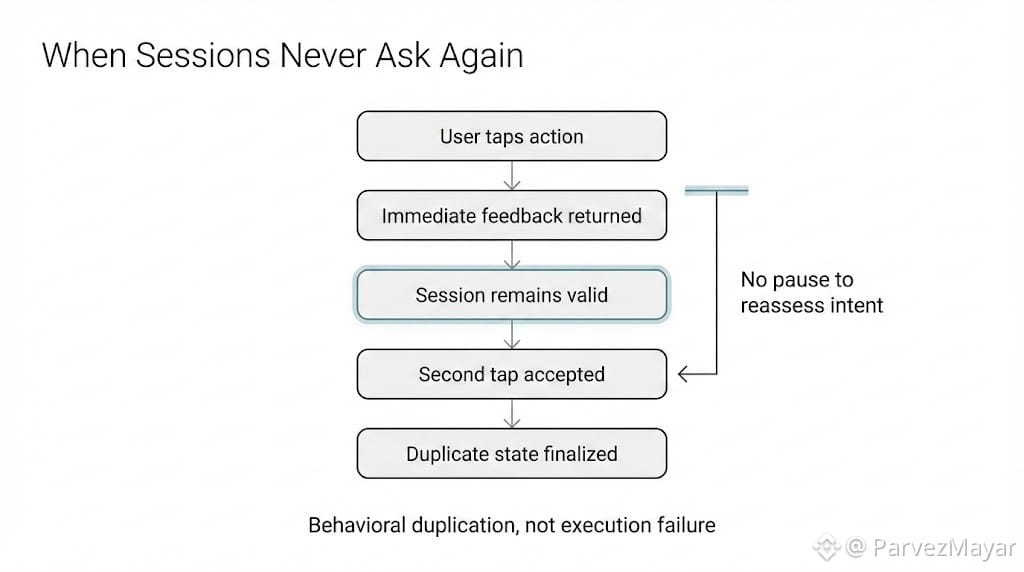
The problem was not the second tap. It was the first one not feeling final.
Inside the Vanar's session, everything looked normal. The action resolved quickly. Feedback landed. Inventory updated. Then the player did what players do when the interface doesn't push back... tried again. Same button, same muscle memory... same context. The system didn't see confusion. It saw a session permission that never expired.
This is the part product teams celebrate... until support gets weird. When wallet prompts disappear and explicit confirmations vanish, the cost of hesitation drops to zero. So does the friction that used to catch ambiguous intent before it became state.
By the time anyone looked closely, the Vanar chain state was clean. Finality had already landed. Twice. Nothing to "undo" without inventing a story no one actually lived through. From the player's view, it felt inconsistent. From the chain's view, it behaved perfectly.
That gap is where support ends up living.
Game session finality closes fast on Vanar. Great. It just doesn't care what you meant. When explicit confirmation isn't asked, the system inherits all the ambiguity the user never had to process. Was the second action a mistake? A retry? A deliberate choice? In a Virtua-style metaverse flow, it can be even worse... people are acting inside the same shared moment, reacting quickly, tapping again because the world didn't pause to tell them it "counted."
The chain can't tell. It was never supposed to ask.
As a studio PM, this is where things get ugly. You can't patch it with copy without putting friction back into the loop. You can't blame users for behaving exactly the way the experience trained them to behave. And you can't lean on the old wallet confirmation moment to slow things down, because you removed it on purpose.
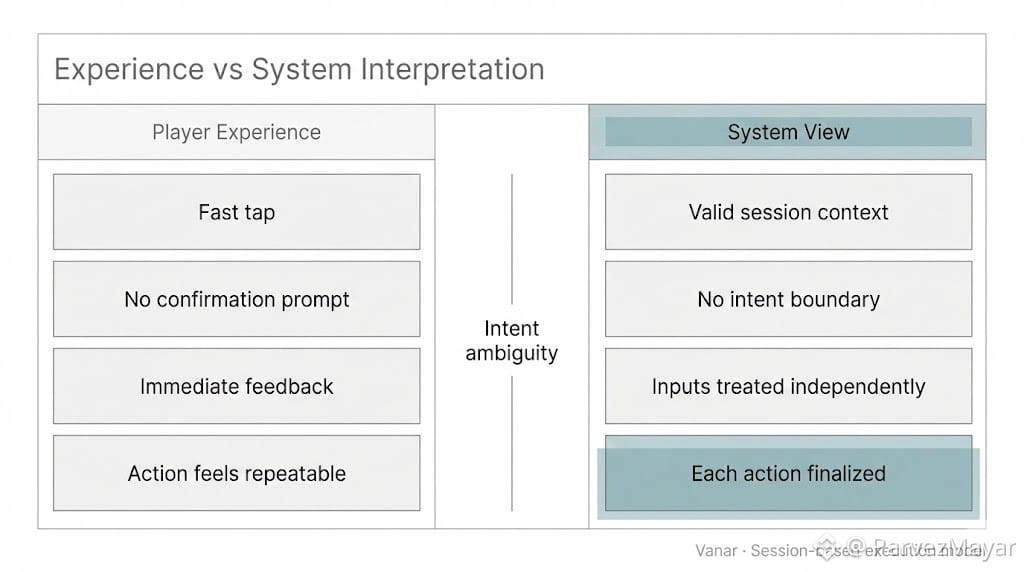
So the application starts absorbing uncertainty instead.
Cooldowns appear quietly. State checks get defensive. Actions that used to be idempotent start carrying memory. Not to punish speed... just to keep speed from turning into accidental duplication. Vanar keeps finalizing. The session-based flow keeps accepting inputs. The app layer starts guessing.
Gas abstraction shifts behavior before teams admit it has. If users never explicitly say "yes," every action looks like "yes." Even the ones that weren't.
And nothing breaks loudly. No obvious failures. No clean error trail. Just edge cases that feel unfair. Tickets that read like arguments: "It worked before." "I didn't mean to." All technically true. All hard to prove.
Vanar doesn't give you the old permission ceremony to hide behind. Wallet-less sessions remove hesitation, but they also remove the only clean moment where intent used to get restated.
So teams write intent back in with code. Cooldowns. Confirm windows disguised as animation. "Anti-abuse" checks that are really "please don't double-tap." Support still gets the disputes. The chain still finalizes. And the only thing left to argue about is whether the system guessed right.
That's not a UX bug. That's the new surface area.