- Follow our account @DrZayed for the latest crypto news.
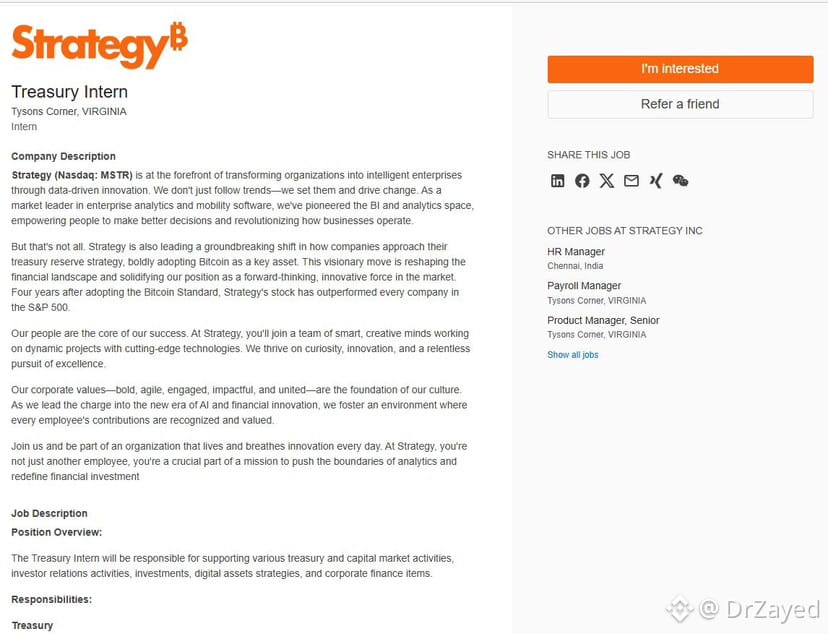
The modern corporate treasury department has undergone a profound transformation over the last decade. Once viewed primarily as a back-office administrative function focused on bank reconciliations and basic cash management, it has emerged as a central nervous system for strategic decision-making. At a firm like Strategy, the role of a Treasury Intern is designed to reflect this evolution. This position sits at the intersection of traditional capital preservation and aggressive financial innovation, offering a unique vantage point into how a global enterprise maintains its liquidity while simultaneously exploring the frontier of digital assets and capital markets.
To understand the scope of this internship, one must first understand the fundamental mandate of treasury: the optimization of a company's financial resources. However, at Strategy, this mandate is interpreted through a forward-looking lens. The intern is not merely a data entry clerk but a junior strategist tasked with supporting five critical pillars: capital markets, investor relations, investment management, digital asset integration, and general corporate finance.
### Capital Markets and Liquidity Management
The bedrock of any treasury department is the management of liquidity and the firm’s interaction with global capital markets. For a Treasury Intern, this involves a deep dive into the mechanics of cash flow forecasting. Predicting when cash will enter and exit the firm is a complex puzzle influenced by seasonal cycles, geopolitical shifts, and internal operational requirements. The intern assists in developing models that ensure the firm always maintains a safety buffer, preventing the need for expensive, last-minute borrowing.
Beyond daily cash positioning, the intern gains exposure to the broader capital markets. This includes supporting the execution of debt issuances or share buyback programs. When Strategy decides to raise capital through the bond market, the treasury team must analyze current interest rate environments, credit spreads, and investor appetite. The intern plays a supporting role in this by compiling market data and assisting in the preparation of credit rating agency presentations. Understanding how a firm manages its weighted average cost of capital (WACC) is a primary learning objective, as it dictates the hurdle rate for every other investment the company makes.
### Investor Relations: The Bridge to Wall Street
The second pillar of the internship is Investor Relations (IR). This function acts as the primary communication channel between the company and its shareholders, as well as the broader financial community. A Treasury Intern in this space learns the art of financial storytelling. They help prepare the materials for quarterly earnings calls, which are the high-stakes events where a company’s performance is scrutinized by analysts and institutional investors.
The intern’s work involves quantitative analysis—ensuring that the financial metrics presented in the slide decks are consistent with the official filings—and qualitative synthesis. They may be tasked with monitoring "street" sentiment by reading and summarizing research reports from investment banks. By tracking what analysts are saying about Strategy versus its competitors, the intern helps the IR team anticipate tough questions and craft responses that accurately reflect the firm’s long-term value proposition. This exposure is invaluable for any aspiring finance professional, as it demonstrates how market perception can directly impact a company’s valuation and cost of capital.
### Investment Strategy and Portfolio Oversight
While a significant portion of treasury is focused on ensuring money is available to pay the bills, another significant portion is focused on what to do with "idle" cash. Strategy manages a robust investment portfolio designed to maximize yield without compromising safety or liquidity. The Treasury Intern supports the oversight of these assets, which may range from low-risk government securities and money market funds to more sophisticated fixed-income instruments.
In this capacity, the intern learns about risk management frameworks. They assist in monitoring the credit quality of the banks and counterparties the firm does business with. If a specific financial institution's credit rating is downgraded, the intern might be part of the team that decides whether to move funds to a more secure location. This role provides a practical application of the "Capital Asset Pricing Model" and other foundational finance theories, as the intern sees firsthand how the firm balances the trade-off between risk and return in a fluctuating economic environment.
### The Digital Asset Frontier
Perhaps the most exciting aspect of the internship at Strategy is the involvement in digital asset strategy. As the financial world begins to embrace blockchain technology, Strategy is positioning itself at the forefront of this shift. This goes beyond simple speculation on cryptocurrency prices; it involves a fundamental reimagining of how a corporate treasury can operate using decentralized finance (DeFi) tools and distributed ledger technology (DLT).
The intern supports research into the tokenization of real-world assets and the potential for using stablecoins for cross-border settlements. Traditional international wire transfers can take days and incur significant fees; digital assets offer the promise of near-instant, 24/7 liquidity. The intern helps the team evaluate the regulatory landscape, security protocols, and operational hurdles of integrating digital assets into a traditional corporate balance sheet. This requires a unique blend of traditional financial literacy and a "tech-first" mindset, as the intern investigates how smart contracts can automate treasury workflows and reduce counterparty risk.
### Broader Corporate Finance and Strategic Projects
Finally, the Treasury Intern is a generalist support resource for broader corporate finance initiatives. This might include assisting in the financial modeling for potential mergers and acquisitions (M&A). When the firm looks to acquire a competitor, the treasury team must evaluate how to fund the deal—whether through cash on hand, new debt, or the issuance of new equity. The intern helps gather the necessary data to run these scenarios.
Additionally, there is a heavy focus on process improvement and automation. Modern treasury is increasingly driven by data science. An intern who can use tools like Python or SQL to automate a manual reporting process is highly valued. Whether it is creating a dashboard to track foreign exchange (FX) exposure or building a tool to monitor real-time interest rate movements, the intern is encouraged to find ways to make the department more efficient.
### Conclusion and Professional Development
The Treasury Internship at Strategy is designed to be a rigorous, high-impact experience. It moves the participant through the entire lifecycle of a dollar—from its acquisition in the capital markets to its deployment in operations, its communication to investors, its growth through investment, and its eventual evolution into digital formats.
By the end of the program, the intern will have developed a toolkit that includes technical proficiency in financial modeling, a strategic understanding of market dynamics, and a forward-looking perspective on the future of money. This role is not just about supporting a department; it is about developing the next generation of financial leaders who are comfortable operating at the intersection of traditional finance and the digital economy. It is a career-defining opportunity for those ready to navigate the complexities of global capital in a rapidly changing world.